Those who were buried anonymously
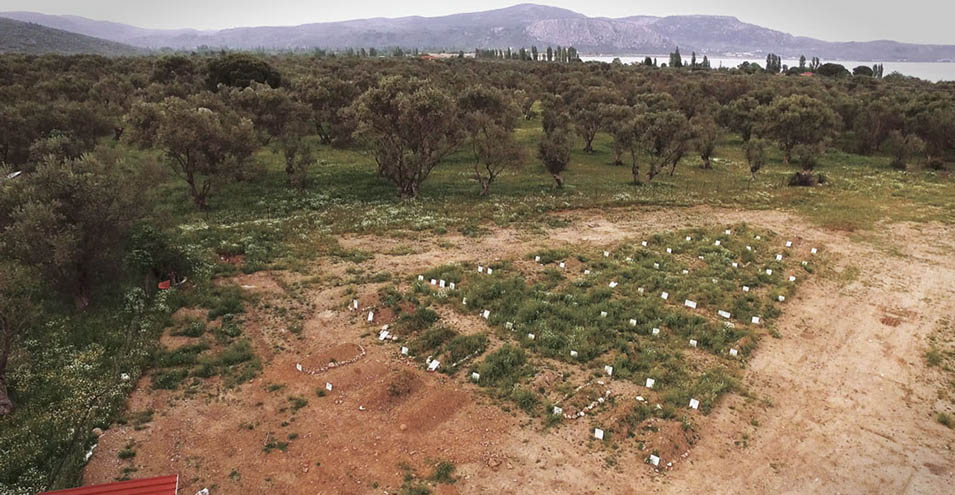
Since 2014, more than 1,250 nameless men, women and children have been buried in unmarked graves in 70 locations in Turkey, Greece and Italy. All of them wanted to cross the Mediterranean and reach Europe, with the hope of a new life.
According to a report by the International Organization for Migration, about 8,000 people have died trying to reach Europe in the past two years.
Most of them died at sea, but many were washed ashore, on the shores of Greece, Italy, and Türkiye.
But who are these dead? Where are they buried? How are their helpless families on the other side of the world supposed to know whether their loved ones are alive or drowned?
Since 2014, 10 people a day have died crossing the Mediterranean Sea.
On average, at least one person is buried in an unmarked grave every day.
Farouk's story
Farouk's beard turned white in six months.
It was October 28th that he spoke to his brother Ghulam for the last time.
Ghulam Nabi Pakkar is an animal surgeon. The Taliban had threatened him. He decided to go to Europe with his wife, three sons, and a daughter.

Farooq, Ghulam's brother, who lives in Herat, said he had spoken to his brother on the phone when he arrived in Turkey. He said they were waiting to board a smuggler's wooden boat to take them to the Greek island of Lesbos. He said Ghulam promised to call back when they arrived.
The Ghulam family was a drop in the ocean of migrants. That same year, more than 500,000 people had tried to reach Lesbos from Türkiye.
When several hours passed and there was no news of Ghulam, Farouk called the smuggler who was supposed to take them. The voice on the other end of the line said that the boat had capsized.
The smuggler also reassured Farouk that most of the passengers had been rescued, and that he should wait for Ghulam to call him back. The call never came.
A little later, Farouk saw a photo of his brother, his body lying on the beach of Lesbos.
Ten kilometers to Europe

That night, a total of 242 people were rescued from the boat, but dozens were never found.
The bodies of Ghulam and his wife were found, but their four children – Tamim, 16, Samim, 14, Najla, 12, and Hasim, 10 – were not found.
Farouk still hopes that the children have made it out alive in Europe. At the same time, he knows that they may have drowned and, since their identities are unknown, may have been buried in an unmarked grave.
Where are the dead buried?
More than 1,000 migrants who drowned in the Mediterranean are buried in unmarked graves in Italy, Greece and Türkiye.
Sometimes the body of a drowned person washes up on the beach days, even weeks, after the incident. In such cases, the body is badly damaged and difficult to identify. Sometimes entire families die in one accident, and no one is left to identify the bodies.
It is not easy to get an exact figure for the number of migrants buried in unmarked graves. The BBC's research is based on available data and interviews with local officials. So the figures are approximate.
Some local authorities in Greece and Türkiye say the number of migrants and bodies being pulled from the sea is so high that they cannot keep an accurate count of all the burials.
Furthermore, the BBC's research was limited to the northern Mediterranean countries, namely Turkey, Greece and Italy. Tragedy has also been reported in the southern Mediterranean. It is therefore possible that migrants have also been buried in unmarked graves in Libya, but given the security situation in that country, it is not possible to collect information.
Also, 880 unmarked graves in the Kilis cemetery in Istanbul were not included in the final count because government officials could not confirm how many of them were refugees who died trying to reach Europe.

Central Mediterranean route
The deadliest accidents occurred on the route from North Africa to the Italian island of Lampedusa.
The route to Malta, Lampedusa, and Sicily is longer and more dangerous than the route through Türkiye and Greece across the Aegean Sea, and the boats on the former route are generally more inconvenient and crowded.
The bodies of most of those who drowned are never found. Of the 800 people on board the ship that capsized off southern Italy on April 18, only 28 survived, and 120 bodies were recovered. No other disaster has claimed so many lives.
Eastern Mediterranean route
About eighty percent of the one million migrants and asylum seekers who arrived in Europe (by sea) in 2015 came via the Eastern Mediterranean route, that is, from Türkiye to Greece.
Most people heading to Greece take the relatively short route from Türkiye to the islands of Lesbos, Kos, Chios or Samos.
The island of Lesbos is no more than ten kilometers from the Turkish coast, yet hundreds of people have drowned in rubber or wooden boats on this short journey in the Aegean Sea.
Mohammadi Nain, an Afghan volunteer who was once a refugee himself, arrived on the island of Lesbos from Turkey in a pedal boat in 2002. “There is very little information about those who drowned,” he says.
“Everyone – NGOs, governments, volunteers – is focused on those who survived and reached Europe. Hardly anyone is paying attention to those who drowned.”
Mohammad is one of several Afghan volunteers trying to help those searching for their missing loved ones on the island of Lesbos.
“We have virtually no information about the missing and those buried with a number,” he says.
“The only thing we know is that they came from Türkiye and disappeared.”
In search of children
After seeing his brother in the photo, Farouk called their sister, who lives in Germany. She and her husband went to Lesbos and identified the bodies of Ghulam and his wife.
But there was no sign of the children.
“As I was browsing the internet, I found a photo of a volunteer holding a little boy. The boy looked just like one of my nephews, and he seemed alive.”
Farouk tried to find the volunteer, but was told that he had left Lesbos shortly after the incident. Farouk's sister and her husband were able to return their brother's wife's body to Afghanistan.
After the accident that claimed Farouk's brother, the main cemetery on Lesbos was full. As a result, local authorities set aside a plot of land – in the village of Kato Tritos, next to an olive grove – for the burial of migrants.
Ghulam was among the first to be buried at Kato Tritos. Since then, more than 70 people have been buried there, more than half of them in unmarked graves.

Farouk wanted to find out what happened to his nephews. Earlier this year, he traveled to Türkiye to see if the children had been taken there.
“The accident happened between Türkiye and Greece. My brother and his wife were found in Greece, but my nephews were not. I thought maybe the current had carried them back to Turkey.”
“I searched for them for about 1,800 kilometers. The hospital, the coast guard… I went everywhere. I had their photo with me. But I found no sign of them.”

A name, not just a number.
The procedure for registering unmarked migrant bodies in Türkiye, Greece, and Italy is similar. They take photos of the body, examine it to see if it has any markings to register, and finally take a DNA sample.
But this practice is not always followed. For example, on the Greek islands, where there is no coroner, as locals say, sometimes anonymous migrants are buried without being registered.
Theodoros Nosias is a forensic pathologist on Lesbos. He is sometimes called upon from surrounding islands to work on bodies found at sea or washed ashore.
“Sometimes people who have lost a family member or a loved one call me,” he says. “They come to the hospital to look at the photos and identify the body. Sometimes they send their own DNA sample to the lab to see if there is a match.”
In Italy, the National Office for Missing Persons is responsible for this process. According to Mr. Pichitelli, at least two-thirds of its work is currently dedicated to identifying missing migrants.
Once all the information on a victim is collected, it is put into a folder and assigned a case number. This number is essentially the immigrant's new identity, which is engraved on their grave.
We want the dead to be buried with the dignity of a human being, with a name and not a number. Vittorio Pichitelli, National Office for Missing Persons, Italy
“We make a notebook for each person with all the relevant information, including objects we may have found with the body,” explains Mr. Pichitelli. “We send this notebook to some NGOs and police departments so that if anyone is looking for it, they can find it.”
Mr. Pescitelli adds: “We are working day and night to restore the names of these men, women and children who were swallowed by the sea. These people have lost everything: their lives, their futures, their families and even their identities.”
"They have become ghosts. Their human dignity has been lost. We are trying to restore at least their human dignity by putting a name on their grave instead of a number."
Hope in DNA
In search of his nephews, Farouk traveled to Lesbos, not only to Türkiye, where he met Nain, the Afghan volunteer we mentioned earlier.
“When it arrived, I took it to the police station, the hospital and the main refugee camp in Moria, but we found no sign of the children,” says Niin.
“But I knew that after that boat capsized, there were many unmarked children buried in the new cemetery. So I helped him send a DNA sample to Athens, so we could find traces of his nephews.”
Farouk is still waiting for the results of the DNA test.
"It's very important to me to know if they're dead or alive," he says. "If we find out they're dead, at least we'll know they're sleeping peacefully somewhere."
Farooq has been back in Afghanistan for a while and wants to get a visa again to go to Greece. But European countries do not easily grant visas to Afghans. Last year, when he was granted a visa, it was an exception.
I wish I could go back to that time and lock the door on him so he wouldn't leave. Farouk Pakkar
Still, Farouk is determined to find out what happened. He has even sold a piece of land he inherited to pay for the continued search for his nephews.
He says, “If they let us return the bodies, I will return them at my own expense.”
"We have lost six members of our family. Our family and our lives have been destroyed."
Farouk has kept photos of Ghulam, Tamim, Samim, Najla, and Hasim so that he can look at them every day.
“I told Ghulam to stay in Türkiye, but he insisted on leaving. I wish I could go back in time and lock the door on him so he wouldn’t leave.”
How was the data collected?
The BBC investigated a number of unmarked graves in Italy, Greece and Türkiye in March and April 2016.
The sources of the research were local institutions and statements from officials, but in many cases the figures are approximate. Some migrants may have been buried in unmarked graves in Libya, but poor security conditions make it impossible to collect data from there.
The figures for migrants who have died or are missing come from the International Organization for Migration's Missing Migrants Project, which counts migrants who have died or gone missing outside the borders of a country or en route to another.
In the case of migrants crossing the Mediterranean to Europe, the missing are generally considered to have drowned. The International Organization for Migration says that data on deaths along the way is difficult to collect and that the figures are approximate. For more information on the Missing Migrants Project’s research methodology, see: http://www.missingmigrants.iom.int/methodology
The locations marked on the map are sometimes approximate.
A note on the use of terms: The BBC uses the term "migrant" for all those who have moved to another country and whose legal asylum process has not been completed, including those who have fled war-torn areas like Syria and whose asylum is usually accepted, and those who have migrated in search of work and a better life, whom governments sometimes call economic migrants.