The second meeting of the Iran Prosperity Project on how to rebuild Iran by experts
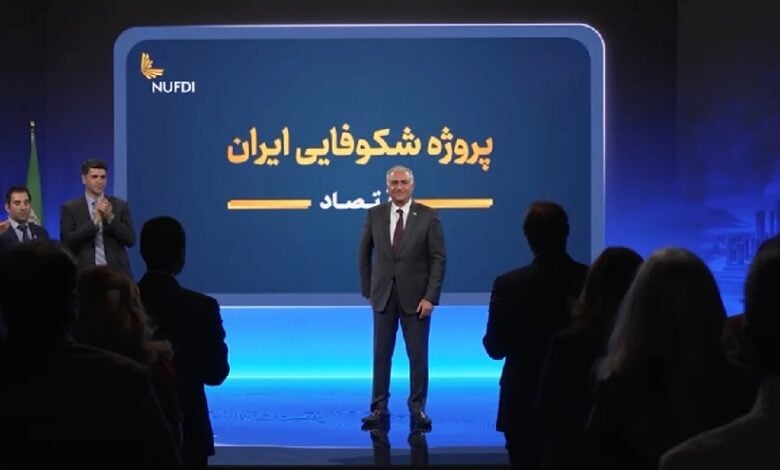
The Iran Prosperity Project, with the participation of experts in various fields, has so far been held in two meetings, which were broadcast on the Menuto satellite network on Thursday and Friday.
Prince Reza Pahlavi considers the Iran Prosperity Project to be a roadmap for rebuilding Iran after the end of the Islamic Republic, launched with the aim of restoring development and prosperity throughout Iran, and this project is also a commitment to the Iranian nation.
At this meeting, experts announced a summary of their plans in the fields of economy, trade, market and education for the reconstruction of Iran during the transition period from the Islamic Republic and the period of stability of the new government. Kamran Khansarinia, Vice President of the Nofadi Organization, stated at this ceremony regarding the cooperation of Iranians abroad in Nofadi: “Even though we live far from Iran, every day we wake up we think about Iran and Iranians. The question has arisen: if the Islamic Republic goes, who will replace it?”
Continuing his remarks, he referred to a part of Ferdowsi's Shahnameh story that deals with the overthrow of Zahhak and added: "If Zahhak leaves, Fereydoun will come; but Fereydoun will not come alone, but will come to Iran with specialists and researchers."
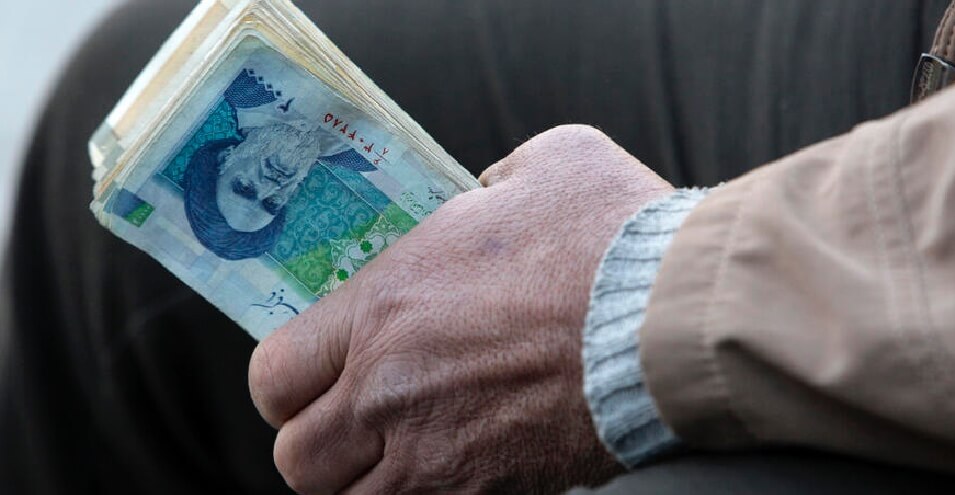
Economist and university professor Mohammad Reza Jahanparvar also spoke about Iran's economic situation at the meeting: "Iran's gross domestic product last year was about $400 billion, about 25 percent of which is dependent on government spending. Government tax revenues have also increased in recent years, as oil and gas exports have decreased due to sanctions, and the government's dependence on tax revenues has increased from 23 percent in 2021 and 2022 to about 46 percent. At the same time, transfer payments, consumer protection, and other government services have also decreased."
He also pointed to the problems in Iran and added: "Despite the problems in the Iranian economy, fundamental changes in the economy cannot be made within 100 to 180 days after the overthrow of the Islamic Republic, but a set of solutions can be implemented to improve the economy. Maintaining public trust, continuing government services and functions, and negotiating with the international community to reduce the burden of international sanctions are some of the short-term solutions for the transition period. Given that during this period, the government has changed and the aggressive foreign policy of the Islamic Republic has ended and there is no burden on the private sector, this transformation will lead to economic openings for Iran."
Regarding financing, he also noted: "During the transition period, the liquidation of harmful and inefficient institutions of the Islamic Republic and the placing of some state and quasi-state enterprises under the supervision of the interim administration will lead to a reduction in costs through budget simplification."
Jahanparvar also emphasized tax reforms and continued: "Currently, the value-added tax has created a heavy burden on the people and undesirable taxes have been imposed on people's assets. The increase in inflation has caused the price of assets to rise, without increasing the value of the wealth of the asset owner, but the tax on the nominal price of the asset has increased. In such circumstances, this type of tax should be eliminated to prevent further economic pressure on the people, especially the middle and lower-middle income groups. It is also possible to attract foreign investment by creating tax incentives. In addition, by making changes to the laws, Iranian businesses operating in neighboring countries can be brought back to the country."
Siamak Javadi, a finance professor at the University of Texas, also explained the necessity of Iran joining the Financial Action Task Force at the meeting. He said: "Corruption exists in many countries around the world, but in Iran the type of corruption is different, and corruption in Iran is completely systematic and widespread. According to the World Bank's indicators, Iran is one of the most corrupt countries in the world. One of the results of this widespread corruption can be seen in Iran's banking network. Currently, the Central Bank has given many loans that have not yet been repaid to this bank, and this bank has suffered significant losses. The lack of independence of the Central Bank is one of the most important problems in Iran's financial system, and this bank has effectively become the government's Qarz-ol-Hasanah Fund."
Referring to Iran's non-membership in the Financial Action Task Force (FATF), he added: "Iran is on the blacklist of this group. Although for a very short period during Rouhani's presidency, the Islamic Republic held talks with this group and made promises, then Iran was placed on the gray list of this group, but after failing to fulfill its promises, it was placed on the blacklist again. In fact, Iran is one of the three countries on this list. Iran's non-membership in this group is a very important sign that shows that the international community and economic players do not consider Iran to be a normal economic country. Therefore, it is essential for Iran to join the Financial Action Task Force in order to exit the economic crisis."
(The Financial Action Task Force (FATF) is an intergovernmental organization that was founded in 1989 at the initiative of the Group of Seven, with a view to developing policies to combat money laundering, and joined the campaign to combat the financing of terrorism in 2001. The secretariat of this organization is located at the headquarters of the Organization for Economic Cooperation and Development in Paris, where Iran is blacklisted.)
Mr. Javadi also said regarding the current situation of the stock market in Iran: "The valuation of the Iranian stock market is arbitrary, and we are witnessing that the value of the Iranian market is arbitrary and bubble-like. We must ask ourselves why a country that has been under sanctions for more than 20 years, and in practice has no real investment opportunities, and its companies are loss-making, can have a progressive stock market? Where does this valuation in the stock market come from?"
He added about the abuse of information from the stock market by managers, most of whom were members of the Revolutionary Guard: "Managers in the stock market abuse their own internal company information and make financial transfers, while the public does not have access to this information and when they buy shares of these companies in the stock market, they lose money. For example, in the past two years, Iran Khodro announced in June that the government had not given preferential currency to this company. Citizens who had bought shares of this company in the stock market lost money. Some time later, it became clear that three weeks before the announcement of this news, the people involved in the matter were aware of this incident among themselves."
Siamak Javadi, while calling for the dissolution of all institutions and programs related to Islamic economics, emphasized: "The Supreme Council of the Iranian Stock Exchange is an organization that applies Islamic thoughts to the mechanism of Iranian financial markets and should be dissolved for at least 3 months and if necessary for 6 months, and this action should be taken with complete transparency and through clear and effective communication with the people and market activists. There is also no reason to worry about Islamic banking, because after the fall of the Islamic Republic, Islamic banking will also end."
Ahmad Eshghyar, a business strategy expert and senior data analyst, also spoke at the meeting about the continuity of the holding's subsidiaries. In his explanation, he referred to the experience of Eastern European countries and Russia after the collapse of the communist system and emphasized that it is very necessary to avoid repeating the failed experience of privatization, which led to the concentration of capital, the loss of people's shares, and the creation of an oligarchy in Russia.
He also proposed the dissolution of large holdings and said: "We do not need these holdings. Holdings can be dissolved, but many of the companies under these holdings have essential and important goods or provide important services that have economic value, these companies will continue their activities. One of the basic principles is that we do not want to cause unnecessary damage to the economy, there is no reason for us to harm the activities of these companies as long as they are performing useful activities. Also, privatizations will be carried out under the supervision of the Ministry of Economy, and efficient middle managers in the body of the Islamic Republic will continue to work the day after the collapse.
"My suggestion is that oil, gas, and petrochemical companies should also be under government control in the short term and that privatization of these companies should be avoided for a period of time, because the oil, gas, and petrochemical industries play a key role in Iran's economy and these very important companies cannot be sold at a 'cheap price' during the political transition period."
"Nejat Bahrami," a researcher and journalist who has taught and managed education in Iran for over two decades, also began her speech at the meeting by emphasizing the need to de-ideologize education in Iran.
He said: "Maintaining the general administrative and employment structure, trying to ensure the continuity of school activities and the continuation of teacher salaries, eliminating the gender segregation policy in schools, making the hijab optional for students and teachers, training teachers for integrated classes, removing some books and some courses from the educational content, immediately changing cultural and extracurricular programs, removing examples of the ideology of the Islamic Republic from schools and educational environments, providing services such as free transportation, especially in rural areas, and distributing free meals in rural areas and less-developed provinces are the most important priorities for education in the first six months after the fall of the Islamic Republic."
Finally, Payam Alipour, a PhD in health economics and financial analyst, spoke about the need to reform the pension system. In this regard, he announced a long-term plan for savings and defined contribution called FDT, which is for those who have participated in the FDT system throughout their lives and have saved and invested in this system based on their income, which can be converted into a pension when individuals retire.
He also emphasized: "If an individual's contribution during their working life is not sufficient to generate an income above the poverty line during retirement, this individual or individuals will be eligible for regular anti-poverty assistance."