Iran remains one of the world's worst prisons for journalists; number of imprisoned journalists increases after recent protests
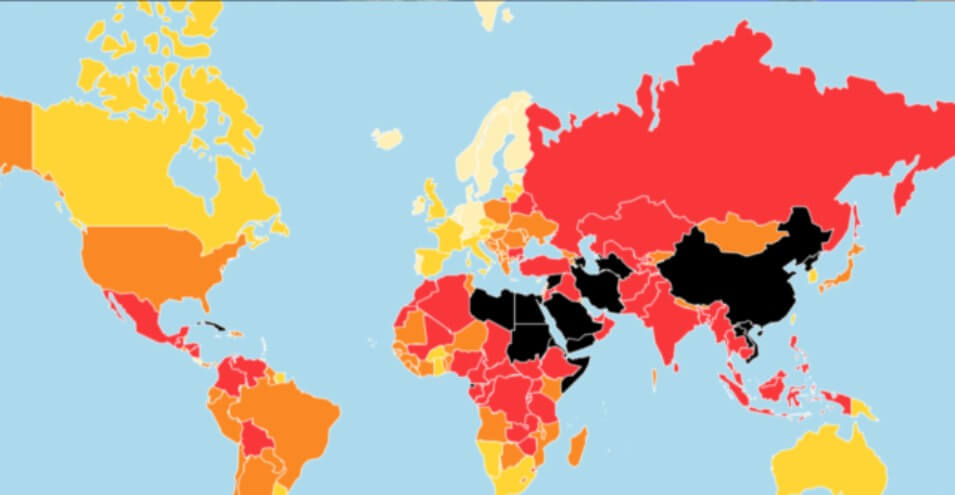
The Committee to Protect Journalists (CPJ) announced in a report that Iran is among the worst prisons for journalists in the world, noting the increase in the number of imprisoned journalists this year and after the recent protests in Iran.
The New York-based Committee to Protect Journalists wrote in a report on Wednesday, December 10, that it has identified at least 250 journalists who are being detained in connection with their journalistic work.
According to this report, after China, Turkey, Saudi Arabia, and Egypt, Eritrea, Vietnam, and Iran are the worst prisons of journalists.
The report, emphasizing the increase in the number of journalists imprisoned in Iran to 11 this year, also mentioned the arrest of Mohammad Mosaed, an economic journalist, during the recent protests in Iran, and stated that during the internet shutdown, which was carried out to prevent the publication of news about the suppression of protests against the increase in gasoline prices, Mr. Mosaed was arrested for tweeting "Hello, free world!" and saying that he had used "42 different proxies" to write this tweet.
International human rights organizations and the United States government have repeatedly accused the Islamic Republic of violating freedom of expression and suppressing civil activists, and have called for the release of journalists and writers who have been imprisoned simply for carrying out their duties and professions.
The report also refers to journalists imprisoned in Turkey and states that although this is the first time in the past four years that Turkey has not ranked first in the census of imprisoned journalists, the decrease in the number of prisoners is not a sign of improvement in the situation of Turkish media.
The Committee to Protect Journalists said in the report that "the decrease in the number of imprisoned journalists from 68 to 47 indicates that the government of Recep Tayyip Erdogan has succeeded in silencing independent and critical media after closing more than 100 news outlets and charging their employees with terrorist crimes."
Previously, the US State Department had published material titled "40 Years of Unfulfilled Promises" by the Islamic Republic on its Persian Twitter account, writing about corruption, lack of freedom of expression, lack of justice, and unfulfilled economic promises by Islamic Republic officials.
The US State Department wrote in these tweets that "Forty years ago, Ayatollah Khomeini promised freedom of speech and freedom of the press. Today, Iran has one of the most repressed media environments. The ruling regime has only failed for forty years."
Source: Voice of America