Land subsidence crisis: Half of Iran's plains have become "desert"
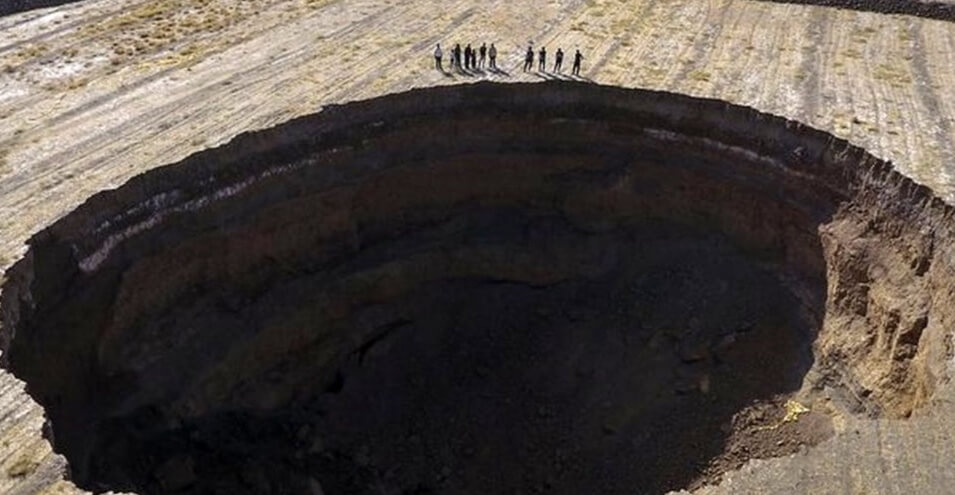
Simultaneously with the release of new satellite images showing the dire state of land subsidence in Iran, officials are also reporting that half of the country's plains have been transformed due to subsidence, as well as a "tripling" of land subsidence around Tehran.
In Iran, for a long time, the excessive and unplanned extraction of water from underground aquifers (aquifers) has caused the ground to collapse, resulting in the disappearance of these holes and aquifers, and subsequent rainfall water cannot replenish these resources.
In recent days, the Intel Lab research institute has released new satellite images of land subsidence around Tehran, describing this phenomenon as a "quiet and silent time bomb" that severely threatens the capital's basic infrastructure and the lives of its residents.
Regarding this trend, Ali Baitollahi, a member of the faculty of the Road, Housing and Urban Development Research Center, told ILNA news agency on Monday, July 4, that "exactly half of the 609 plains in our country have become deserts due to subsidence and falling groundwater, and the other half are not in a desirable state and are on the verge of crisis and danger."
He added that "currently, the Varamin, Mahyar, Eshtehard, and Shahriar plains are on the verge of crisis, and we must prevent them from becoming deserts as soon as possible."
Mr. Baitollahi explained that in the southwestern regions of Tehran, namely regions 18 and 19, the subsidence rate is about 24 centimeters per year, while international standards define subsidence of 4 millimeters per year as the "critical limit."
A faculty member of the Urban Planning Research Center added: "While infrastructure such as oil tanks in Rey, an oil refinery, various industrial complexes have been established in southwest Tehran, and there are dense oil and gas pipelines in this area."
Ali Baitollahi pointed out, among other things, the existence of 30,000 unauthorized wells in Tehran province and "the construction of long water pools in the areas of these wells by influential people," and said, "It is the duty of the Ministry of Energy to prevent the drilling of unauthorized wells."
In recent days, Ministry of Energy officials have attributed part of the reasons for Tehran's recent blackouts to the high electricity consumption in these 30,000 unauthorized wells. Although the authorities' statements about these wells have been repeated for years, there has been no news about a serious response to this problem.
Meanwhile, the Geological Survey of Iran announced on Monday that the situation of land subsidence in the suburbs of Tehran has worsened "threefold" over the past decade, and although the organization has been warning officials about the danger of this phenomenon spreading to Iran's future for 20 years, "these warnings have never been heeded."
Reza Shahbazi, Director General of the Geological and Environmental Hazards Survey Office of the Iranian Geological and Mineral Exploration Organization, said in an interview with ISNA news agency: "Our studies show that the level of land conflict in the southwestern outskirts of Tehran with the subsidence phenomenon has almost doubled to tripled over the past decade."
He said that the organization was aware of the spread of this phenomenon in Iran 40 years ago and had given the necessary warnings to the authorities about 20 years ago, but the authorities ignored these warnings.
Before him, Alireza Shahidi, head of the Geological Survey, also referred to the state of land subsidence in Iran on June 29 as a "disaster" and a "silent earthquake," warning of the death of the country's plants, animals, and human communities, saying that "we are leading the country toward destruction."
Stating that subsidence will cause security crises for the country, he noted: "Drought causes people to migrate from the south to the north of the country and depopulate large parts of the country. Statistics show that 4 millimeters of subsidence is referred to as a crisis in the European Union, while up to 17 centimeters have been observed in Isfahan and 36 centimeters in Tehran per year."
Source: Radio Farda