"Closing the Strait of Hormuz": Tools and Consequences

US President Donald Trump has vowed to completely cut off Iran's oil exports. According to Brian Hook, a policy adviser at the US State Department, a new round of tough US sanctions against Iran will be implemented from August 4, with the next phase starting from November 4, with the ultimate goal of reducing Iran's oil exports to zero.
Previously, Donald Trump announced his agreement with the King of Saudi Arabia to increase oil production by two million barrels per day to balance the global market capacity after the reduction in Iranian oil exports.
Recently, Saudi Arabia and the United Arab Emirates have explicitly announced that they will increase their oil production to compensate for the oil shortage in the market as the US tightens sanctions on Iran.
In response to these statements and the resumption of sanctions, Hassan Rouhani said to a group of Iranians in Switzerland: "The Americans... do not understand the meaning of this because it makes no sense at all that Iran's oil is not exported and then the region's oil is exported. If you can do this, you can see the results."
Qassem Soleimani, commander of the IRGC's Quds Force, also expressed appreciation for Hassan Rouhani's words in a message and announced that the force under his command is ready for any policy that is in the interest of the Islamic Republic.
Rouhani's words, which are an implicit threat, have been interpreted in Western political and military circles as closing the Strait of Hormuz. Despite statements by Heshmatollah Falahatpisheh, head of the National Security Commission of the Majlis, who dismissed the interpretation of Hassan Rouhani's words as closing the Strait of Hormuz, Esmail Kowsari, deputy commander of the IRGC's Sarallah headquarters, said on Wednesday, July 4, that the Strait of Hormuz would be closed to the world if necessary.
A day later, Mohammad Ali Jafari, calling Hassan Rouhani's recent position "decisive," stated: "In possible circumstances, the enemies can be made to understand what the use of the Strait of Hormuz for everyone or no one could mean."
Despite these different perceptions, the reality is that, given Iran's strained relations with the United States and Saudi Arabia, Hassan Rouhani has sought to make these two countries aware by showing off the Islamic Republic's power tools in the Persian Gulf, that disrupting maritime communication lines and tanker traffic in the Persian Gulf, the Strait of Hormuz, and the Sea of Oman is one of the tools Tehran is considering.
In this regard, several questions come to mind. Is it possible to close the Strait of Hormuz and disrupt the free export of oil from the Persian Gulf? From a military perspective, what tools does the Islamic Republic have to do this? Will Iran's experiences in tanker warfare be useful in the context of the eight-year Iran-Iraq war? What will be the US response and what consequences will it have?
Tools
From a military perspective, the Islamic Republic has the necessary tools to disrupt maritime communications and even to temporarily block the Strait of Hormuz; although making it unsafe is worse than blocking it because oil tankers will no longer have the security they need to pass through this waterway - a waterway that is one of the most strategic shipping routes in the world and through which about a fifth of the world's oil needs, at a rate of nearly 18.5 million barrels of oil per day, pass.
One of the Islamic Republic's tools for making communication lines unsafe is naval mines. Mines are considered a very powerful deterrent in naval warfare, and the number of mines in the IRGC and army's naval forces, including the advanced Chinese "AM-52" mines, is estimated at 2,000, which is an acceptable relative strength.
The republic's other major tools include: fast boats and gun and missile frigates; surface units including patrol ships and destroyers equipped with missiles and torpedoes; subsurface units including "Kilo-class" mine-laying submarines and small submarines; shore-to-sea missiles along Iran's coasts on the Persian Gulf and Sea of Oman; commando operations to damage offshore installations in Arab countries; and suicide operations with boats laden with explosives.
Experiences
During the Tanker War, which began in February 2019 and lasted for four years, launched by Saddam with the aim of cutting off Iranian oil exports and leading to the internationalization of the war in the Persian Gulf, the Revolutionary Guards gained experience in minelaying that resulted in severe damage to the "Bridgeton" tanker and the "Samuel B. Roberts" destroyer, which led to the sinking of the "Iran Ajar" minesweeper and the implementation of "Operation Mantis" by the United States.
It is unclear whether the IRGC can learn from its past experiences and mistakes, but if it has the opportunity and a suitable field for laying mines, this force or the Navy would have the ability to contaminate parts of the Persian Gulf and even the shipping route in the Sea of Oman towards Bab al-Mandeb and the Strait of Malaga - something that, if realized, could disrupt the order of the global oil market.
Mine clearance operations
Contrary to popular belief, mine-clearing operations to clear contaminated areas will be a very difficult task for the United States and other Western countries. It is time-consuming, costly, and requires a great deal of human and non-human resources, including minesweeping ships and helicopters, and various ground and air units.
Based on a comprehensive study by an American expert, Caitlin Tamage (professor at Georgetown University), the United States' mine clearance of the Strait of Hormuz and its surrounding waters would require 28 to 40 days. If the time required to carry out other operations to repel Iran's response capabilities, such as destroying its shore-to-sea missile batteries, air defenses, and naval capabilities, is added to the mine clearance operation, the duration of these combined measures would be 37 days in the best case scenario and 112 days in the worst case scenario.
In this regard, one of Iran's major weaknesses is its lack of mine clearance capabilities, meaning that if the United States mines and blockades Iran's strategic ports and islands, the Islamic Republic will be unable to clear or neutralize the mines.
Conclusion
In the worst circumstances of the tanker war in the Persian Gulf, the Islamic Republic was unable to close the Strait of Hormuz and was content with harassing operations and creating insecurity in the maritime communication lines of the countries in the southern Persian Gulf. Ultimately, the direct confrontation between the United States and the Islamic Republic was one of the major factors that forced the Islamic Republic to accept Security Council Resolution 598.
Currently, the Islamic Republic is eyeing the package proposed by European countries and their failure to comply with US sanctions and their continued purchase of oil from Iran, and the implicit threat of disrupting maritime transport routes should be seen as a counter-threat to the US effort to reduce Iranian oil exports to zero. However, if Iranian oil exports are completely cut off, the Islamic Republic will not be interested in the free flow of oil from the Persian Gulf and will not sit idle.
Closing the Strait of Hormuz, or attempting to do so, would be tantamount to declaring war on the United States and the southern Persian Gulf countries. This would trigger a strong US response, give international legitimacy to US actions against Iran, and perhaps lead to a consensus among Europe and even China and Russia with the US to impose further sanctions.
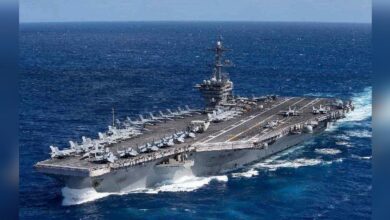
The US Fifth Fleet is closely monitoring Iranian activities in the Strait of Hormuz, and any IRGC naval activity in terms of minelaying will not escape the fleet's attention. The US has a large and powerful presence in seven small and large bases in the southern Persian Gulf countries, and in the final analysis, in a military confrontation with Iran, it has the capacity to inflict heavy damage on Iran.
Meanwhile, Hassan Rouhani's agreement with the positions and statements of the commanders of the Revolutionary Guards who want to push Iran into a military conflict is a cause for concern - commanders who, due to the lack of the necessary military knowledge and incorrect processing of information or for political reasons by exaggerating the power and capacity of the IRGC, have an incorrect and vulgar perception of the capabilities of the United States and the military-political recruitment of regional actors, and can cause disaster by instilling false self-confidence in the country's executive officials.
Hassan Rouhani has abandoned his so-called “reformist” promises and commitments and joined the ranks of the IRGC commanders and fundamentalists. The phrase “I kiss your hand” in Qassem Soleimani’s message and Mohammad Ali Jafari’s support for the recent “firm” positions of Hassan Rouhani and the country’s executive officials for their “revolutionary approach and vision in the battle against the enemy” are indicative of this turn in Iran’s domestic politics. Increasing domestic and foreign pressures have brought all factions closer together, and the issue of the survival of the Islamic state, regardless of any costs to the people, is more important than ever.
Source: Radio Farda