Satellite images from above Evin Prison reveal the extent of the massive fire there
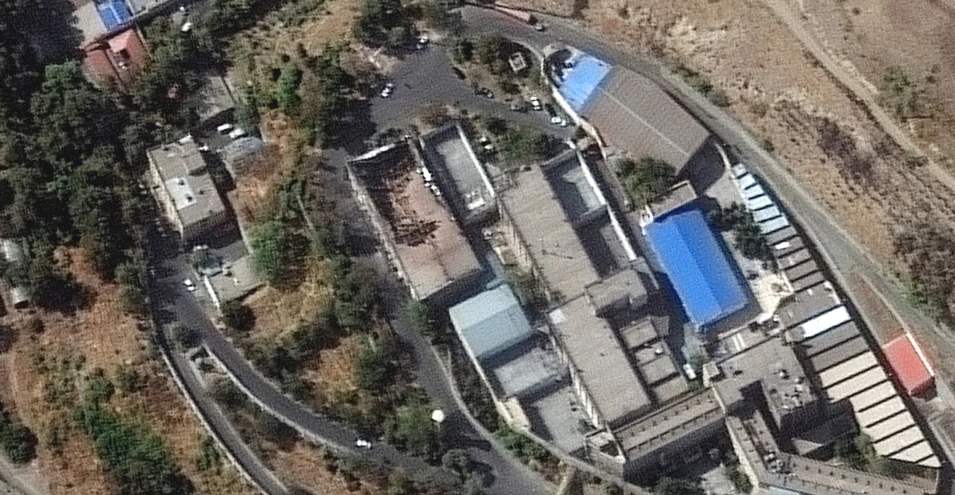
Satellite images taken from the top of Evin, one of the most notorious and feared prisons in Iran and the world, have shown details of the extent of the massive fire that broke out there on the evening of Saturday, October 13.
Photos taken by the PBC's Planet Labs satellite team, which were evaluated by experts for The Associated Press, show that the roof of one of the large structures in the northern section of Evin Prison has burned.
The Judiciary of the Islamic Republic of Iran, which continues to claim that the structure was a place to hold prisoners for financial crimes and theft, confirmed on Monday, October 15, that the number of victims of the fire had increased to eight. It had previously been reported that 61 prisoners were injured among the prisoners in this ward.
The situation at Evin Prison in northern Tehran has been drawing the attention of the Iranian people and the world's public opinion since Saturday evening, after videos of a fire were published online. Then, with the increase in the publication of videos of the spread of flames and the gathering of worried families of prisoners, world leaders also commented on the incident.
The videos first showed the sound of a siren in the prison, followed by a series of gunshots, and then the echoing chants of "Death to the dictator."
Many of the videos released related to Saturday night's events also showed a long convoy of motorcycles apparently ridden by special forces forces who had been dispatched to Evin from other parts of Tehran.
A day later, other videos were posted online showing people on the roof and around Evin structures pouring suspicious liquids onto the flames, causing the fire to spread rapidly.
It is unclear who the people who were pouring liquids before the fire spread, and if they were not prison guards or government security agents, how they gained access to this fearsome, high-security complex.
The Atlas of Iran's Prisons, a project prepared by a California-based legal group on information about Iran's prisons and prisoners, identified the structure in Evin that caught fire as a ward housing financial crime prisoners, but project officials said the wards had changed over the years.
News teams dispatched by the Islamic Republic of Iran Television News Network, accompanied by the governor of Tehran and a number of senior officials from Iran's prison institutions, claimed that a fight among prisoners in the financial crimes ward caused the fire. Other contradictory reports claimed that a number of prisoners started the fire to escape.
People who were previously imprisoned in Evin Prison have emphasized that the films produced by the Islamic Republic of Iran Radio and Television and the statements of the officials are full of contradictions.
Mustafa Nili, a lawyer for a number of political prisoners imprisoned in Evin, in an interview with the Etemad newspaper, identified one of the areas damaged by the fire as ward eight of the prison, but said that apart from some financial convicts, a number of political prisoners were also held in this place.
According to Mr. Nili, political prisoners held in Ward No. 4 of Evin were also injured by tear gas inhalation. The Tasnim news agency, close to the Revolutionary Guard, also reported that Wards 6 and 7 of Evin were also damaged in the incident from Saturday night to Sunday morning.
Gholamhossein Mohseni Ejei, head of the Islamic Republic's judiciary, reiterated on October 15 that "enemy elements" were involved in the incident.
Political prisoners in Evin have said that the Islamic Republic of Iran had moved dual-citizen prisoners away from the scene of the fire earlier than others in order to keep them safe; one of them was Siamak Namazi, an Iranian-American citizen whose elderly father was allowed to leave Iran two weeks ago after many years.
Jason Rezaian, an Iranian-American journalist for the Washington Post who was himself imprisoned in Evin Prison for about two years, wrote on his Twitter page that Evin is no ordinary prison; many of Iran's best and brightest are incarcerated in Evin for long periods of time; where brave men and women are denied their basic rights to speak truth to power.
Evin Prison has been home to tens, if not hundreds, of thousands of prisoners since the Islamic Republic of Iran came to power, and according to prisoners' accounts over the decades and numerous memoirs written by political prisoners, it has witnessed the execution of thousands of prisoners and horrific torture of prisoners. A small section of the prison is dedicated to non-political prisoners.
Iranians consider Evin to be one of the "best universities" in terms of the number of elites and brains imprisoned there. Currently, dozens of journalists, political and environmental activists, cultural figures, and filmmakers such as Jafar Panahi are imprisoned in this prison.
Since the beginning of the recent widespread protests in Iran, which have entered their second month, there have been at least three violent and deadly clashes inside prisons.
Before the Evin incident, it was first reported that Sanandaj Prison had suffered 61 injuries in an attack by prison guards on October 6, and then widespread clashes broke out in Lakan Prison in Rasht, the extent of which is still unclear.
Source: Radio Farda