Jahangiri: We may be forced to offer coupons for some goods
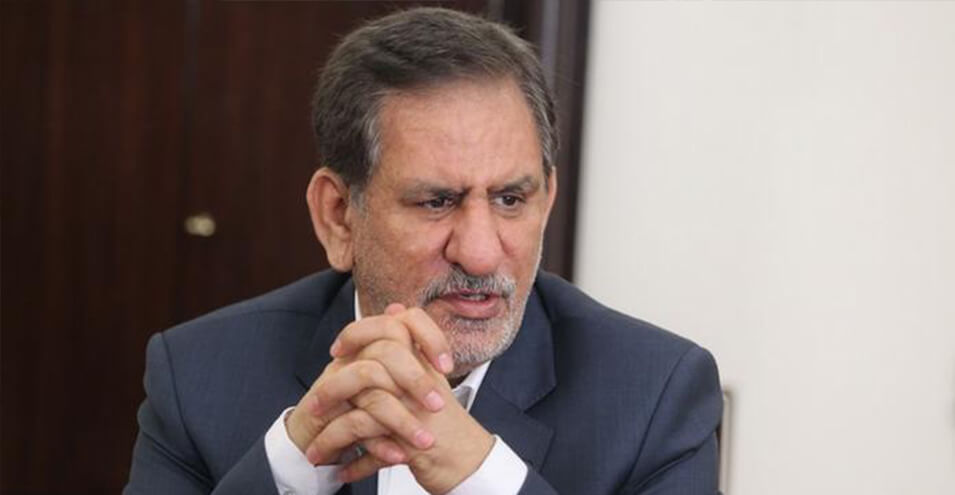
Referring to the current economic situation, the First Vice President announced the possibility of a return to rationing and couponing for some goods. In recent days, rumors of the possibility of gasoline rationing have been met with many opposing reactions.
With the intensification of US sanctions against the Islamic Republic, securing essential goods and preventing unbridled price increases has become one of the major problems of the Hassan Rouhani government.
The First Vice President's latest remarks about different views on how to procure essential goods and the possibility of rationing them indicate the government's uncertainty in this regard.
Yesterday (Saturday, May 4), on the sidelines of a visit to the Tehran Book Fair, Eshaq Jahangiri reminded reporters that during the Iran-Iraq war, almost all imports were carried out by the government and distributed through a coupon system.
He added that after the war, the policy of free economy and privatization was put on the agenda, and now, although the government is responsible for providing foreign exchange for the import of basic goods, the importers are from the private sector.
According to ISNA news agency, Jahangiri then explained the two solutions the government has to control the economic conditions ahead and said: "Now, given the new economic conditions, two discussions have arisen. We are moving towards more restrictions, so the role of the government will probably become more prominent. We may be forced to move towards rationing and couponing for some goods."
The First Vice President says that this theory has supporters inside and outside the government, and the prerequisite for its implementation is the re-entry of the executive branch into economic activities.
He continued: "Some economic activists are opposed to this theory. They believe that in such difficult circumstances, we should move towards liberalizing the economy; even removing the restrictions we had before. Instead of providing the desired goods to the poor through rationing, we should liberalize the economy and provide hidden subsidies in cash to the people."
The government's future-shaping decision and uncertainty
Continuing his speech, Ishaq Jahangiri called on experts to clearly express their views and criticism in these two ways because the government must "soon" make a decision that "will affect the future of the country."
Jahangiri acknowledges that thirty years after the end of the war, when policies have moved, at least on the surface, toward liberalizing the economy and shrinking the government, it is “not easily possible” to restore all past laws and regulations at once and revive extensive regulatory and executive organizations.
Although returning to the method of distributing basic goods through coupons has many opponents and obstacles, the majority of the representatives of the Islamic Consultative Assembly voted in favor of a proposal from the Consolidation Commission during the review of the 2019 budget, according to which the government would be required to provide citizens with "commodity cards" to provide basic goods.
According to some rumors and media reports, the return to rationing and the provision of goods through "electronic commodity registers" was supposed to begin with gasoline. After opposing reactions, the Ministry of Interior described the publication of this news in media outlets such as Tasnim and Fars as a "very dangerous game."
Gasoline rationing has been suspended "for now."
However, evidence suggests that such a discussion was on the agenda and preparations were in place. Behrouz Nemati, spokesman for the Majlis Presidium, announced after a closed-door meeting on Sunday morning, May 5, that gasoline rationing had been “suspended for the time being.”
Ali Asghar Yousefnejad, a member of the Majlis' presidency, also said in an interview with Tasnim, referring to the government's decision to ratione gasoline, "This issue has been ruled out by the government for now and no time has been announced for it."
Yousefnejad emphasized the high risk and consequences of rising energy prices, saying: "The government should abandon the decision it has made due to social and economic issues so that we can seek a solution to the problem in an expert environment."
Tasnim and Fars news agencies, both affiliated with the Revolutionary Guard Corps, reported on May 1 that 60 liters of rationed gasoline will be made available to car owners monthly at a price of 1,000 tomans per liter, and that free gasoline will be available at 2,500 tomans per liter.
Without referring to these news agencies, Oil Minister Bijan Zanganeh denied the rationing and price increase of free gasoline, saying: "The issues raised in this regard by some media outlets are lies, and they lie as always."
However, the statements of the two members of the presidium of the parliament confirm the existence of such programs that have been "currently" canceled or suspended, and Jahangiri's statements confirm the support of a number of government members for the return of rationing and the distribution of goods coupons in the current critical conditions of the Iranian economy.
Warning about the consequences of “coupon revival”
The return to the “coupon era” has drawn many critics, especially among private sector activists. Mohsen Jalalpour, former head of the Iranian Chamber of Commerce, warned of the harmful consequences of the move a day after the parliament passed a resolution requiring the government to distribute basic goods through vouchers.
In a note published on his Telegram channel, he wrote: "From now on, you have a controlled, multiple-price economy in which free exchange is not possible. In this environment, the private sector cannot grow. As a result, monopoly is formed. Once monopoly is formed, all kinds of corruption arise, and the bulk of the government's power and resources must be spent on combating the hoarding and hoarding of goods."
Referring to the experience of distributing coupons for goods in the 1960s, this economic activist warned that the "revival of coupons" would strengthen the foundations of government production and distribution, and this trend would have harmful consequences.
Source: DW