Khamenei gave the ministers' response to the four bills
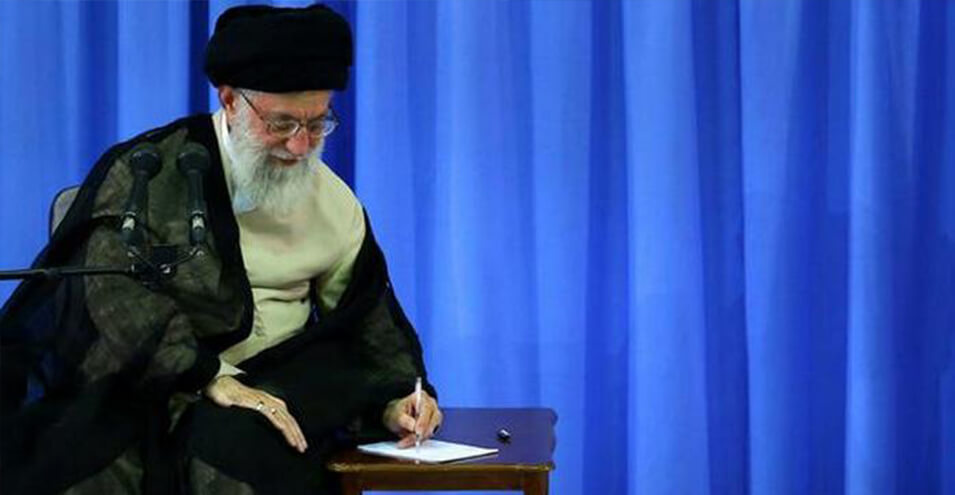
According to Rouhani's chief of staff, the Leader of the Islamic Republic has responded to a letter from several ministers requesting to expedite the process of approving bills to combat money laundering and terrorist financing. "The leadership has given very good instructions," Vaezi said.
On Wednesday, January 23, Mahmoud Vaezi, the head of the Iranian presidential office, confirmed that several ministers of the Rouhani government had sent a letter to the Leader of the Islamic Republic regarding the acceleration of the process of approving bills to combat money laundering and terrorist financing, and announced Ali Khamenei's response to this letter.
Without disclosing the details of Khamenei's response to the ministers' letter, Hassan Rouhani's chief of staff said only that the Leader of the Islamic Republic "gave very good instructions in his response."
Mahmoud Vaezi considered the writing of a letter that is said to have been written by four members of the 12th cabinet to Khamenei to be a common occurrence and said: "In the 11th and 12th governments, the relationship between ministers and cabinet members and the Supreme Leader's office was very close. When I was the Minister of Communications, I sent numerous letters to the Supreme Leader, both presenting reports and receiving instructions from him."
According to ISNA, Vaezi added: "We had letters with three or four signatures before, which is a common practice and nothing new has happened, and the letter that was sent two weeks ago was written by the High Council for [Combating] Money Laundering. This council includes eight cabinet members, and issues that may arise in the future due to the failure to approve the four bills and the restrictions that will be created in this regard are being examined."
"Very good instructions" leader
The head of Rouhani's office stated that "the decision of our friends was that we report the summary of the meeting to the Supreme Leader," adding: "This happened and this was done and it was not a special issue, and the leader was kind enough to respond and sent the letter, which has been a normal procedure up to now. The leader also gave very good instructions in his response, and that is why this letter was written."
Alireza Rahimi, a member of the presidium of the Iranian parliament, announced last Monday that a number of Rouhani's ministers had written a letter to the Leader of the Islamic Republic, calling for the Expediency Council to expedite the review of two bills known as Palermo and CFT.
Ali Motahari, the Second Vice Speaker of the Iranian Parliament, also said yesterday that the ministers, in their letter addressed to Ali Khamenei, had called for the approval of these bills before the deadline set for Iran by the Financial Action Task Force (FATF).
Iranian Labor Minister Mohammad Shariatmadari, noting that he himself was not among the signatories of the letter, said that the bills in question were "particularly sensitive" and that the government wanted them to be approved "within this limited time."
Iranian President Hassan Rouhani also emphasized the "special importance" of the bills to combat money laundering and terrorist financing during a government meeting today, calling for "other institutions" such as the government and parliament to take action to finally approve these bills.
The PANA news agency had previously reported that the ministers of foreign affairs, oil, industry and mining, labor and social welfare, roads and urban development, power, and agricultural Jihad were among the signatories to the letter. In addition to the Minister of Labor, Bijan Namdar Zanganeh, Iran's oil minister also said that he was not among the signatories to the letter to Khamenei.
Some media outlets close to the so-called hardline fundamentalists had previously written that those who sent the letter to Khamenei had threatened to resign if the bills were not approved.
Denial of "disagreement" between government and leader
In another part of his speech today, Rouhani's chief of staff expressed regret over "the way news and atmosphere have been created in this regard," and in response to the news, he said: "This distancing between everyone and sowing discord within the cabinet, and that there is a difference between the leadership's office and the government, is false. In no way has there been any discussion of resignation or any other issue. Our relations with the office of the Supreme Leader are very cordial, and therefore my request is that the media not pay attention to such issues."
The preacher's final words on this issue took a threatening tone: "We in the President's Office are following up on this issue to determine which media outlet first raised such an issue and which news agencies have expanded on it by citing this baseless news."
Shortly before the news of Khamenei's response to his ministers' letter was published, Hassan Rouhani said: "Fortunately, the government and the parliament have taken good steps in cooperation regarding the four bills, and we hope that other institutions that must take steps in the final stages in this regard will also work more quickly so that we can pass these bills and disappoint this hope of America and neutralize their conspiracy in the financial and banking issue."
“Iran’s friends are waiting”
The twelfth head of state also said that "today, all friends" of the Islamic Republic in the region and the world are "awaiting" the approval of these bills in Iran.
Previously, some members and supporters of the Rouhani government had said that if bills to combat money laundering and terrorist financing are not approved, the Islamic Republic will face problems not only with European Union member states, which consider such approvals a condition for continuing their transactions with Iran, but also with countries such as Russia and China.
After the Islamic Consultative Assembly "insisted" on its previous resolution on Iran's accession to the Convention on the Suppression of the Financing of Terrorism (CFT) on January 20, the Expediency Discernment Council decided to put the bill on its agenda. On January 19, the council also failed to approve the bill on Iran's accession to the Convention against Transnational Organized Crime, known as the Palermo Convention.
Some members of the Expediency Discernment Council have announced that they will review these two bills in the coming days. Two other bills related to FATF, namely the bill to amend the law on combating the financing of terrorism and the bill to amend the law on combating money laundering, have already been approved by the Expediency Discernment Council and the Guardian Council.
The approval of the four FATF-related bills is essential for Iran to definitively leave the Financial Action Task Force's "blacklist" and facilitate the Islamic Republic's international banking transactions. The European Union has also stated that the implementation of the bills to combat money laundering and terrorist financing in Iran is a requirement for cooperation with the Islamic Republic to save the JCPOA.
The Financial Action Task Force (FATF) extended Iran’s suspension from the group’s blacklist for another four months on October 17. This gives the Islamic Republic until the end of this month, Bahman, to pass the four bills targeted by the FATF. Establishing “international standards” to combat money laundering and terrorist financing worldwide is one of the main tasks of this intergovernmental organization.
Source: DW