Call for serious action against the rise of "fake Imamzadehs" in Iran
A member of parliament called for a “forceful” response to the rise of “fake imamzadehs” in Iran. Another member called on the Awqaf Organization to “close down these shops.” At least 11,000 imamzadehs have been registered in Iran.
Mohammad Ali Pourmokhtar, a member of the Islamic Consultative Assembly, called for a serious crackdown on “fake imamzadehs” in Iran on Sunday, December 30. Pourmokhtar told Khabar Online: “The Awqaf Organization must intervene in this matter to prevent the insulting of imamzadehs. In addition, the Awqaf Organization is the main custodian of this matter and has a duty not to allow these abuses.”
This conservative representative, who was a member of the Article 90 Commission in the 9th Parliament and at that time cases regarding Imamzadehs were raised in this commission, said about the number of Imamzadehs in Iran: "I do not have accurate statistics now, but the last time we followed up on this case in the Article 90 Commission, the number of Imamzadehs had reached 11,000. At that time, by raising this issue, we tried to warn people who were building Imamzadehs; this was stopped to some extent, and in this regard, the Endowment Organization was also informed and dealt with this practice, but it was expected that the Endowment Organization would be more sensitive to this issue."
Awqaf “Shut down these shops”
Gholamali Jafarzadeh Aymanabadi, a representative from Rasht in the Iranian parliament, also said about "fake imamzadehs": "The Awqaf organization should close these shops."
For several years, criticism has been rising in Iran over the “unaccountable” increase in Imamzadehs. Jafarzadeh Aymanabadi told the “Khaneh Mellat” news agency: “In the meantime, between the ninth and tenth parliaments, several thousand more Imamzadehs were added to the number of Imamzadehs; the question people are asking is when will the story of Imamzadehs end? What does it mean that their number is increasing and why is it constantly increasing? This increase in Imamzadehs is meaningless to young people. At some point, the case of the discovery of Imamzadehs must be closed, and Imamzadehs should not be constantly being produced.”
Gholamali Jafarzadeh Aymanabadi also said: "The discovery of Imamzades should end in one place; some of these have no genealogy at all, and in some villages, stories are being made up; therefore, the Endowment Organization must stop it and deal severely with these superstitions and some statements by officials that are insulting to religion."
Jafarzadeh Aymanabadi’s statements were met with a reaction from the Iranian Endowment Organization. In a response, the organization, noting that the “genealogy review” of the Imamzades had been conducted by an expert, wrote to the Rasht representative: “It was expected of this respected representative, as a legal entity with the rostrum of the Islamic system, that before repeatedly repeating such sensitive issues that easily become the subject and propaganda fodder of the media hostile to the system, he would have followed up on the issues from this organization, far from marginalizing them, so that, if necessary, during an expert meeting, the complete statistics and information on the country’s holy sites and how they were recorded and recorded over the past several years would have been explained to him in the context of the comprehensive information and management system for endowments and holy sites.”
Responsible for the "incompetence" of identifying Imamzadehs
It seems that the response of the Iranian Endowment Organization to the Rasht representative was not convincing to Mohammad Ali Pourmukhtar, a conservative member of parliament. He said: "There is a person in Qom who is responsible for verifying the genealogies, about whom Ayatollah Nouri Hamedani has issued a fatwa stating that this person is not qualified to confirm the genealogies of the Imamzades. In fact, this person, to whom the genealogies of the Imamzades are entrusted to pass them down from generation to generation to an Imam, has been questioned by Ayatollah Nouri Hamedani. This is while some of the Imamzades have received genealogies from this person. It seems that the Endowment Organization should get involved in this issue to prevent the insult of the Imamzades. In addition, the Endowment Organization is the main custodian of this matter and has a duty to get involved in the issue and not allow these abuses. "The other point is that in any case, money is being taken from the people in this process, and tens of millions of rials are being spent on these shrines, domes, and shrines, and if this practice continues, it will definitely be detrimental."
In response to the question of whether any action has been taken to destroy fake Imamzades, Pourmukhtar said, “This is the duty of the Awqaf Organization and we have not seen any effective action yet.” According to him, in the ninth parliament, the Article 90 Commission addressed the issue of fake Imamzades and “to some extent” prevented their spread, but the issue was “let go” after a while. The MP ultimately considered dealing with “fake Imamzades” as “the first duty of the Awqaf Organization” and said, “It is expected that this work will be done with full force.”
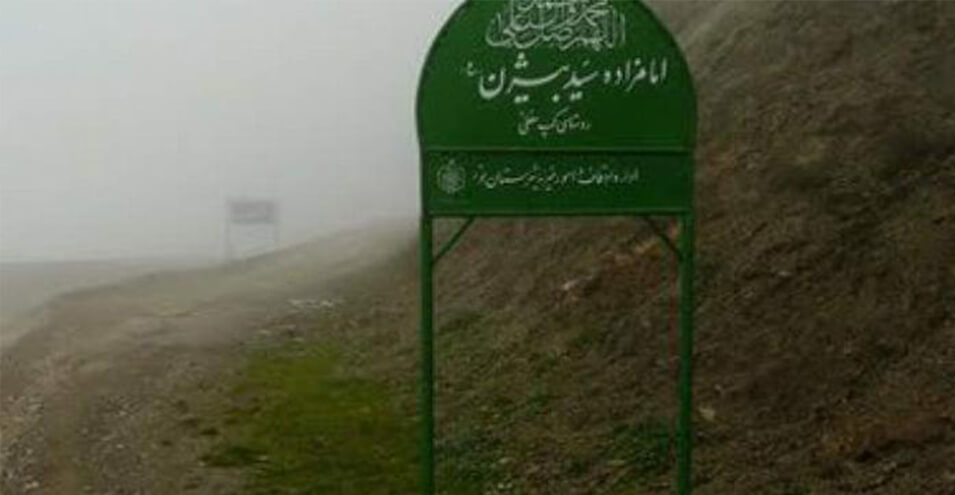
"Imamzadeh Bijan" or "Imamzadeh Bijan"
Although the “increase” of Imamzadehs and their successive “discoveries” in Iran have faced a lot of criticism in recent years, officials of the Awqaf Organization do not believe that the reason for this is that the Imamzadehs are “fake.” Ahmad Sharafkhani, Deputy Director of Culture and Social Affairs of the Awqaf and Charity Organization, said in September of last year (2017): “A large part of the Imamzadehs have complete genealogies. If some of them do not have genealogies, a reliable historical book confirms the presence of Imamzadehs, or the old local reputation that has reached us proves that there was an Imamzadeh in this place. Also, the age of historical and ancient monuments found in some Imamzadehs indicates that these were truly descendants of the Imams.”
According to this official from the Awqaf Organization, the reason for the "increase" in the number of Imamzades is the organization's "collection of accurate statistics and information about these places."
The unusual names of some Imamzadehs in Iran, such as “Imamzadeh Bijan,” “Imamzadeh Ayn-o-Ghin,” and “Imamzadeh Qol-Qoli,” have provided a source of humor for some, especially on social media, and have fueled the issue of “fake Imamzadehs” in Iran. Officials from the Awqaf Organization have, of course, given reasons for these unusual names.
Hamid Asgari Savadjani, the director general of “Religious Sites and Holy Sites” of the Iranian Endowment Organization, said in an interview with “Democratic Online” in mid-August: “There is an Imamzadeh in Noor County called Imamzadeh Seyyed Mohammad (AS). Since the Imamzadeh’s surroundings were known as a peaceful and ghost-free place, the place gradually became known as Bijan. The Imamzadeh was also known by this name. Eventually, the letter c was changed to zh in the local dialect and this Imamzadeh became known as Imamzadeh Bijan. While its original name is Imamzadeh Seyyed Mohammad (AS). The original name of Imamzadeh Qol Qoli is also Muhammad bin Hanafiyeh, who is buried in Gilan Province. Some people believe that they must roll in this Imamzadeh to relieve themselves, and if they are not injured as a result of rolling, they relieve themselves, while there is no written or documented document confirming the behavior of people in this Imamzadeh to relieve themselves.”
Published statistics indicate an increase of at least seven times in the number of Imamzadehs compared to before the 1979 revolution in Iran.
Source: DW