Saeed Malekpour's mother asks the prosecutor to pardon her son after serving 10 years in prison
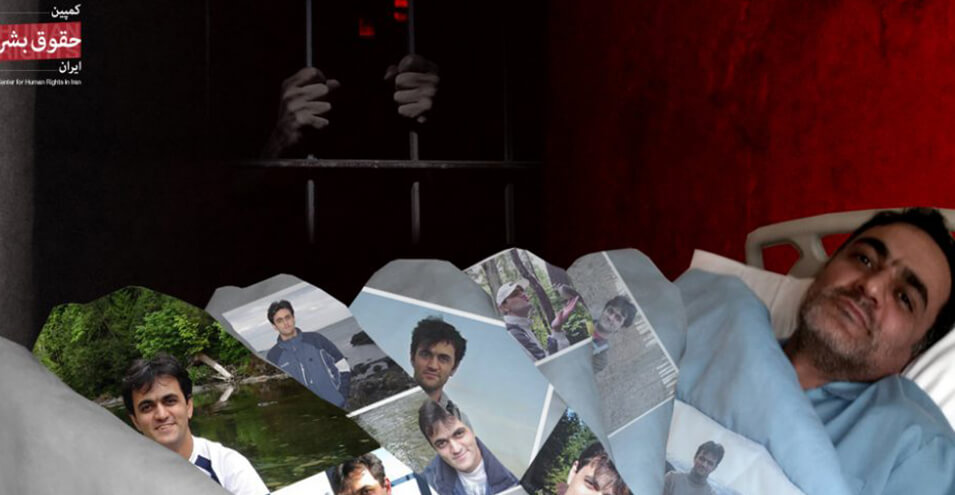
The mother of Saeed Malekpour, a prisoner sentenced to life imprisonment, has written a letter to the Tehran prosecutor demanding the release of her son after 10 years in prison. In her letter, Akram Esmailzadeh asked Abbas Jafari Dolatabadi to “pardon” her son and release him after 10 years in prison without even a day of leave, “on the occasion of the 40th anniversary of the revolution.”
Saeed Malekpour's mother wrote at the beginning of her letter, a copy of which was provided to the Human Rights Campaign in Iran, to the Tehran prosecutor : "I am Saeed Malekpour's mother. Saeed has no father, and apparently I am both his father and mother, but after God, he is my only support, who has been away from his mother's embrace for more than ten years and is in the embrace of prison and the wall. If he has committed any crime, ten hard years, which you know how many years he has spent in solitary confinement or prison, are enough for him."
Akram Esmailzadeh, referring to the fact that his son has not been granted even a single day of leave in his 10 years of imprisonment, despite prison regulations, continued his letter: " Think of a mother who needs her son's help at an advanced age. After all these years, when every moment of his life has been a year for us, he has not even had a day off. I am sure that Islamic compassion is nothing but this, and I, as a mother, have my eyes set on the Islamic compassion of the system and you, and I expect that, given that all relevant authorities, from the prison to the case expert, will confirm his good morals and behavior. You, who are the public prosecutor and defender of people's rights, give him a taste of Islamic compassion, and given that the respected head of the judiciary has promised a broad and unprecedented pardon, announce your agreement to pardon him in the Pardon and Forgiveness Commission so that he can be included on the pardon list in the fortieth year of the revolution."
At the end of her letter, Saeed Malekpour's mother asked the Tehran prosecutor, not as an official, but as a fellow countryman, to release her son: "I request your release and pardon for my son after ten years. Please make the necessary arrangements as you see fit, and we will always be praying for you."
The letter was published by domestic media outlets such as Ensaf News. Mr. Malekpour suffers from multiple illnesses, including heart disease, kidney stones, prostate disease, and osteoarthritis of the knee. He was transferred from prison to Taleghani Hospital for four days in October 2018 after suffering a heart attack. The prisoner’s sister told the Campaign in October 2018 that, unfortunately, no action had been taken to treat his other illnesses.
Saeed Malekpour, 42, is a graduate of Sharif University of Technology and a Canadian-based cyber activist. He traveled to Iran from Canada in 2008 to visit his family when he was arrested by security forces. Saeed Malekpour was sentenced to death by the Revolutionary Court in October 2010 on charges of blasphemy, allegedly for managing a network of pornographic websites. The sentence was confirmed by the Supreme Court on February 1, 2011, and sent to the Execution of Sentences Department for execution. However, in September 2013, the death sentence was commuted to life imprisonment with one degree of reduction. Saeed Malekpour did not plead guilty to the charges in his trial.
In the first months of his arrest, Saeed Malekpour, in a televised confession broadcast on Iranian state television, claimed that he had established the websites Awizoon, Iran S… and Expercia in Canada with the support of an American company. However, he later retracted his confession in the lower court, saying that he had been forced to make such a confession under pressure and torture.
In March 2008, Mr. Malekpour published a shocking letter describing what had happened to him, stating: "When I was asked to speak on camera about purchasing software from England and placing it on my website, and saying that if people visited this site, this software would be installed on their computer without their knowledge, and then I would have control of their computer's webcam even when the computer was turned off, and in this way I would film people's bedrooms over the Internet. Even though I told the interrogators that such a thing was technically impossible, they replied, 'Have nothing to do with this.'"
Source: Iranian Human Rights