The decline of the elite and the revival of the Aghazadeh in Iran
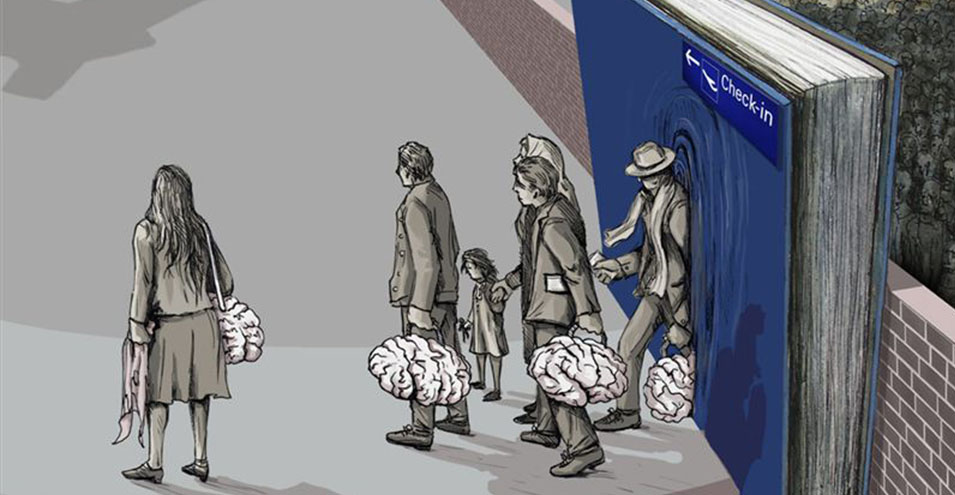
Sara.Kh. FCNN News Agency: The flight of elites and educated people from Iran is on an unprecedented upward trend. A group of this group leaves their homeland with the intention of immigrating to countries with more opportunities. However, a significant group completely cuts off their relationship with their mother country by fleeing Iran. In other words, they deprive their homeland and fellow countrymen of their capabilities and assets to the extent of 100 percent.
Some Iranian students and young people living abroad spoke to FCNN about their concerns about this. They fear that the next generations of Iranians will fall victim to a brain drain and elites leaving the country in the not-so-distant future, in such a way that the percentage of intelligent people in the country will be minimized and, correspondingly, the IQ of the society will take an uncontrollable downward trend.
These young people each consider a factor involved in the escape or migration of the elite from their homeland.
Eliminating meritocracy in Iran
Sima Lotfi, a student studying in the United States, claims in an interview with FCNN that disregard for meritocracy is the main reason why many elites leave and even flee Iran.
Criticizing some views that attribute this choice of intelligent young people to economic problems or their tendency to be unruly, he emphasizes that money is part of the motivation for migration in the fate of elite Iranian youth, but not all of it.
He believes that even lovers of unbridled passion will find enough opportunities in Iran without needing to leave their homes.
According to Sima, ignoring the principle of meritocracy in Iran is a waste of elite forces and an insult to these national assets. Of course, this Iranian student goes further and claims that our country's authorities welcome the brain drain, regardless of the consequences of their actions. So that the lack of educated workers in the country can provide a basis for the aghazadeh to amass wealth.
I am concerned about Iran's future.
Omid Sagazer, another Iranian who has lived in Germany with his family for more than three decades, views the brain drain phenomenon from a different perspective.
Hope cannot tolerate indifference to the problems and needs of her fellow countrymen, and she hopes to be able to serve her countrymen once conditions become safe.
According to this young Iranian, fleeing a country that requires the presence of elites and intellectuals will not solve any problems in the lives of Iranians.
He is one of those who is concerned about the future of Iran.
Continuing his conversation with FCNN, Omid emphasizes that fleeing one's homeland cannot be justified for any reason, except in situations where one's life is not safe at all.
This is what happened to him and his family due to his political activities in the early days of the revolution in Iran. However, Omid claims that whenever his health and safety are ensured, he will return to Iran and serve his countrymen.
Our country is regressing.
Sadegh Javanmardi has also immigrated to Canada to continue his studies for many years.
Sadeq is happy to have left his country at the age of nineteen, claiming that if he had stayed, he would have suffered the same fate as the other young people in his family.
In his opinion, economic problems, stagnant industry and production, government monopoly, and various gang games prevalent in our country are blocking the path of youth progress.
In a way that either they have to surrender to the circumstances and, despite their abilities, engage in a profession unrelated to their expertise and education and die there. Or they fall into the trap of addiction and corruption and waste their lives carelessly. Of course, in his opinion, there is a third way, which is to emigrate or flee the country.
In Sadegh's opinion, there are also those who, with not very remarkable intelligence, are included in various quotas in educational and professional centers and seemingly make progress.
He continues: "In general, in a country where stagnation prevails, no one grows. The Aghazadeh and their cronies only get rich, until a poisonous seedling like Babak Zanjani grows. This situation is pushing the country further backward day by day."
Silent bells of officials
Meanwhile, we see that from time to time, some officials in our country sound the alarm and warn about the waste of the Iranian elite's power. Of course, without mentioning the roots or forcing anyone to answer.
Seyyed Zia Hashemi, Deputy Minister of Science, Research and Technology, has confirmed that our country is weak in employing elite and educated personnel. According to this official, while we are ranked 15th in terms of research projects, we are ranked 75th in the world in employing educated personnel.
Of course, Hashemi, like other officials, is not willing to introduce blind spots and is content with repeating a few slogans to find a way out of this dilemma.
Mehdi Seydi, head of the elite working group of the Supreme Council of the Cultural Revolution of Iran, has also reported an increase in elite immigration in recent years, saying that this trend has increased again.
In an interview with Tasnim, referring to the latest statistics, he announced that the departure of elites from Iran in the last academic year (2014-15) increased by 16 percent compared to the previous similar period.
In this situation, we do not see any reaction from the authorities and those involved in affairs in our country. In other words, it seems that no effort is being made to preserve the elite and young people with high IQs in the country. Sometimes, the planning of the officials is such that they accelerate the loss of the country's scientific power and exploit every opportunity.
This time, the lottery has fallen in the name of students who feel a sense of duty in holding Islamic religious ceremonies.
Apparently, the country's university administrators have dug into their pockets to encourage this group of students and their trip to the war-torn and crisis-ridden country of Iraq.
Zulfiqar Yazdanmehr, head of the Ministry of Science's Student Welfare Fund, announced the promise of paying a loan of 7 million to students applying to participate in the Arbaeen march in Iraq.
The repayment time for this fee-free loan is after the students complete their education.
According to this official, the aforementioned trip is a cultural and spiritual act, and the university has a duty to support sending students to Iraq on this trip.