The Islamic Republic's influence inside Britain
The influential think tank "Policy Exchange" reported on the influence of the Islamic Republic within Britain.
Dr. Paul Stout, head of security and extremism at the Policy Exchange think tank in London, reported on the Islamic Republic's influence in Britain in a detailed 87-page report titled "Tehran on the Line - Iran's Threat to Britain." The report shows what threats the regime's activities under the guise of religious freedom and tolerance have created for Britain's security over the past two decades.
The aforementioned report includes the Islamic Republic's methods of influence and operations within the United Kingdom, and if the report's 14-point proposal is adopted and implemented, it could be effective in countering the Islamic Republic's influence.
By creating various institutions, the Islamic Republic has sought to exert social and cultural influence and increase its political influence in England. According to the "Politics Exchange" report, this influence has now spread dangerously due to the negligence of British security forces.
The think tank "Policy Exchange" criticized the inaction of the British security forces and the Home Office, but raised a question that remained unanswered. The content of the question is as follows: "It is clear who is responsible for protecting Britain from the Iranian terrorist state! The police and the security services. But whose responsibility is it to counter the spread of the Islamic Republic's soft influence in Britain? A process through which the Islamic Republic attempts to influence political, religious, educational and cultural organizations in this country."
The first part of this 16-page report deals with the Islamic Centre of England in the Midavel neighborhood of London, which is considered the main artery of the Islamic Republic in Britain. The directors of the Islamic Centre of England from the beginning to the present day have been Ayatollah Mohsen Araki, Hojjatoleslam Abdul Hossein Moezzi, Sheikh Mohammad Ali Shomali, and Seyyed Hashem Mousavi, all of whom were directly selected by Ali Khamenei to run this institution.
The Charitable Institutions Oversight Commission began its legal investigation into the Islamic Center in 2020, and by appointing Ms. Emma Moody, a British lawyer, as the center's interim director and dismissing Seyyed Hashem Mousavi, the center's political activities faced some obstacles. However, after 2 years of investigation, the final report on the center has not yet been published.
In the second chapter of the aforementioned report, another institution related to the Islamic Republic's influence network in Britain is mentioned, which is as follows: "The Islamic Human Rights Commission, the Islamic Mission of the Ahl al-Bayt Society, Dar al-Islam Charity, Beit Taha, Willesden Seminary, Islamic College, Al-Mahdi Foundation, British Muslim Students Association, Lebanese Youth Foundation, Islamic Republic School."
According to published reports, the Islamic Republic's influence in Scotland is much deeper than previously thought. Another criticism in the report is the performance of various British governments in simplifying the issuance of visas for government clerics. Since 2005, more than 100 visas have been issued to religious officials from the Islamic Republic of Iran, of which 8 Iranian clerics have received permanent residency permits in the UK.
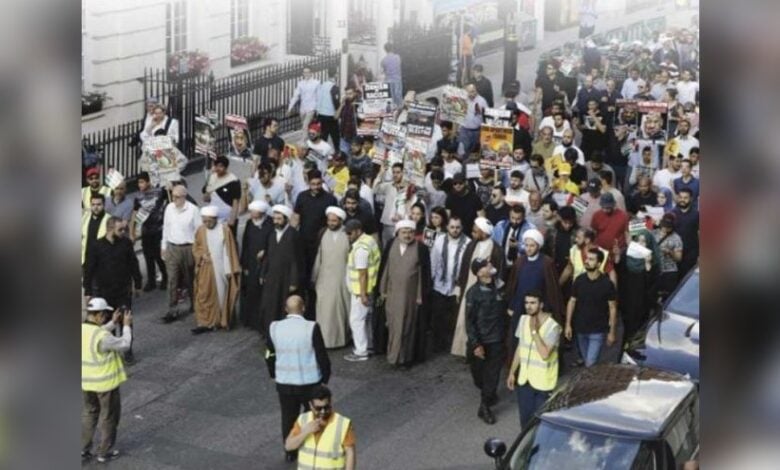
The "Politics Exchange" report believes that the Islamic Republic played a key role in organizing pro-Palestinian demonstrations in the UK, and that Israel's war against Hamas since October 7 has provided a good opportunity for the Islamic Republic to advance its plans in Britain using its influence network, which it has been working on for more than 20 years.
The Policy Exchange think tank has proposed 14 measures to counter the growing influence of the Islamic Republic government in Britain, as follows:
- Refusal to issue religious visas for employment in Islamic Republic institutions in Britain
- Review of visa issuance for all officials of the Islamic Republic of Iran
- More strictness on the Commission for Supervision of Charitable Institutions to properly perform their duties
- Placing the Islamic Revolutionary Guard Corps on the terrorist list
- Research on the role of the Islamic Republic in advancing laws against blasphemy
- Investigation by the British Home Office into the activities of the Popular Mobilization Forces in the country
- Greater focus by the Home Office and British security services on the activities of the Islamic Republic
- Taking UK security and values into account when considering asylum cases
- Interior Ministry requests security services to prepare annual report on extremist threats
- Preventive Countermeasures Against Cyberattacks of the Islamic Republic
- Employing more Persian speakers in security services
- Implementation of the new National Security Law, which was signed by the King in July last year (2023)
- A proper understanding of how the "Peace and Unity" conferences in Scotland came about and why British officials participated in them
- Collecting more statistics from followers of different sects of Islam in the UK for better analysis
The think tank's idea that the Islamic Republic may be seeking to influence British Muslims and expand its influence through them, and whose responsibility it is to prevent that, is unfortunately not reflected in the job descriptions of the security services within the UK.
It should be noted that from the time this report was compiled to its publication, there has been no response from the Islamic Republic's opposition abroad or from Persian-language media.