Why did Islam never add "slavery" to the list of prohibitions?
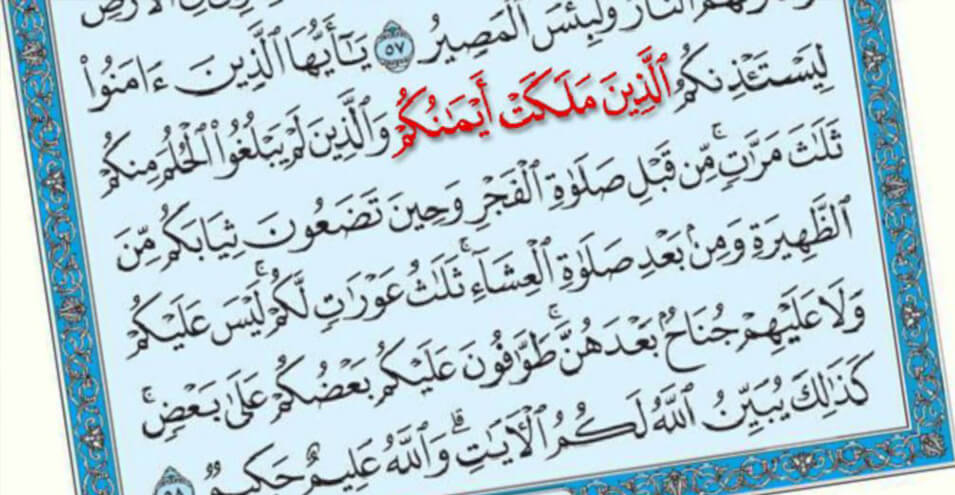
Not only is slavery accepted in Islam, but a set of conditions and rules have been formulated and defined for it; both in the Quran, in the Hadiths, and in Islamic law. The Prophet of Islam personally owned slaves and bought, sold, exchanged, and freed slaves.
This question, for a Muslim or someone who defends the set of values of Islam today, at least from a moral perspective, can be decisive as to why and how Islam, which introduces itself as a religion of equality and justice, has never included human trafficking and slavery on its long list of taboos.
This week's guests are Tabu Mehdi Jalali Tehrani, a former researcher in religion and state studies at Columbia University, and religious scholar Sajjad Nikayeen.
We will begin the program with Mr. Nikayin. Mr. Nikayin, this question can be an important one for a Muslim person: how are both slavery and slavery recognized in Islam?
Sajjad Nikayin: What exists in Islam as slavery was neither the establishment nor the legislation of the institution of slavery, nor its creation. The issue was solely and exclusively the legalization of this tradition that existed anyway. If you look at the prophets as social reformers, social reformers prioritized their work and acted based on specific priorities. Messing with deep-rooted and established social traditions that fuel tension and destabilize society was not a priority for the prophets, except in cases where it was a matter of beliefs or belief in the existence of the origin, which was their mission.
As you can see, the debate is not just about America. It has been going on up until our contemporary period, in America itself, and in Europe until the 17th century. Not only monotheistic and heavenly religions, even human societies had accepted it. Even Abraham Lincoln, when he issued the decree to abolish slavery, was not based on human values, but in order to weaken the South and the Confederate States.
In Islam, there was also a common tradition at that time, but the conditions for keeping slaves and the conditions for dealing with them [were determined in Islam], and this was in order to make those conditions more humane, which was not necessarily acceptable to Islam. You were faced with a reality, and that was that slaves were the product of a problem called war. This is more important. That is, wars occurred in which both sides did not deal with the other side's prisoners based on UN law, human rights, and war conventions, but on the basis that the prisoners of the other side were considered slaves, and since war occurred, there was no choice but to find a solution for these prisoners of war, and in Islam, slavery is a product of war...
Regarding this part of the war in particular, because I have another question, please allow us to discuss it independently, but before we go to Mr. Jalali Tehrani, the other guest on the program, I have a question for you. You say that Islam did not establish anything, but rather tried to reform the prevailing tradition. Because it could not go to war with all these traditions. Islam, which basically begins with a war with these traditions, for example, idolatry is also a prevailing tradition of the time…
Nik Ayin : I said, not all traditions. I said prioritization. If your priority is to communicate monotheism, you will put all your capital into communicating monotheism. There is no package that [changes] everything together from the very beginning. For example, take the ban on drinking alcohol. How many stages was it implemented in?
Okay, I will continue the discussion with Mr. Jalali Tehrani, another guest on the program. Of course, our listeners may now have the point that if the issue is social reform, is the proclamation of monotheism more important or preventing the buying and selling of human beings? Let us pose this question with Mr. Jalali Tehrani.
Mehdi Jalali Tehrani: Yes, I also wanted to address the issue of traditions that you mentioned. Now, apart from the tradition of idolatry, we have social structural traditions that the Prophet of Islam breaks. He leaves his own tribe. He goes from the city of Mecca to the city of Medina, which was not customary at that time for someone to go into exile. Muhammad was, to be honest, a tradition-breaker in many areas.
But on the issue of slavery, we see Islam silent. Even if we say that it is a priority; the question is how did you go to such lengths and create the rules for it, the Sharia has detailed instructions on what to do with slaves. Well, you would have gone to such lengths and abolished it altogether. If it is in conflict with your monotheistic principles. While I believe that slavery is compatible with monotheistic principles.
Another issue Mr. Nikayin mentioned is that this issue of slavery is not necessarily approved by Islam. Who can determine what is approved by Islam and what is not? Especially for someone who wants to believe today. How can he understand what was approved by Islam or not? In general, monotheism is a relationship of slavery in its entirety. Man is not recognized as a free man. The value of man is to be a slave. To be a slave of God. Now this slave finds a hierarchy. A person who is not a slave must express his servitude to God and accept his guardianship, but another person who is a slave must accept his servitude to this person. It is not compatible with today at all and is completely slavery in its entirety.
Mr. Nikayin! Now you definitely have an answer for Mr. Jalali Tehrani, and I would like to ask you this here: Perhaps there is a doubt that slavery was of economic, political, and even religious significance, and we see it in the text of religion. Just as a Muslim cannot be enslaved. Therefore, perhaps there is an expediency of this kind in seeking superiority, which, as you say, has not been given priority in the religion of Islam to abolish the buying and selling of human beings?
Nikayin: Before answering your question, let me start by answering Mr. Jalali Tehrani. It is said that the Prophet got involved with many traditions, I would say that he did not get involved with many traditions. Traditions have been constantly changed, based on expediency and the societies that Islam entered. Regarding how to determine whether this was a case of religious consent or not. There you can determine that by going to the issue of slavery with the reasons, indications, and references that exist and seeing that with appropriate and inappropriate circumstances, breaking all individual rules and obligations and expiation for sins is freeing a slave, all of them and without exception. If you do not fulfill your vow, it is recommended to free a slave for that breach of covenant. If someone does not fast during the month of Ramadan, we have the option of freeing a slave in return, and…
If Islam was truly desirable and the foundation of Islam was to fatten the institution of slavery [these would not exist]. Just as it existed until the not-so-distant centuries, two or three hundred years ago, and when they wanted to abolish it, they did so with war and bloodshed. While you see that in Muslim countries, including our own Iran, when they joined the Convention on the Abolition of Slavery and the National Assembly ratified it, in Bahman 1307, the bifurcation bill was ratified without any war or bloodshed, and no war would take place, and no jurist would issue a fatwa that a fundamental pillar of Islam had been abolished.
Mr. Jalali's statement that everyone is a slave and that accepting monotheism is the basis of slavery is a surrealistic view of human society relations. If we simply consider the fact that a Muslim is obligated as the criterion for being a slave, even if it is not called slavery; that is a very romantic and dreamy view of human issues and the structures of human societies. Yes, I feel obligated to the modern state, and the mere fact that I am obligated is not proof of slavery.
We have had an important issue called war, and you have no more than two options for determining the fate of prisoners of war; either bring them into society and put them in prisons, or, as Islam says, take them into families. In the words of those who came during the Safavid era, when slavery was still prevalent in Iran, they described Iran as a paradise for slaves.
Another issue was preventing war. That is, before they went to war, they thought that if we went and the war was lost, we would lose our freedom. So they avoided war to a large extent and it was a preventive factor.
Let me go back to Mr. Jalali Tehrani. Of course, I asked you a question that we can now discuss together about the answer. Mr. Nikayin spoke about freeing slaves as a positive thing. Is it possible, with today's set of moral values, for you to commit a sin and use the freedom and sale of a human being as a way to ease your conscience? Or even to prevent war. That is, the issue is the freedom of a human being, and I repeat that question with you, that slavery seems to have been accompanied by a kind of economic, political, and religious superiority. What will you answer?
Jalali Tehrani: Well, when we look at the slavery law or the slavery laws, we see that the child of a slave is a slave, and this slavery generally applies to Muslims. Therefore, there are these discriminations in it. What we need to clarify here is from what perspective we are looking at Islam? Do we consider Islam to be a religion that liberates and liberates humans, as it was proposed in the early days of Islam and the beginning of Islam. The issue of justice was at the forefront. I mentioned this, and Mr. Nikayin did not respond.
In general, an individual can come out of his own tribe and not be in his own tribal hierarchy, and tribes are equal, and there is communication and marriage between different tribes, these were the traditions of breaking and establishing new laws that were carried out by the Prophet of Islam; how is it that slavery was not given priority here, and if humans are all equal and the difference is only in their piety - these are the general principles that have been discussed anyway - so how did the Prophet of Islam or after him resolve this contradiction?
Today, when we look at the religion of Islam, should we consider it a religion that has eternal and valuable and always valid commandments, or can we throw away some parts? For example, they pointed out that slavery was abolished in Britain in the mid-17th century and in America in the 19th century. So, in this way, can we also throw away a series of commandments?
Before we return to Mr. Nikayin, I would like to mention the issue of female slaves. Female slaves were even used to provide sexual services to their owners, and this is also permitted in the Quran. What can be said about this?
Jalali Tehrani: I just wanted to mention that when I generalized the discussion of slavery and Mr. Nikayin said that it was a romantic view - I don't have that understanding - slavery is a discussion if it means being owned by a mamluq and being your property and you own it. In this context, you can even generalize to women; not just women who are slaves in the conventional sense or in the sense of the laws, but in the sense of a human being who is not free and has no autonomy and must answer to someone, we see this generally in the case of women in general in Islam.
From our perspective today, it is a moral vice for a woman to be forced to wear a veil because of her beliefs. I mention this because they say that she has chosen her own beliefs, so she is not restricted. I refer to the arguments that moral philosophers and political philosophers raise. For example, Isiah Berlin says in her Four Essays on Freedom that if a person is paranoid, that is, suspicious, then he is not free, even if he has denied himself this freedom.
Nikayin: I'm talking about a romantic view here. Okay, someone who has paranoia. What should we do with him now? Let's force him to say "don't have it"? That is, impose something on him? Anyway, we have accepted freedom of will and choice and it is agreed upon. Suppose someone who voluntarily decides to impose something on himself is, in your view, a psychopath or a paranoid person. Whatever. Or he has a phobia or any other reason.
Jalali Tehrani: This was just an example, Mr. Nikayin…
Nikayin: This is exactly where the romantic view takes shape. That all humans are the same, regardless of the average human. Human relationships are much more complicated than just a word called freedom, freedom in the 21st century sense, freedom in the sense of 2018, freedom in the present time we are in [October 31, 2018]. Freedom is a constantly evolving meaning, taboos that are being broken daily… We put all of this in a time machine and take it to Muhammad 1400 years ago and [we measure] Muhammad’s religion with today’s standards and think it is universal, time-inclusive, and space-inclusive. [These are] what separates the realist from Mr. Jalali Tehrani, the surrealist in politics.
Muhammad is a child of his time. I am not saying that his teachings should be discarded. In the modern world, look at the Emancipation Proclamation issued by Abraham Lincoln, which does not mention human rights at all. [It says] that through the Constitution, national authority will soon be established... It is all about national authority and the weakening of the Confederate States of the South, and there is no human discussion at all.
In today's world, according to the definition given to you by the Office of Human Trafficking Control in the US Department of State, we have 45.8 million slaves in the world, and a concept called modern slavery has been formed. Therefore, this tradition is so entrenched that no matter how much you remove it on paper and officially, even by force, it actually exists underground.
I will return to you, Mr. Jalali Tehrani. Among the points that Mr. Nikayin raised and that we also see in the text of the Islamic religion is how to treat slaves and respect their rights. Is the issue how to treat slaves or is the issue at all how a human being allows himself to enslave another human being? In any case, slavery existed in the Islamic religion. He also mentioned that, for example, it existed in America and was abolished a hundred years ago. We never see any attempt in Islamic law to abolish this.
Jalali Tehrani: Yes, at first I saw that Mr. Nikayin used a label that I didn't understand what it was, introducing themselves as realists and me as a political surrealist.
They had a couple of other points. One was about the abolition of slavery in America. Yes, the abolition of slavery in America was not done because of the value of human rights, and it was more about the industrial world where the Northerners needed workers instead of slaves, but consider that they didn't have much of a claim to that effect and they hadn't based their path on any fixed moral sources.
In Islam, we have a fixed moral source, which is Islam itself. Can we refer to this source and reference or not, is it of no use to us? The claim that we compare Abraham Lincoln's America with the Prophet of Islam is wrong. The next issue is that they talked about modern slavery. We have 45 million modern slaves. It is not legal. It is illegal. We say the same thing about the death penalty. We say that the death penalty is wrong because we are legally killing a human being, but criminals will kill human beings. The issue is whether we accept this as a law with a moral basis or not?
And the last issue, which is actually the main focus of the conversation with Mr. Nikayin, is that he says that what happened 1400 years ago cannot be compared to the contemporary world, for example, October 31, 2018. My question is that he is a Muslim on October 31, 2018. How does he view these jurisprudential, moral, and religious sources of Islam? If we understand Muhammad in terms of his own time and say that we believe in his own time, that is a different discussion altogether. How can we criticize Islam? I say that my ethics change based on my understanding of the day. Until 10 years ago, I did not recognize anything as animal rights. Until, for example, 15 years ago, I did not recognize anything as LGBT rights. How can this issue be resolved? With Islam, which is a fixed source and all its commandments and values have been proposed from the beginning.
Mr. Nikayin, I would like you to summarize your discussion in your response.
Nikayin: When you say value, it means that this action or this act is a moral act. When we say a moral act, it means that you should try it. When we say that Islamic values are fixed, value is one of those words that we either insist on or have a surrealistic understanding of, that the values of the 21st century, the 14th century, and the early centuries were all the same, and then whatever has been issued from Islam and in the history and jurisprudence of Islam, all of this is one value; regardless of the fact that this was a temporary way out.
We have no place where we recommend taking slaves. I will take the word value again from the words of Mr. Jalali Tehrani and use it; Muslims did not view it as a value. Just as in America it is abolished after bloodshed, but in no Islamic country does slavery end with bloodshed, because it is not a value. It is neither their nor my honor to use labeling, but when we say that 10 years ago I did not believe in animal rights and now I do, my argument is the same. For example, is there any mention in the Quran that slavery is an immutable law and will not change forever? No, it is not like that. No Muslim considers slavery to be part of the core of Islam.
Okay. Mr. Jalali Tehrani, we are at the end of the program. Please let us hear your conclusion.
Jalali Tehrani: Yes, you see, the question arises that, for example, we consider ourselves Muslims, why do we consider ourselves Muslims? Do we like the rulings of Islam or have we accepted the values of Islam as pleasant values and with them we consider salvation for ourselves. As a rule, our emphasis is on values. When we accept the values, we then come to the rulings to see what rulings are imposed on us.
If these values are to change in today's world - now if in America it was with war and bloodshed - in my opinion it is considered a value. In the case of women's rights, it was with strong resistance and civil struggles, naturally. If in the Islamic world these things were not abolished with war and bloodshed and were gradually abolished, they have acquired other aspects. That is, the same modern slavery that we are talking about and they are talking about 45 million people, I am talking about at least half of the Islamic world, which is 600 million or 700 million, and women are the Islamic world. When we look at the concept. The forms of slavery change.
Here is an ijtihad I saw in Mr. Nikayin's speech. Should we, in the modern world we live in today in the 21st century, put our sources of value where? If we put them in Islam, which many things have changed and you say there was no such thing, then there is no reason for us to return to Islam. There will be nothing on which we can rely for salvation.
Thank you very much, Mehdi Jalali Tehrani and Sajjad Nikayin.
Source: Radio Farda