Coronavirus claims the life of Ahmad Zargar, a judge who violated human rights
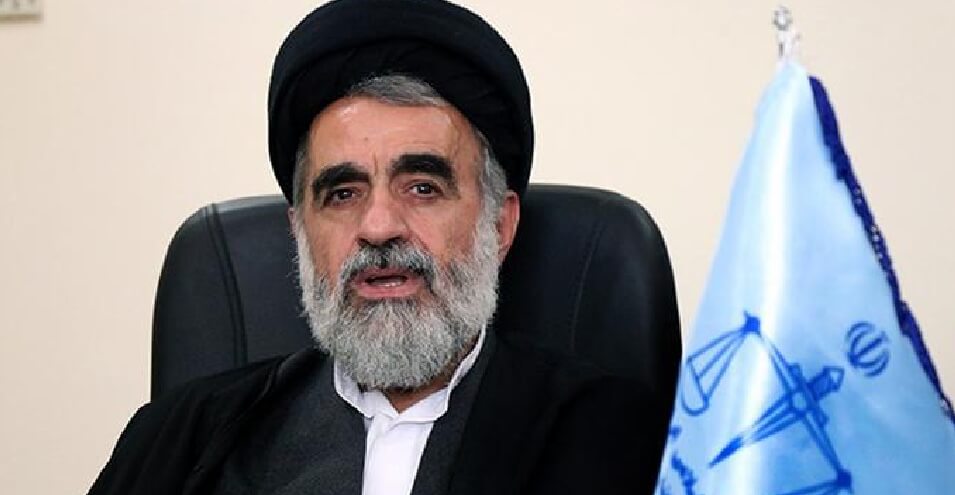
Ahmad Zargar, the head of the Central Islamic Revolutionary Court, died at Khatam al-Anbia Hospital in Tehran due to COVID-19. He held many legal responsibilities after the revolution.
Zargar was born in Semnan in the mid-1930s. He was a student of Beheshti and Quddousi at the Haqqani School in Qom. Like other students of this school, he began working in the Tehran Prosecutor's Office and the Islamic Revolutionary Court in April 1979. On May 10, 1979, he was appointed to the Tehran Anti-Narcotics Headquarters by Khomeini's decree.
In October 1988, after my arrest, I was transferred to the political ward of the Pol-e-Rumi Prosecutor's Office. For days, through the window of my cell, I would see prisoners accused of addiction and drug trafficking, who, by the order of the goldsmith, who was the Sharia judge of the courts of evil deeds and drugs, would writhe and scream in the courtyard and in front of our cell under heavy whippings.
After Ali Razini assumed the position of the Central Islamic Revolutionary Prosecutor's Office in February 1984, Zargar was appointed as a prosecutor and became the Deputy Chief of the Central Islamic Revolutionary Prosecutor's Office for Narcotics and Violations. During the presidency of Morteza Eshraqi, Zargar continued to head the said position.
He, who was a close friend of Ahmad Khomeini, was also working in Khomeini's office at the same time. Describing his closeness to Khomeini, he says: "On a winter morning in 1988, when everyone remembers the extreme cold, especially the snow that fell in Shemiran, the Imam called, and I rushed to his service. I saw that his room was completely cold. The Imam opened the door and he was only wearing an undershirt."
Seyyed Hassan Khomeini was among the first to offer condolences on his passing, writing: "The deceased lived his life striving for his own thoughts and ideas and with love for the path and ideals of the Imam (PBUH)."
In his memoirs of May 1, 2016, Hashemi Rafsanjani wrote about Ahmad Zargar, who was known for his cruelty and cruelty, that as the anti-narcotics prosecutor, he "was complaining and asking for help" about the Supreme Judicial Council's decision not to execute unarmed smugglers.
Ahmad Zargar was among those dismissed from his position as the Anti-Narcotics Prosecutor by the head of the judiciary, Sheikh Mohammad Yazdi, in 1972. He was also the deputy secretary of the National Anti-Narcotics Headquarters from 1970 to 1972.
After being dismissed from this position, in 1994, Ahmad Jannati appointed him as the Secretary of the Headquarters for Enjoining Right and Forbidding Wrong, and he worked in this position until 2018. One of his most important achievements in this position was the effort to pass a law to protect those who enjoin right and forbid wrong. With the passage of this law, those who forbid wrong could easily harass people, especially women, and enjoy legal protection. He was also the Secretary of the “People’s Headquarters for Prevention and Social Protection” affiliated with the Judiciary for many years.
Since 2008, Zargar was a representative of Sadegh Larijani and then Seyyed Ebrahim Raisi in the headquarters to combat smuggling.
For years, he headed Branch 36 of the Islamic Revolutionary Court of Appeals in Tehran, upholding the oppressive rulings of Sheikh Mohammad Moghiseh (Nasserian) and Mohammad Hassan Zare Dehnavi (Judge Haddad) one after the other. His name became a hot topic after the protests of 2009 as the head of Branch 36.
Before becoming the head of the Islamic Revolutionary Court of Tehran on November 11, 2020, in addition to heading Branch 36 of the Court of Appeals, he was also the head of Branch 2 of the Special Court for investigating crimes of "economic disruptors and corruption."
On July 19, 2021, the hearing of the charges against the defendants in the Rostami Safa case was held under his chairmanship. This was the last case he handled. While reading the indictment of the defendants, the prosecutor's representative said: This case is one of the largest banking cases in the country, and the defendants are among the country's largest debtors. The Rostami Safa group had taken millions of euros, dirhams, dollars, and yen by using rent. The hearing of the court case of the defendants in the 60 million euro currency fraud case, the hearing of the smuggled cars case, the hearing of the case of former Saipa officials, Ahmad Araqchi, and many other cases involving government officials were assigned to Zargar so that the secrets of the cases would not be revealed to the insiders.
On April 13, 2011, the European Union sanctioned Ahmad Zargar and 31 other officials of the Islamic regime for their involvement in human rights violations.
The Zargar family
Seyyed Mahmoud, Ahmad Zargar’s younger brother, who was an employee of Jihad Sazandegi, was killed in March 1983 during the occupation of Majnoon Island after serving for three months. His sister-in-law, Mohammad Hassan Akhtari, who was the Sharia judge of the military court in 1979, the Friday prayer leader of Semnan, the regime’s former ambassador to Syria, and the secretary general of the Ahl al-Bayt World Assembly, led numerous terrorist operations through Hezbollah in Lebanon and other “jihadi” groups in the 1960s and 1970s. He succeeded Ali Akbar Mohtashemi in Syria and is currently responsible for the international affairs of Khamenei’s office.
Hassan Younesi, the son of Ali Younesi, the intelligence minister of Mohammad Khatami's government who was arrested in 2009 and sentenced to one year in prison, is also Ahmad Zargar's son-in-law. Ali Younesi, like Ahmad Zargar, was a graduate of the Haqqani School, and the two families were familiar with each other and had a relationship for this reason. Hassan Younesi studied law with his father's rent and is currently a member of the Bar Association.
The 67 Massacre and Zargar
Davoud Zargar, a close relative of Seyyed Ahmad Zargar, was hanged in Evin Prison in 1988 by the death squad appointed by Khomeini. Since Ahmad Zargar was Morteza Ishraqi's deputy, Raisi was his deputy in the "group", and Nayeri had a close relationship with Zargar since 1989, unlike the other massacred prisoners, Davoud was given a chance to come to terms with his position after realizing the extent of the regime's brutality and accept the death squad's conditions to avoid execution. These conditions began with "writing a letter of disgust", and in some cases, "conducting a video interview" and "cooperating with intelligence" were also added. Many prisoners were executed in the summer of 1988 despite writing a "letter of disgust". Davoud, who had escaped the wave of killings in Evin, was taken to the death squad again in September and hanged for not accepting the conditions of the committee. Seyyed Reza Zargar, Davoud's brother, was also imprisoned in Evin and Semnan prisons in the 1960s.
Footnote:
Mohammad Hassan Mofid, the son of Ayatollah Hossein Mofid, who was the Chief Justice of the Supreme Court between 2004 and 2009, survived because the members of the panel knew his father. However, his cousin Hadi Beigi, who had a different last name, was executed in Evin.
Source: DW