Church of San Stefano, Jolfa | A magnificent wonder
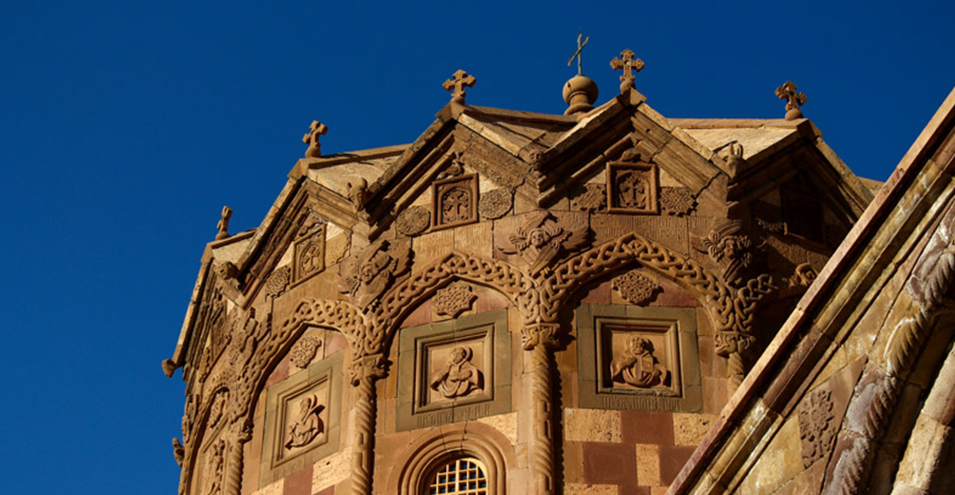
It is unlikely that if you take a picture in the Church of St. Stephen, anyone will notice that your picture was taken in Iran. When you see the first parts of the church, you will be amazed by its grandeur, splendor and beauty, and the Church of St. Stephen will become one of the most amazing places you have ever seen.
Who is Saint Stephen?
Saint Stephen, or Stephen, was one of the apostles of Jesus Christ. He was one of the first Christian missionaries and was stoned to death by the Jews in Jerusalem on December 26, 36 AD, on charges of speaking against Jewish law, and is the first martyr of Christianity. Of course, there are many churches around the world with the same name.
About St. Stephen's Church
The Church of Saint Stephen or Saint Stephen's Church is the second most important church for Armenians in Iran after the Kara Church.
This church was most likely built in the 9th century.
It had suffered serious damage due to an earthquake, but was restored and rebuilt during the Safavid era.
This work was registered on March 5, 1962, with registration number 429, as one of the national works of Iran.
In addition, this church is also on the UNESCO World Heritage List.
This church is still in use, and on one day of the year, thousands of Armenians gather at this spot to perform their special rituals.
History of St. Stephen's Church
There are various narrations about the construction date of this church. Some consider this building to belong to the early Christian era. While Taruniyeh considers this building to belong to the Safavid era. Also, the existence of some architectural evidence has considered this work to belong to the fourth and sixth centuries AH. For example, similarities have been seen between this church and the Tataous Church (in West Azerbaijan Province).
According to some Armenian historians, this monastery was built by one of the twelve apostles of Jesus, Saint Bartholomew, in the first century AD.
In addition to being a place for religious ceremonies and religious studies classes, this church was also a gathering place for artists in the fields of painting and illumination, singing and music, calligraphy, science and philosophy, and so on.
Architecture of the Church of St. Stephen
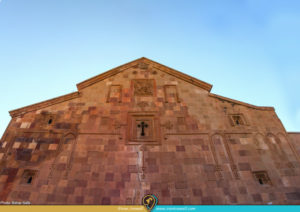
The church building is cylindrical and covered with a conical dome. This church is made of pink, red and white stones, which makes the church very impressive. There are seven watchtowers and five stone cylinders in the Church of St. Stephen like fortresses. Urartian, Parthian and Roman architecture is a combination that has given the entire building its current form.
The church measures approximately 15.85 by 22.37 meters and has two entrances. On the outside of the church is a domed bell tower.
The main church building has three parts:
- The church courtyard and the 16-sided dome
- Bell tower
- Daniel's Oven
Entrance door
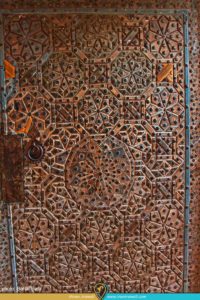
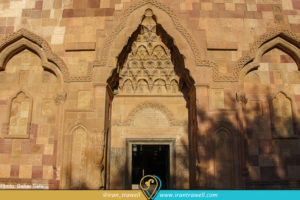
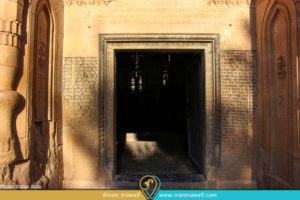
The beautifully carved door of the church will undoubtedly attract your attention. This door belongs to the Qajar era. It is a relic of the Qajar era. On the entrance door there is an inscription by Abbas Mirza in Persian script and its Armenian translation.
The church courtyard and the 16-sided dome
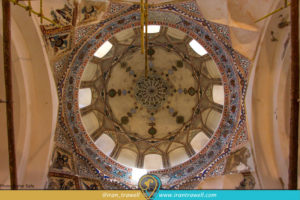
After the entrance to the Church of San Stefano, there is a sixteen-sided dome above the church. A beautiful dome decorated with beautiful geometric designs. Each side has a window in between that opens into the dome and the church courtyard, illuminating the space inside the courtyard with natural light.
The main courtyard of the church is built in the shape of a cross, measuring 21 by 16 meters, and has a porch and altar.
Bell tower
The bell tower is located in the southern part of the church building in two floors and on 4 columns. On its second floor, you can see a pyramid-shaped dome resting on eight smaller prism-shaped columns. At the tip of the pyramid-shaped dome of the bell tower, like the top of the main dome of the church, a metal cross is installed, the columns of the bell tower are made of red stone and the capitals are beautiful and artistic.
The front of the arches of this column is decorated with various relief motifs such as angels, crosses, bergamot, stars, and eight-petaled flowers.
Daniel's Oven
Saint Daniel was born in Syria in 410 AD and died in a village on the banks of the Euphrates after 80 years of asceticism and prayer. Daniel's Stove, also known as the Chapel of Saint Paul, is a hall attached to the northern wall of the church, which has a rectangular plan and its entrance is from the west side of the building. This section also has three important parts:
- Assembly hall; in the middle
- Oven; Eastern part
- Baptismal site; western part
Decorations of the Church of St. Stephen
The fact that this church is built in a beautiful and serene environment is a testament to its original beauty. Although you have to walk uphill to reach the church building, the good weather and walking among the trees make the journey enjoyable.
Its exterior walls are made of beautifully carved stones.
Iran Travel offer
Due to the mountain path and then the church stairs, visiting this place is not recommended for people with walking disabilities.
After your visit, you can shop at the nearby handicraft store.
After visiting this building, you can go to the stores in Jolfa and enjoy shopping at reasonable prices.
Visit the Church of St. Stephen
Address: East Azerbaijan, 17 kilometers west of Jolfa city and 3 kilometers from the southern bank of the Aras River, "Qezel Vank" neighborhood (Red Monastery).
Visiting hours: 9-18
Holidays: 14th of Khordad, 21st of Ramadan, 25th of Shawwal, 9th and 10th of Muharram, 28th of Safar
Entrance ticket: 25,000
Foreign tourist tickets: 150,000
Source: Iran Travel