British House of Commons Foreign Affairs Committee calls for designation of IRGC as terrorist organization
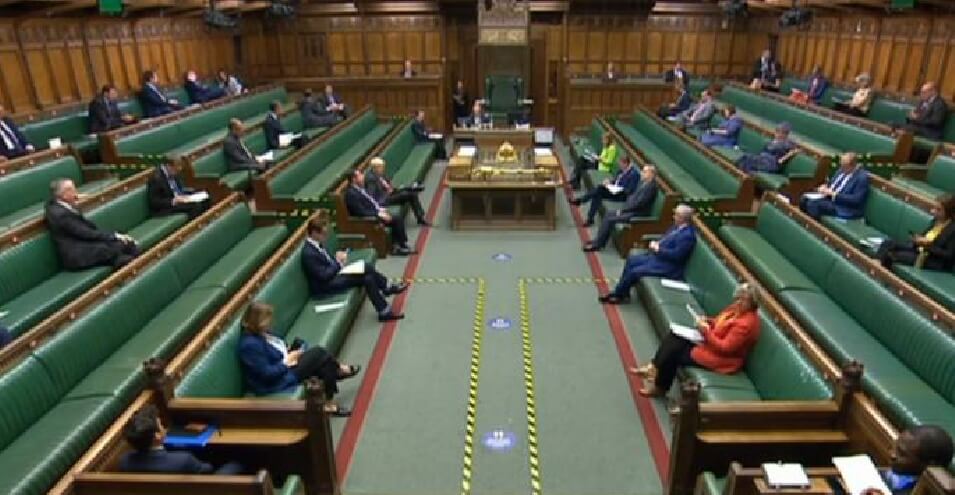
The British parliament's foreign affairs committee has called on the government to designate Iran's Revolutionary Guard Corps as a terrorist group. The MPs also called for new talks with Iran over its missile program and regional activities.
The British Parliament's Foreign Affairs Committee has called on the government to designate Iran's Revolutionary Guard Corps as a terrorist group. The committee, which includes members from both the Labour and Conservative parties, has officially described the detention of British-Iranian dual nationals in Iran as "state hostage-taking" and called on the government to do more for them, according to the Guardian newspaper.
The UK Parliament's Foreign Affairs Committee believes that the government's current approach to releasing dual nationals in Iran has not been effective. There are currently at least four dual British-Iranian nationals imprisoned in Iran, one of whom is Nazanin Zaghari-Ratcliffe.
"The British government must call the arbitrary detention of foreign nationals what it is: hostage-taking," said Tom Tugendhat, chairman of the committee.
The chairman of the committee said the charges, trials and sentences of British citizens imprisoned in Iran were “a mockery of the justice system.” He called the use of “young mothers and pensioners” as bargaining chips “unacceptable” form of politics.
The committee's report calls on the British Foreign Office to change its approach to negotiating the release of dual-national prisoners, including by pressuring Iranian President Hassan Rouhani to include a precondition for normalizing relations with Iran to respect human rights norms.
The British Parliament's Foreign Affairs Committee also called on Boris Johnson's government to use the Magnitsky sanctions laws (sanctions for human rights violations) to target human rights violators in Iran.
British representatives also called for the IRGC to be listed as a terrorist organization due to its “open and sustained support for terrorists and non-state actors who are active in undermining stability in the region.”
"The nuclear deal has collapsed"
Another part of the report by the British Parliament's Foreign Affairs Committee suggests that the "fractured nuclear deal" with Iran be renegotiated to add the necessary commitments to limit Iran's missile program.
The report states that the committee's assessment of the 2015 nuclear deal with Iran is that what remains of the agreement is only an "incomplete and failed deal," and it is stated that: "Of course, this assessment will not be welcomed in Tehran."
The authors of the report have called for amending the so-called "sunset clause" in the JCPOA and have also called for binding commitments to limit Iran's ballistic missile program and for increased inspection powers for the International Atomic Energy Agency to be included in the negotiations.
According to the so-called "sunset" clause, Iran will be able to increase enrichment centrifuges after 10 years (i.e. from 2025) and will be allowed to increase the volume of its less enriched uranium after 15 years.
Iran's regional activities
British MPs have also called on the British government to outline its long-term plans for how to address Iran's "widespread destabilizing activities."
The committee stressed that Britain is well-placed to consult with the United States and its allies in the Gulf to develop a joint strategy.
The British House of Commons Foreign Affairs Committee has rejected the US decision to withdraw from the JCPOA and impose a policy of maximum pressure on Iran, saying: "The disagreement on how to address the nuclear issue, particularly between the United States and the E3 group (Britain, France, and Germany), has not served Britain's interests."
According to the authors of this report, the US withdrawal from the JCPOA has left Iran with no incentive to engage with the West and has given Russia and China the opportunity to pursue their own agendas in the Middle East.
Members of the British Parliament's Foreign Affairs Committee believe that in the absence of determined leadership and comprehensive cooperation, there is a risk that Iran will turn more towards Russia and China to improve its economic situation, which would be less costly for Iran politically.
Source: DW