Trump's claim of the "collapse" of the Islamic Republic; Hormuz crisis and the collapse of Iranian oil exports
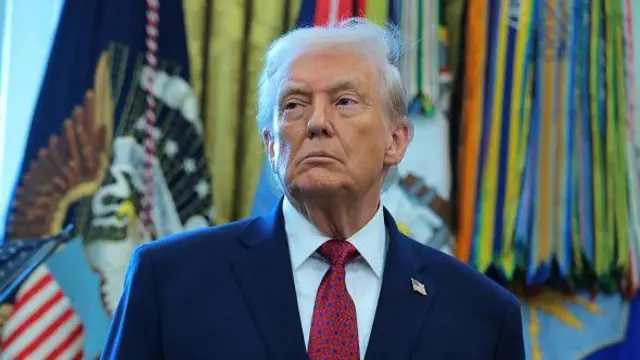
Donald Trump's claim of the "collapse" of the Islamic Republic has come at a time when the Strait of Hormuz crisis and the collapse of Iranian oil exports have placed unprecedented pressure on the country's economy.
Amid escalating regional tensions and growing economic pressures, the US President has claimed that the Islamic Republic of Iran is in a critical situation and has even sent messages to Washington about its internal situation; a claim that, although not accompanied by details, has attracted the attention of analysts due to its coincidence with developments on the ground and in the economy.
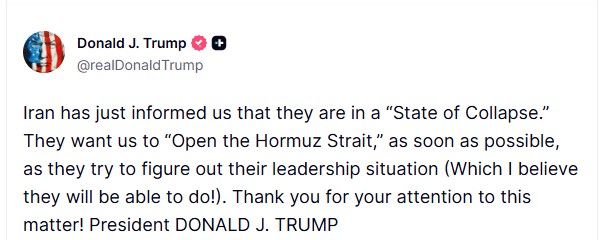
Donald Trump announced in a message on the social network "Truth Social": "Iran has just informed us that they are in a state of collapse. They want us to open the Strait of Hormuz as soon as possible, while they try to determine the status of their leadership (which I think they will succeed!)." These statements are made while no official explanation has been provided about the channel or content of this communication.
Meanwhile, the strategic Strait of Hormuz, one of the world's most important energy transport routes, has effectively become a crisis point due to the military actions of the Islamic Republic and the response of the United States. This vital passageway, which previously served as the passageway for a significant portion of global oil and liquefied gas exports, is now facing serious disruption.
In response, the United States has implemented a naval blockade of Iranian ports, a move that has had a direct and severe impact on Iran’s oil industry. Data from analytical institutions shows that Iran’s oil exports have suffered an unprecedented decline, from a level of nearly two million barrels per day to less than a third. This dramatic decline, coupled with restrictions on maritime transport, has effectively paralyzed the country’s export capacity.
At the same time, the crude oil storage crisis has also become a serious challenge. As storage capacity fills, Iran is forced to reduce production, and this trend is expected to intensify in the coming weeks. This situation has not only put pressure on the country's foreign exchange earnings, but could also lead to a large budget deficit in the coming months.
Experts believe that the full effects of the crisis will be delayed, as the oil sales cycle, from shipment to receipt of payment, takes several months. Therefore, although the pressures have already begun, the deeper financial consequences are likely to become apparent in the coming months.
In addition to these developments, ongoing military tensions and production declines in other countries in the region have also added to the complexity of the situation. However, what distinguishes Iran’s situation is the simultaneous combination of external pressures, blocked export routes, and structural problems in the domestic economy.
In such circumstances, the claim made by the US President (regardless of its accuracy or exaggeration) is a reflection of a crisis whose signs are visible in various economic and political spheres; a crisis that seems likely to take on wider dimensions if the current conditions continue.