The Tomb of Esther and Mordecai Reopens, Yet Its Security Remains Shrouded in Threat
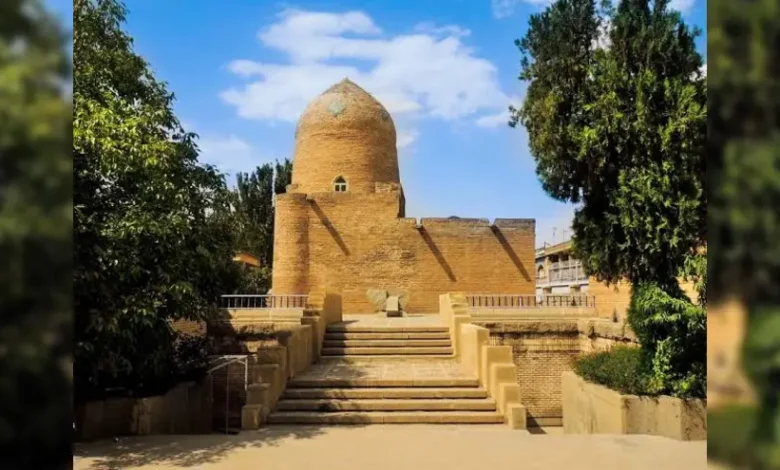
The historic tomb of “Esther and Mordecai” in Hamadan has reopened to Jewish pilgrims and visitors following the completion of restoration and reconstruction work; however, behind the news of this shrine’s reopening lies a history of arson, threats, and attacks that raises a serious question: Is the restoration of a building alone sufficient for religious minorities in Iran, or must security, freedom of pilgrimage, and the right to enjoy religious heritage also be guaranteed?
According to an announcement by the Tehran Jewish Society, the restoration of the tomb of Esther and Mordecai in Hamadan has been completed and the site is once again able to receive Jewish pilgrims. However, pilgrims wishing to visit must notify the Jewish Society at least one week before their trip so that necessary coordination for obtaining entry permits can be arranged.
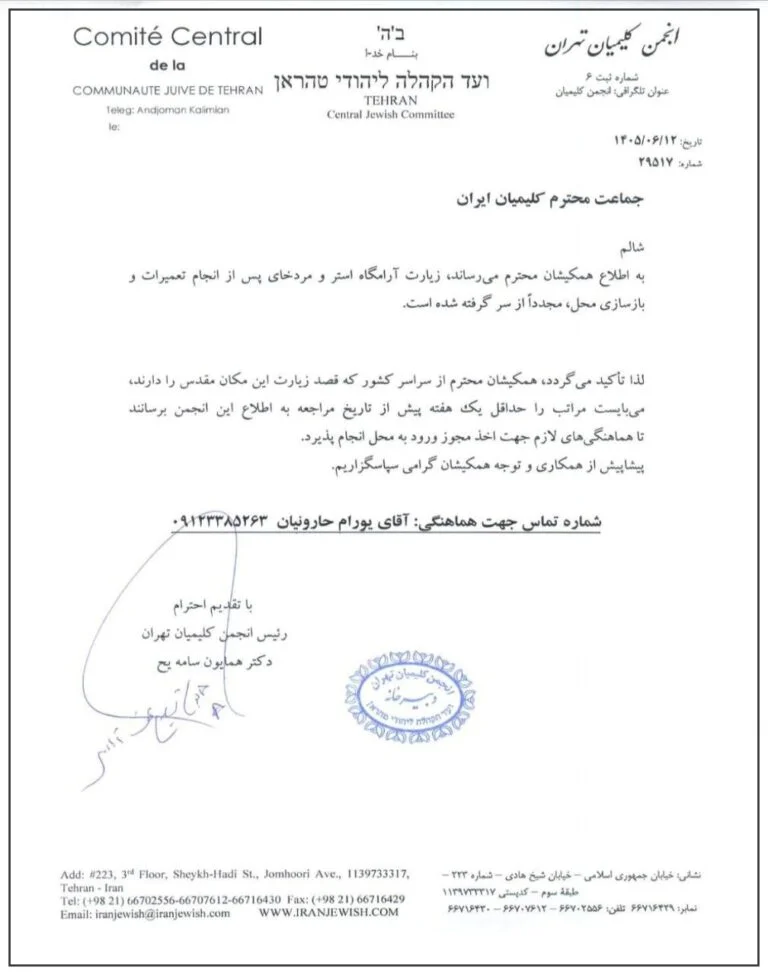
This requirement for security coordination may appear on the surface to be merely an administrative process, but alongside the history of incidents at this site, it presents a different picture; a picture of a shrine that, instead of being solely a place of prayer, pilgrimage, and preservation of historical memory, has for years been grappling with issues of security and restricted access.
According to Jewish tradition, the tomb of Esther and Mordecai is the burial place of Queen Esther of the Jewish court of Xerxes and Mordecai; two figures whose story is narrated in the Book of Esther in the Old Testament.
The significance of this place is not limited to the Jewish community. UNESCO’s file on the historical heritage of Hamadan also introduces the tomb of Esther and Mordecai as one of the Jewish heritage landmarks of the city. The tomb itself was registered in Iran’s National Heritage List in 1937 with registration number 291.
Therefore, the protection of this site cannot be considered merely an issue concerning a single religious minority. This structure is part of Iran’s multilayered history; a history in which Jews, Christians, Muslims, and other religious and cultural groups have each shaped part of the memory of this land.
However, concerns about the security of the tomb are not unprecedented. In April 2020, reports emerged of a fire at this complex. Local authorities at the time spoke of the limited extent of damage and the beginning of restoration work, and the cause of the fire was not definitively announced.
But one of the most serious incidents occurred in March 2024; when a video was released showing the throwing of incendiary materials and Molotov cocktails at the tomb. Local authorities announced that the perpetrators were being identified using CCTV footage, and reports indicated that no major damage was sustained to the main structure.
This attack occurred at a time when tensions between the Islamic Republic and Israel had escalated, and in some published accounts, the attackers’ actions were characterized as a retaliatory response to an attack on the Islamic Republic’s consulate in Damascus. But the important point is: Esther and Mordecai are not Israel; they are a Jewish shrine at the heart of Iran’s history.
Converting a religious and historical site into a target for political score-settling, by whoever does so, is nothing other than sacrificing heritage and the security of non-combatant citizens on the altar of political disputes. Being Jewish does not negate being Iranian.
The Iranian Jewish community is among the oldest Jewish communities in the world. The population of this community has decreased sharply in recent decades; various sources today estimate the number of Jews in Iran at around 8 to 10 thousand, though the figures vary.
This population decline is not merely a statistical figure; behind it lie generations of emigration, security concerns, social restrictions, and profound political and economic transformations.
In such circumstances, the preservation of places like Esther and Mordecai becomes even more important. When a community’s population shrinks, its synagogues, tombs, schools, cemeteries, and shrines are not merely buildings; they are custodians of part of a nation’s identity and memory.
If these few remaining sites are also to face threats, arson, or security restrictions, it is natural that questions about the future of religious minorities’ presence in Iran become more urgent. Iran’s heritage cannot be preserved selectively.
The Islamic Republic may speak of Iran’s historical diversity, but the real test is not in slogans, but in the practical protection of sites belonging to religious minorities.
The protection of a Jewish shrine should not be considered a special privilege. Just as a mosque, church, or Islamic shrine must be protected from violation, a synagogue or Jewish tomb must enjoy the same right.
From a Christian perspective as well, human dignity and respect for others are not contingent upon religion, ethnicity, or political stance. Scripture repeatedly calls humanity to peace, love, and the avoidance of revenge. One cannot speak of faith and morality while simultaneously allowing political differences to turn a religious community’s sacred sites into arenas of retaliation.
The reopening of the tomb of Esther and Mordecai is good news; but better news would be the day when a Jewish shrine no longer needs to pass through threats and security permits merely to remain open.
Iran’s heritage belongs to all Iranians, and security and freedom of worship are the rights of all citizens, regardless of religion or belief.