8 Baha'i citizens summoned in Birjand to face imprisonment
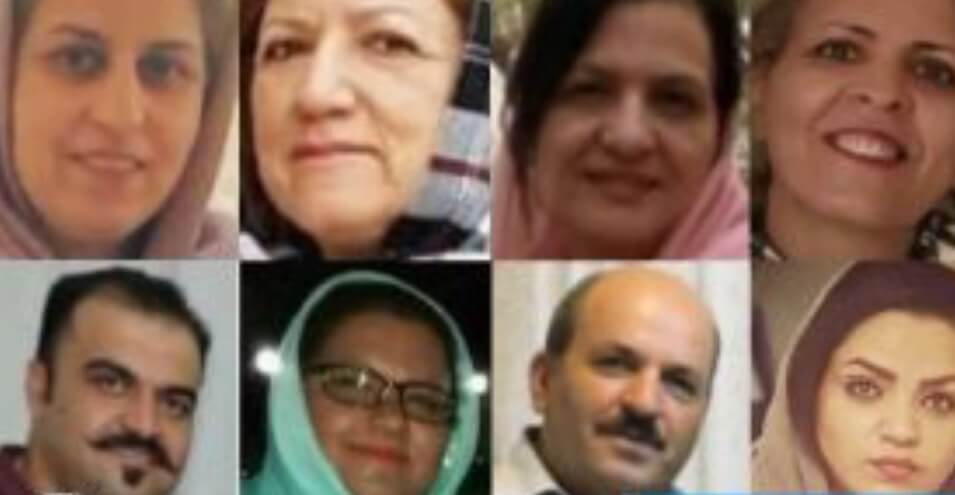
Atiyeh Salehi, Nasrin Ghadiri, Banafsheh Mokhtari, Farzaneh Deimi, Arezo Mohammadi, Ataullah Malaki, Roya Malaki, and Saeed Malaki, eight Baha’i citizens living in Birjand, were summoned to the Birjand Court of Appeals’ Enforcement Unit to serve their sentences. These Baha’i citizens were previously sentenced to a total of 11 years and 3 months in prison by the Fourth Branch of the Court of Appeals of South Khorasan Province in September of this year.
According to HRANA News Agency, the news agency of the Human Rights Activists in Iran, 8 Baha'i citizens living in Birjand were summoned to the Birjand Court's Sentence Enforcement Unit to serve their sentences.
Atiyeh Salehi, Nasrin Ghadiri, Banafsheh Mokhtari, Farzaneh Deimi, Arezo Mohammadi, Ataullah Malaki, Roya Malaki, and Saeed Malaki are eight Baha’i citizens who were summoned to serve their sentences in separate summonses. They have been told to report to the Birjand Court’s Sentence Enforcement Unit within ten days of receiving the notice.
These citizens were previously tried in the preliminary stage along with another Baha’i citizen named Rahmatullah Deimi and sentenced to a total of 51 years and 8 months in prison. Based on this verdict, Atiyeh Salehi, Ataullah Malaki, Farzaneh Deimi, Nasrin Ghadiri, Banafsheh Mokhtari, Arezo Mohammadi, Saeed Malaki, and Roya Malaki were each sentenced to 6 years in prison by Branch 2 of the Birjand Revolutionary Court, headed by Judge Hojjat Nabavi, and Rahmatullah Deimi was sentenced to 3 years and 8 months in prison due to his advanced age.
After the defendants objected to the verdict, Branch 4 of the South Khorasan Provincial Court of Appeal, headed by Judge Ebrahim Ramezani and counsel Hamid Arabzadeh, sentenced Nasrin Ghadiri, Farzaneh Deimi, and Banafsheh Mokhtari to 15 months in prison each on the charge of “membership in an illegal organization that undermines the security of the errant Baha’i sect,” on September 8, 2020, and sentenced Arezo Mohammadi, Ataullah Malaki, Roya Malaki, Atiyeh Salehi, and Saeed Malaki to 18 months in prison each on this charge. The court also acquitted Rahmatullah Deimi of the charges.
In addition, the one-year prison sentence for all defendants on the charge of “propaganda in favor of the Baha’i organization as a group and organization opposed to the sacred system of the Islamic Republic” was also dropped. The court stated the reason for this as “because this action of theirs resulted in a conviction under the first charge, therefore this action does not carry a separate penalty.”
Earlier, an informed source told HRANA about how these individuals were arrested: “During the celebrations of the 200th anniversary of the birth of Baha’u’llah, the prophet of the Baha’i faith, Baha’is were arrested and their businesses sealed in various cities in Iran. The city of Birjand was also not spared from these attacks on the Baha’i community, and in late October 2017, the security forces of Birjand County searched the homes of these individuals and confiscated a number of their belongings. These citizens were summoned to court twice in 2019 for questioning, and their trial date was May 2, 2020. On May 2, they were sent a text message with a notice of the verdict, and on May 3, their verdict was made available on the website.”
This informed source also told HRANA about the conditions of Nasrin Ghadiri, who is not actually a citizen of this city: “Ms. Ghadiri is 60 years old and lives in Mashhad. She only lived in Birjand temporarily from 2014 to the end of 2017 to take care of her father, who was ill. In October 2017, when the Intelligence Department went to inspect the homes of Baha’is, Ms. Ghadiri was in Mashhad and not in Birjand. However, when the security forces visited her father’s house in Birjand, they confiscated her personal belongings and took her away. She had also been arrested and imprisoned in 2019 and 2020.”
Baha'i citizens in Iran are deprived of freedoms related to religious beliefs. This systematic deprivation occurs despite the fact that, according to Article 18 of the Universal Declaration of Human Rights and Article 18 of the International Covenant on Civil and Political Rights, everyone has the right to freedom of religion and to change their religion with conviction, as well as the freedom to manifest it, either individually or in community with others and in public or in private.
According to unofficial sources, there are more than 300,000 Baha'is in Iran, but the Iranian constitution only recognizes Islam, Christianity, Judaism, and Zoroastrianism, and does not recognize the Baha'i religion. For this reason, the rights of Baha'is in Iran have been systematically violated over the past years.
Source: HRANA