Masoumeh Ebtekar's claim in response to the tablet program made headlines on Twitter; protest against the lies and hypocrisy of Islamic Republic officials
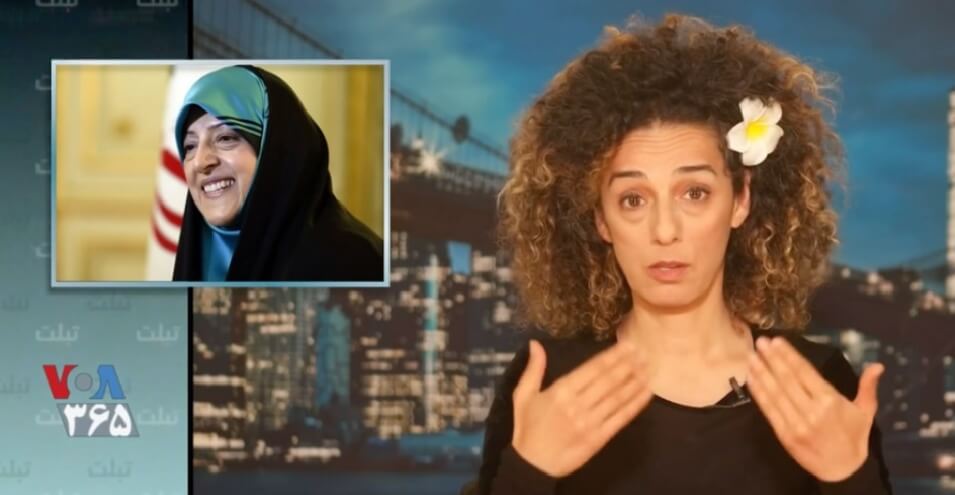
After Masoumeh Ebtekar denied the Voice of America's Tablet program's report about her son and said that he was in the United States to study like other young people, a number of prominent Iranian women and social media users reacted to her remarks.
Masoumeh Ebtekar, who played a prominent role in the occupation of the US embassy in Tehran and the hostage-taking of its staff, claims that her son will return to Iran after completing his studies, but Masih Alinejad, a journalist and host of the Tablet program, says that Ms. Ebtekar's son has finished his studies, but he is not willing to return to Iran.
Former US State Department spokesman Alan Ayre wrote on Twitter, referring to a video of Ebtekar's speech in which he said how much he should pay: "Masoumeh Ebtekar paid?... It's really funny."
Pouya Bakhtiari's mother also addressed Masoumeh Ebtekar in a video message and asked why she, who climbed the wall of the US embassy and called it "occupying a spy's den," sent her child to America?
She, who lost her son to security forces during the protests last November, asked: "You are sending people like my son underground to gain wealth so that you can send your children to Western countries to live." With the publication of Ms. Ebtekar's words, a number of Iranian women and artists living in the United States also reacted to them, considering her words a clear contradiction in the behavior of the Islamic Republic's officials towards their children and the Iranian people. Among them, Roya Hakakian, a writer, poet and journalist, wrote in a message on Twitter that many of the facts about the hostage-taking at the US embassy in Iran have not been stated or have been stated in reverse.
He added: "The fact that the son of Masoumeh Ebtekar, who played a role in the hostage-taking, is in America while those who do not share his views on the hostility towards America and do not express it are deprived of the opportunity to present their art in Iran is a profound injustice."
Nina Ansari, a writer and historian, also referred to Masoumeh Ebtekar's words in a message on Twitter, calling them the impudence of a woman who was the spokesperson for the hostage-takers occupying the US embassy and who recently called the US government a terrorist government.
Two Iranian female artists living outside Iran also reacted to Masoumeh Ebtekar's statements. One of them said: "Ms. Ebtekar! It's great that you, who climbed the wall of the American embassy and took its employees hostage, can travel to America and return to Iran easily and without worry. But I, who have not been and will not be politically active and only speak the truth in the songs I sing, cannot return to Iran and see my family because if I return, I will face prison or even possible execution."
He then asked Masoumeh Ebtekar why there was such a contradiction.
Another artist said in a video message to Masoumeh Ebtekar: "You have not paid any money for your work. I paid money to be sentenced to prison for singing, forced to leave my country and seek asylum in another country, and I cannot return to Iran to visit my family."
She added that it is the grieving mothers, political prisoners, and all Iranian women who have paid the price.
Earlier, US Secretary of State Mike Pompeo, in response to Iranian users of social media who asked about the presence of children of Islamic Republic officials in the United States, said : "The same people who are destroying the lives of the Iranian people are sending their children abroad because they are rich; because they have stolen your wealth and taken your money through corruption; they [Iranian regime officials] have harmed the good and hardworking people of Iran."
He added: “They have taken your money and now they are sending their children abroad to study, to shop, and to enjoy the freedoms that we have in the United States. They know that their country is no longer good enough for them. The [Iranian] authorities say that the country is good for you people, but it is not good for their families.”
The presence of children of Islamic Republic officials in the United States, Canada, and European countries comes at a time when the Iranian regime's inefficiency, hostility toward those same countries, and corruption have faced the country with severe inflation and economic recession, making life extremely difficult for the middle and low-income classes.
Source: Voice of America