*Corporal punishment has hindered students from speaking out and defending themselves, as well as their development*
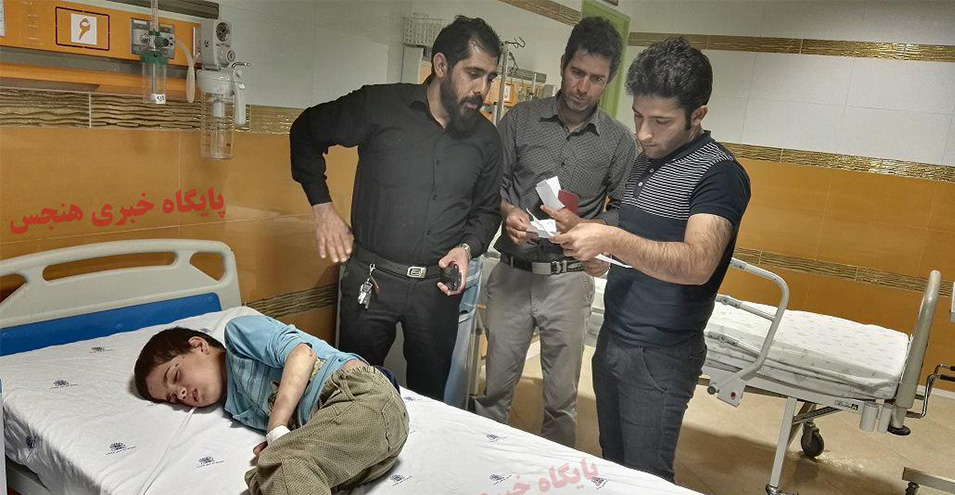
Corporal punishment of students has always been considered a red line in education.
Today, everyone knows that correcting the behavior of misbehaving students through physical punishment is not only ineffective, but also has a negative impact on the students' psyche and makes them avoid lessons and homework. Despite these proven principles, news of corporal punishment of students from schools around the country is still occasionally reported, surprising people and officials.
According to FCNN, a large part of behavior is learned, but a percentage of it is also innate and depends on the teacher's personality. We can consider the punishment of students as part of the chain of violence in society, but we cannot accept that a teacher, like a teenage student, engages in violence under the influence of a certain television series or the public atmosphere of society.
If a teacher is a mature and educated person who has acquired the necessary qualifications to attend school and educate and train students, if a teacher has studied psychology and educational sciences at university and in-service courses and knows how to control his or her anger in critical situations, if a teacher has such good mental health and balance that he or she does not take revenge on the student for problems in the class, such as low wages or difficult living conditions and school deficiencies, if a teacher knows that the answer to violations such as talking, not knowing the lesson, shaking, laughing, not having a book with him, etc. is not beating, it is incomprehensible that a teacher, at a time when the unwritten law of corporal punishment is becoming increasingly apparent in classrooms, still ignores dialogue and corrective behavior and uses force to discipline students.
The Student Discipline Law provides conditions for school administrators to discipline, including reprimands, verbal warnings in the presence of students, class changes, written warnings, temporary expulsions, and transfers to another school.
On the other hand, there is a big question mark as to whether the Ministry of Education is unaware of what is happening inside schools, and ultimately the media must step in and expose such unfortunate problems so that education can take action.
The school executive regulations explicitly address this issue and state that corporal punishment in any form is prohibited in education; if someone violates the law, they will be fined and referred to the Administrative Violations Board, according to the law.
As stated in the school's executive regulations, no school official should impose corporal punishment on students, and this is prohibited by law in any form or under any title.
The law explicitly states that this punishment must be enlightened and informed, and that the student's mental and physical conditions, age, and social status must be taken into account, and that the punishment must be proportionate to the offense the student has committed and must not be intentional.
The school's executive regulations also state that the student must be provided with a method of making amends for the violation and asked to make up for his mistake and violation, and that this should not be done in front of a group, which is also stated in the aforementioned regulations.
Regarding the sentence for those who inflict corporal punishment on students, including school principals, supervisors, teachers, and school officials, given that the law prohibits this issue and considers it a violation, the Administrative Violations Review Board must make a decision for them and issue a sentence; this sentence includes a warning, a reprimand, a reprimand, or anything else the law decides for it.
*The school disciplinary code is from 13 years ago.
One thing to consider is that all of these laws written regarding the executive and disciplinary regulations of schools date back to 1990, and since then, no revision has been made in this regard. There are still doubts in some minor cases that require a revision of this law after 13 years.
Today, when all education programs are in line with the Fundamental Transformation Document and all upstream documents, there is a need for education to reconsider the issue of school executive and disciplinary regulations.
A video has been posted on social media showing a teacher beating students with a belt in Shahriar city. This video is not an exception to the rule, but from time to time similar examples of this incident are reflected on social networks, creating a wave of hatred and disgust. For our generation, this disgust is a sign of change, and a structural change in the value system of society.
But there are other reasons that exacerbate the problem;
The glorification of violence in various forms in public forums, the huge class gap and the growth of marginalization that leads to widespread norm-breaking and fuels the culture of gambling and mischief. A teacher who teaches on the outskirts of cities, and that too with minimal salaries, without wanting to know that he cannot force rebellious and disobedient children from poverty to voluntarily submit to discipline by other methods. Basically, he is not trained to find communication skills and even if they want to, he does not know what to do. The system is also not sensitive to this issue until it is pressured by public opinion, and basically, with the looting of the teachers' reserve fund, we understand that the attention of senior managers is elsewhere and it is the work of civil society organizations and social networks that raise the level of sensitivity of families, students and even school officials to the issue in the outskirts of cities. But the problem can be solved in another way, which is by establishing teachers' own trade union organizations that can both defend their rights and increase their level of awareness.
The most important thing is to realize that both the teacher and the punished student are victims and that their behavior is rooted in thousands of factors that secretly and openly create a negative event. A child who is punished in school may also be exposed to violence on the street and in the family, just as a teacher is constantly punished with the whip of poverty and deprivation and inevitably vents his anger in his workplace. Without fighting black poverty and empty tables, the problem of punishment cannot be solved in isolation, although with this understanding, efforts in this regard cannot be stopped. Until a child who suffers from poverty reaches adolescence, the only identity he can acquire is arm strength and its display, and this makes the job difficult for schools. It is the job of society to give these children the opportunity to acquire an identity in other ways, such as playing sports. Instead of providing this opportunity, schools promote stereotypical propaganda for official values, which mostly bores its audience.
Hoping for a day when peace, friendship, and kindness will reign in human societies.