The dilemmas of religious freedom in Iran today
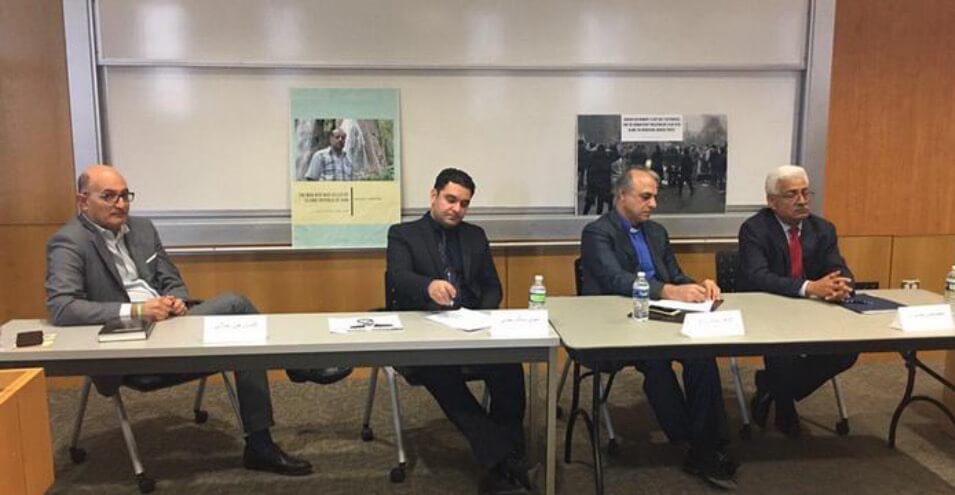
On Sunday, December 8, a ceremony was held at George Washington University, organized by the Iranian Republican Association (Washington, DC), the main topic of which was the state of religious freedom in Iran today. A report from the ceremony.
At the beginning of the ceremony, a minute of silence was declared in honor of the victims of the November 2019 protests. The first speaker of the ceremony was Jack Haley, an American human rights activist who is known in the United States as Mr. Human Rights. In a short speech, Jack Haley emphasized that the solution to combating human rights violations should be taken from those who themselves suffer from human rights violations. He encouraged the attendees to have a great goal and work to defend the Universal Declaration of Human Rights as a progressive document.
Discrimination against Sunnis is institutionalized in the law.
Baloch and Sunni activist Mohammad Hassan Hussainbar spoke harshly about the violation of Sunni rights in Iran. He emphasized that there are no official statistics on the Sunni population in Iran, but it is estimated that about a quarter of the Iranian population is Sunni. Hussainbar said that despite the large population, Sunnis are deprived of the right to be elected to high positions such as the leadership and presidency. He emphasized that in practice, they have not even allowed a Sunni minister to be elected in all these years. Even for employment in government departments, questions about Shiite jurisprudence and guardianship of the jurist are asked in the selection exam, and in many institutions, including the intelligence and military, the employment of Sunnis is practically prohibited. Hosseinbar pointed out that discrimination is institutionalized in the constitution and applicable laws, and said: "According to the constitution, the official religion of the country is Shiite Islam, which is unchangeable forever."
Hossein Bar continued by saying that in the metropolis of Tehran, Sunnis are not allowed to build a mosque and Sunnis are encouraged in various ways to change their religion to Shiism. He recalled that a few years ago, the oldest Sunni mosque in Mashhad was destroyed overnight and even a Friday imam who went to Afghanistan was assassinated in Herat. Hossein Bar also mentioned Mawlavi Fazlur Rahman Kohi, who officially supported the recent public protests and was arrested along with seven of his supporters, and has not been heard from for two weeks.
Iran ranks fifth among countries that persecute Christians
The ceremony was continued by Pastor Farhad Sabqroh, who converted from the Sabean Mandaean religion to Christianity. He has a long history of arrest and persecution in Iran, most recently in 2011 and was forced to leave Iran.
At the beginning of his speech, Pastor Farhad Sabqroh mentioned the victims of the recent protests and said it is strange that we still have to gather for this gathering in the 21st century when many people in Iran are persecuted and oppressed just for their beliefs. He emphasized, "What rights can I, a Christian, defend when our fellow countrymen are crying blood over human rights violations?" As a Christian and a member of Iranian society who is also wounded, what can we say except to want this situation to end. Today, many religious minorities have chosen to emigrate from their homeland due to pressure.
Sabqroh went on to say that Iran ranks fifth among countries that oppress and persecute Christians. Citing a long list of those who have lost their lives in Iran for their Christian beliefs, he said that in the past year alone, more than 170 Christian converts have been arrested and four have been sentenced to death. Many have also been denied university education or career advancement.
Pastor Sabqroh said that many churches, especially Protestant churches, have been closed. Only churches that worship in Armenian or Assyrian are allowed to operate, and the one or two remaining Persian-speaking churches are also subject to the presence of a representative of the Ministry of Intelligence at their prayer meetings. The establishment of house and underground churches is also prosecuted as an act against national security.
Sabqroh concluded by saying, "I was continuously interrogated for 17 years, but I have no wish other than peace, security, and freedom for our country, Iran."
Mohammad Ali Taheri is now under house arrest after years in prison.
Mehdi Sang-Safidi, a teacher of the Arfan Halgheh and a student of Mohammad Ali Taheri, was the other speaker at the ceremony.
Playing a clip about the situation of this group and Mohammad Ali Taheri, he said that according to government sources, one percent of the Iranian population follows the Halgheh mysticism; a group that has been suppressed and attempts to eliminate their spiritual leader Mohammad Ali Taheri began ten years ago. Sang-Safidi emphasized that I am here today as the voice of Mohammad Ali Taheri, the Halgheh mysticism group, and people who strive to fight oppression and seek justice.
The speaker introduced Mohammad Ali Taheri, the founder of Erfan Halgheh, and said that his spiritual insights began many years ago and after a while he began public education. However, in the 1980s, security agents at the Tharallah camp repeatedly arrested Taheri, tortured him, and eventually imprisoned him. He remained in prison until May of this year, after which he has been under house arrest.
Sang-Safidi also emphasized that during this period, many of his students were also arrested and tortured, and HRANA News Agency mentioned 300 of them by name, but our estimate is more than a thousand. He concluded by saying that today is an era of confrontation of ideas, and one cannot fight a war of ideas with swords.
Iranian society is transforming and responding to the persecution of Baha'is
Kavian Sadeghzadeh Milani, a physician and human rights defender from the Baha'i faith, was the last speaker at the ceremony. Referring to Article 12 of the constitution regarding the official religion of the country, he said that even in areas where Sunnis are in the majority, apartheid and religious discrimination are common. Milani said that of course, religious apartheid also has different layers, and Article 13 mentions the Christian, Jewish, and Zoroastrian religions, but does not mention religions such as Hindu and Buddhist. He also said that Article 14 of the constitution states that the government and the people are obligated to treat followers of other religions with justice and equity, but there is no mention of rights, and justice and equity are relative and interpretable concepts. Milani emphasized that all of this is in conflict with the principles of human rights and an open and democratic society without religious persecution.
Referring to the persecution of Baha'is at the beginning of the revolution, Milani said: "My father, who was a leader of the Baha'i community, was kidnapped when he was a child and no news has been received of him, and not even his body was returned to us." He continued: "At that time, no one in the Iranian intellectual and political community raised any concerns, but fortunately today the Republicans are holding a meeting on this issue. This shows that we have changed, Iranian society has changed, and perhaps it is because of the cruelty and cruelty of the Islamic Republic that we have gone through the path of change that Europe took in several hundred years so quickly."
Milani concluded his speech by saying, "All of us who have been persecuted demand that those who seek power in tomorrow's Iran learn from this period and be responsible." He also emphasized that in Iran, even many Shiites do not have freedom of speech and writing and are persecuted.
Secularism bound by democratic standards is the solution to the problem.
At the end of the ceremony, the host of the program read out a statement from the Republican Association (Washington, DC) on the occasion of International Human Rights Day. Part of the statement reads: "Until secularism bound by democratic standards is achieved in Iran, the problems of the victims of the lack of religious freedom in Iran will not be fundamentally resolved. Although believers in other religions and mystical sects mostly do not have political claims and only want to exercise their rights, the characteristics of the power structure of the Islamic Republic, the de-religiousization of society, and the decline of Shiite believers have made the exercise of their rights a practical threat to the survival of the system."
The final statement also states: "Therefore, the answer to the problems in this area is ultimately political, and we believe that a peaceful transition to democracy based on cultural pluralism can solve the problems in the area of religious and ideological freedoms. Therefore, pro-democratic political forces, as well as those advocating religious and cultural tolerance, are expected to pay more attention to the problems and bottlenecks in the above area in their programs and positions."
Source: DW