The "Stone Age" Threat: Behind Trump's Political Goals in the Shadow of Tensions with Iran
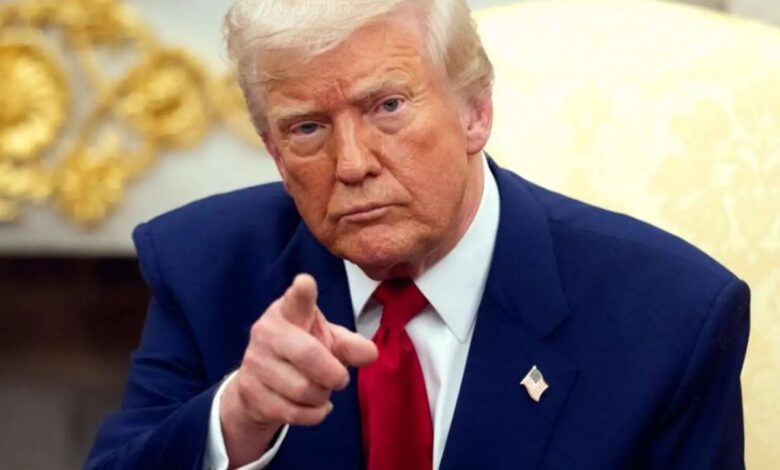
The "Stone Age" threat in Trump's words seems to be a tool for advancing political goals and controlling public opinion, rather than a strategic signal to overthrow the Islamic Republic.
Donald Trump's recent speech, following the escalation of tensions with Iran, seemed more like a sign of a complex political and media game than a clear declaration of a military stance. In the speech, broadcast from the White House, he claimed that his key goals, including weakening Iran's naval and air power and crippling its missile and nuclear programs, were almost complete, a claim that was immediately accompanied by a sharp threat: "We are going to hit them very hard in the next two to three weeks and we are going to take Iran back to the Stone Age."
This dual tone (declaring imminent success while simultaneously threatening to escalate attacks) is seen by many analysts as not a coherent military strategy, but rather part of a psychological pressure and public opinion management scenario. Such language has been seen before in Trump's political approaches, where maximal threats have been a cover for goals beyond the battlefield.
The remarks sparked a sharp international backlash. China called the actions “illegal” and warned of their consequences for regional stability. Russia, describing the remarks as “irresponsible,” expressed concern about the escalation of tensions. The reactions show that Trump’s remarks have affected not only Iran but also broader geopolitical equations.
But what is more striking than the threats themselves are the significant silences in the speech. Trump made no mention of the Strait of Hormuz, a vital chokepoint through which much of the world’s oil passes. This silence is no accident. Any direct reference to the region could have shaken global energy markets and sent oil prices soaring, putting economic pressure on American consumers—a serious risk for a politician who has always insisted on controlling fuel prices.
Also noteworthy is the lack of mention of Iran’s uranium enrichment status. This deliberate omission could be an attempt to avoid undermining the “victory” narrative. Acknowledging the continuation or progress of Iran’s nuclear program would effectively call into question claims of military success and might even push Tehran to adopt more aggressive positions.
Global markets were quick to react to these contradictions. Rising oil prices, volatility in Asian stock markets, and a strengthening dollar all suggest that Trump’s message was not only unclear, but also injected uncertainty into the global economic climate. Some analysts have described the situation as a “mixed message”: a combination of a declaration of victory and a threat of a wider war.
A key question arises: Is the real goal of these threats simply to change behavior or even topple the Islamic Republic? The evidence suggests the answer is no. Trump’s pattern of behavior in recent years, from negotiations with North Korea to trade disputes with China, shows that he often uses threats as a bargaining tool, not necessarily a prelude to final action.
In fact, the "Stone Age" threat can be seen as part of a multi-layered strategy: on the one hand, creating psychological pressure on Iran to bring it to the negotiating table, and on the other, demonstrating power to domestic audiences in the United States, especially in an environment where foreign policy has become a tool for electoral campaigns.
This approach, while it may have short-term propaganda gains, could lead to further instability in the region and even a decline in the trust of international allies in the long run. Using threatening language without a clear roadmap will not only not solve the crisis, but will also complicate it.
Ultimately, what emerges from this speech is not a specific plan to end the crisis, but a calculated attempt to manage multiple fronts simultaneously: pressure on Iran, control of global markets, and influence domestic public opinion. Threats, in this context, have become a tool of politics rather than a tool of war.