The Islamic Republic has called the Christian faith a security threat and has gone to war against them under the label of "espionage."
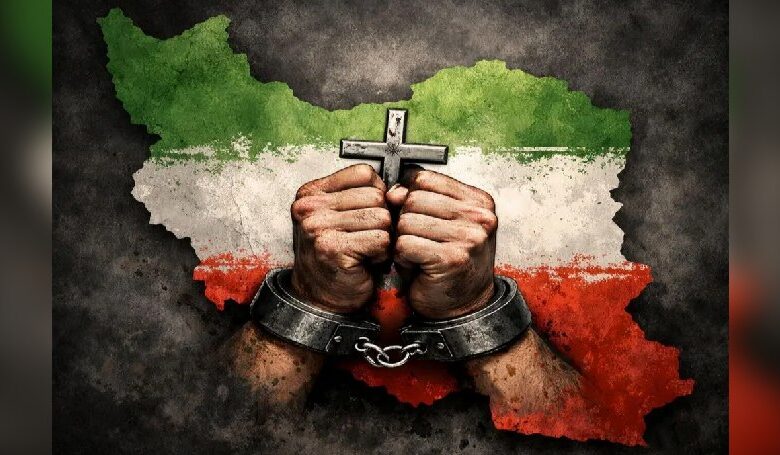
The arrest of Christians on security charges and labeled as espionage is the latest report from global Christian organizations of the Islamic Republic's escalating organized repression against these citizens.
In a new and detailed report on the situation of Christians in Iran, four international human rights organizations, Article 18, in collaboration with Open Doors, World Christian Solidarity Worldwide, and Middle East Watch, have published their eighth annual report, which paints a dark and brutal picture of the organized repression of the Christian community in 2025.
The report, titled “Victimization,” focuses on the unprecedented increase in arrests of Christians, especially converts, following Iran’s 12-day war with Israel, on charges of “espionage,” “Zionist Christianity,” “abduction by aliens,” and “propaganda against the regime,” all without any credible evidence.
This report was published on February 19, coinciding with the anniversary of the murder of "Aristotle Sayah," an Episcopal priest who was murdered in Shiraz eight days after the establishment of the Islamic Republic.
According to this "Victimization" report, the Islamic Republic has increased pressure on Christians to unprecedented levels in 2025:
- 254 Christians were arrested in 2025 on charges of religious beliefs or activities, almost double the number from the previous year.
- The number of people sentenced to prison, exile or forced labor more than doubled (57 people compared to 25 in 2024).
- At the end of 2025, 43 people were serving sentences and at least 16 were in pretrial detention.
- The total sentences issued in 2025 were over 280 years in prison, an increase from 263 sentences the previous year, indicating a trend toward harsher sentences.
- At least 11 Christians have been sentenced to more than 10 years in prison, and sentences of exile and social exclusion (deprivation of medical services, education, or work) have also been issued.
These statistics show that the Iranian regime has not only detained civil society activists and Christians more widely, but has also systematically become stricter in enforcing punishments.
The report emphasizes that the new wave of arrests intensified after the Islamic Republic's 12-day war with Israel in June 2025, when security officials cleverly linked the domestic wave of repression to the external conflict, portraying Christians as "trained elements" or "foreign agents."
In many cases, state media showed video footage of gatherings of Christians abroad along with their religious books, presenting it as evidence of Bible smuggling and “anti-national security” activity.
According to this report:
- The use of Articles 500 and 500 of the Islamic Penal Code, which consider Christian religious activities to be "propaganda against Islam," has increased significantly and can carry up to 10 years in prison.
- Persian-speaking Christians are denied the right to freely hold religious services in official buildings and are forced to gather in house churches, which are often targeted by security forces.
- The Bible in Persian has been confiscated many times during house searches and used as evidence against them in court.
- The Islamic Revolutionary Guard Corps (IRGC), an institution that is on the European Union's list of terrorist organizations for its crackdown on recent nationwide protests, has played a more prominent role in the arrest and interrogation of Christians.
- Activities abroad, such as attending religious services in Türkiye, are used as “evidence” against detainees.
The published report also notes that the repression is not only limited to the Christian community, but that by the end of 2025, thousands of Iranian citizens, including at least 19 Christians, had been killed in response to nationwide protests; a situation that the international community has described as "barbaric."
In the final section of this report, a set of recommendations are made to the Iranian government and the international community, including:
- Reopening of the Bible Society, which has been closed for more than 35 years.
- Unconditional release of Christians and other religious minorities detained for their beliefs.
- Reopening closed churches and ensuring freedom of worship for Persian-speaking Christians.
- Diplomatic and legal pressure on Iran to adhere to international obligations on freedom of religion and belief.
- Promoting a fair and humane process for Christian asylum applications in other countries.
- Including the situation of Christians in reports by the United Nations and human rights institutions.
This new report not only paints a clear picture of the increasing repression of Christians in Iran, especially in the wake of regional tensions, but also shows that this repression is part of a broader structure that has all but destroyed religious freedom and human rights in the country.