Reporters Without Borders: Repression of Iranian Journalists Intensifies
Reporters Without Borders has reported new cases of arrests and convictions against Iranian journalists. An official from the organization said that “the Human Rights Council must take more serious measures to protect and defend journalists.”
Reporters Without Borders has expressed concern over the continued repression and arrest of journalists in Iran. In a new statement, the organization referred to the dire human rights situation, including freedom of information, in Iran, as reflected in the new report by UN Special Rapporteur Javed Rehman, and noted that new cases of repression and arrest of journalists have occurred shortly after the publication of this report.
Reporters Without Borders points to the conviction, arrest, and bail of five journalists.
Mohammad Musaed is one of these journalists, who was sentenced to four years and nine months in prison on September 2. Musaed wrote in a tweet that the court, in justifying this sentence, had accused him of “slandering,” “creating a crisis,” “inciting an empty-minded audience,” and “undermining the foundations.”
Mosaed was arrested on November 8, 2019, the first day of the internet shutdown in the country, after posting a tweet about it, and was released on December 7 after posting bail.
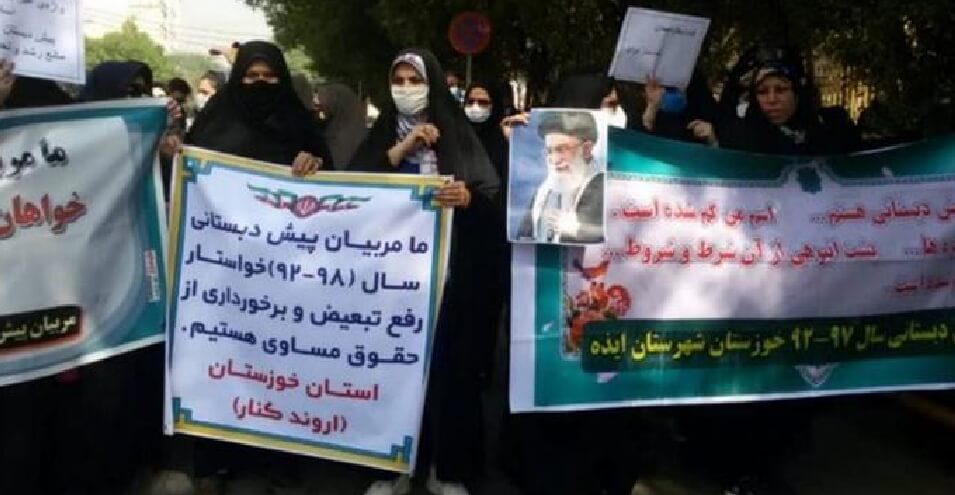
Another journalist recently arrested is Kowsar Karimi, according to a statement from Reporters Without Borders. Karimi is a reporter for the official Mehr news agency (affiliated with the Islamic Propaganda Organization) who was arrested on August 28 while trying to cover protests in the village of Abolfazl, south of Ahvaz.
The people of this village were protesting against the actions of the Mostazafan Foundation to demolish their homes. An official of the Islamic Propaganda Organization released Kausar Karimi on bail on the same day as the release of the health worker, but Mehr News Agency “has been threatened that if it continues the investigation, they will order the summoning of the agency’s CEO.”
“Protest against the regime; further repression of journalists”
Babak Tahmasebi is another journalist who, according to a statement from Reporters Without Borders, has recently learned that Branch 17 of the Ahvaz Court has upheld a two-year prison sentence and 74 lashes. Tahmasebi was charged with “spreading lies” and “insult and defamation” following a complaint by officials of the National Drilling Company and for his reports on the precarious living conditions of the company’s workers.
The RSF statement then refers to the case of a Kerman journalist named Amirreza Teymouri, who, as a reporter for the Tabnak website, was summoned to the FATA cyberspace police following a complaint by a city representative and head of the parliament’s economic commission, and after questioning was charged with “spreading lies with the intention of disturbing public opinion.” The journalist has been released on bail pending trial.
The latest case in the statement by Reporters Without Borders is the case of Gonbad-Kawasi journalist Aman Mohammad Khojamli, who was sentenced to a fine of one million six hundred thousand tomans by the Court of Appeals on charges of “spreading lies” and “disturbing public opinion.” The journalist was brought to trial for publishing material about the economic crisis and following a complaint by security agencies. He had previously been arrested in February 2019 and released on bail.
Reza Moini, head of the Iran and Afghanistan office of Reporters Without Borders, said about the recent arrests and convictions of journalists that “protests against the regime have led to further repression of journalists,” and expressed the expectation that after the shocking report of the UN Special Rapporteur, “the Human Rights Council must take more serious measures to protect and defend journalists.”
The poor state of press freedom and the obstruction of conditions for journalists to work have been the subject of numerous reports by human rights groups and freedom of expression advocates, including Reporters Without Borders. In the organization's latest World Press Freedom Index, Iran is ranked at the bottom of the list, 173rd out of 180 countries.
Source: DW