Iranian experts optimistic about the restoration and replenishment of Lake Urmia
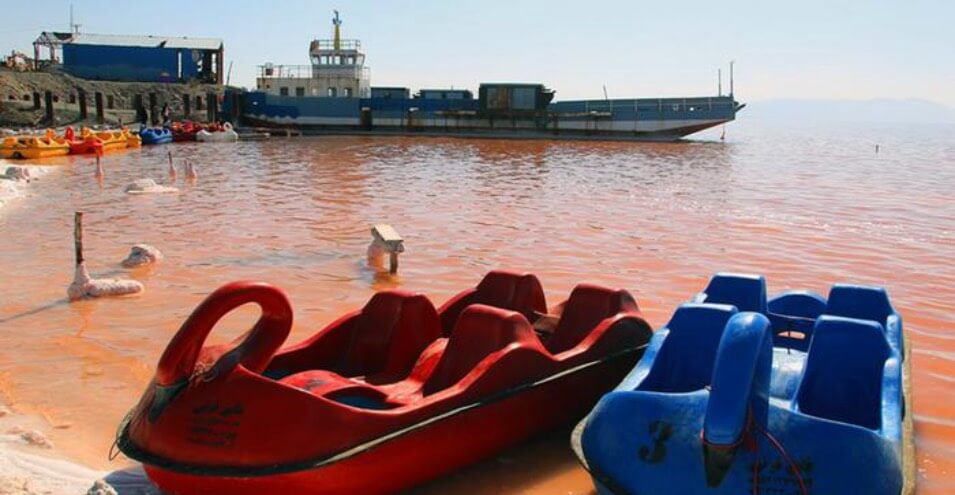
The water level of Lake Urmia has risen by more than a meter after torrential rains. The population of Artemia and single-celled algae in the lake has increased, and birds have returned to the lake. Experts are optimistic about the lake's recovery.
Hopes for the revival of Lake Urmia have now increased after years of water scarcity and drought. For the first time, the 2018/19 water year in Iran was abundant.
The condition of Lake Urmia has improved due to torrential rains and dredging of the riverbed. According to local authorities, the volume of the lake's water has increased from one billion cubic meters to five and a half billion cubic meters.
But how sustainable is this situation?
In order to maintain the current improved condition of Lake Urmia, the government has decided to annually inject 600 million cubic meters of water into Lake Urmia through the Zab River and the Kani Dam. The project of wastewater treatment plants in the cities of Urmia and Tabriz with a capacity of 250 million cubic meters and annual water saving in the agricultural sector are among the projects that the Lake Urmia Restoration Headquarters has considered implementing.
Dr. Nasser Agh, a faculty member at Urmia University and founder of the "Artemia and Aquatic Animals Research Institute", who recently visited Lake Urmia, confirmed in an interview with Deutsche Welle Persian that the water level in Lake Urmia increased in the 2018/19 water year, and said that rainfall was good throughout the country, including the Azariabjan region, and that there was heavy rainfall in some provinces such as Lorestan and Khuzestan, and as a result, the reservoirs behind the dams were filled, and the water was released from behind the dams according to the plan of the Lake Urmia Restoration Team.
According to this local expert, overflows from rivers and groundwater have increased the amount of water entering Lake Urmia.
Nasser Aq continued his speech by emphasizing that the increase in the water level of Lake Urmia is greater than what has been officially announced.
He added: "The water level of Lake Urmia has increased by more than one meter, and in an area of 3,200 square kilometers, many parts of the salts of the water bed have dissolved and increased the depth of the water. Therefore, the increase in height is not only one meter, but more than one meter. The water volume of Lake Urmia has increased by a good amount this year, and the Artemia bloom proves this."
Artemia bloom in Lake Urmia
Continuing his speech, the faculty member of Urmia University emphasized that this year, the abundant water entering Lake Urmia and the sharp decrease in water salinity, at least in the surface waters, caused Artemia to flourish completely in Lake Urmia and its population to increase astonishingly throughout Lake Urmia.
Artemia is a crustacean whose habitat is Lake Urmia, one of the largest in the world. Before the drought crisis in Lake Urmia, the production of this crustacean was at a very high level. Artemia eggs can remain in the salt for many years, and whenever water flows into it, the eggs hatch and the organism begins to flourish.
In an interview with Deutsche Welle's Persian service, Mr. Aq expressed optimism that Lake Urmia has returned to normal conditions to some extent.
He added: "If the high water trend continues this year, the return to normal conditions could be sustainable, and in that case, Lake Urmia will continue to improve and recover naturally in the coming years."
Aq continued: "What I mean by normalization is that I see Lake Urmia as a living ecosystem. This means that there is Artemia, there are unicellular algae, birds are coming. This means that the ecosystem of Lake Urmia has been restored to a smaller level compared to before, and if this trend continues, we will move towards the restoration of this lake."
This local expert continued his talk by explaining the actions of the Lake Urmia Restoration Committee, saying that the actions taken by the committee regarding dredging have helped bring more water into the lake.
Mr. Aq said: "One of the problems we always had was the problem of water entering the lake due to the filling of the riverbeds. Transferring water from the Zarrineh River to the Simineh River through the construction of a 19-kilometer canal inaugurated by the Lake Urmia Restoration Committee has also helped improve the condition of the lake. This canal transfers the water from the Zarrineh River, which was widely spread and evaporated in the southern part of the lake, to the Simineh River."
Will Lake Urmia be the same as before?
Dr. Nasser Aq, a faculty member at Urmia University and founder of the “Artemia and Aquatic Research Institute,” believes that Lake Urmia will never be restored to the same extent and depth as before. He emphasizes that the Lake Urmia Restoration Task Force’s action of considering an area of 4,300 square kilometers for the restoration of the lake is itself a great and positive move.
Hope and optimism have now increased among local experts working on the restoration of Lake Urmia.
In this regard, Aq said: "Now, the view of the authorities and experts is that this waterlogging trend will continue for several years, and we are hoping that the rainfall will continue and we will have water in the coming years. Despite this, the Restoration Headquarters and the West Azerbaijan authorities are looking for new water sources. The Zab River water transfer program will end soon, and 600 million cubic meters of water will be transferred to this lake annually."
The sustainability of the positive changes that have occurred in Lake Urmia depends primarily on the country's abundant water year next year and in future years.
Source: DW