A vaccine for the people of Iran or the oppressed of the world?
Fifteen months after the World Health Organization declared the coronavirus pandemic, and while the official tally to date has reached more than 182 million cases of COVID-19 and 3.9 million deaths, estimates suggest the numbers are two to three times higher.
At the same time, it is no exaggeration to say that the only light seen at the end of the dark tunnel of the largest global pandemic of the past hundred years is related to the most extensive vaccination program in human history, of which more than three billion doses have been administered in all corners of the world as of the time of writing this note.
Of course, we should not ignore the fundamental issue that the distribution of the Corona vaccine in the world has been extremely unbalanced, and this issue has caused great concern, such that the 74th World Health Assembly, which was held virtually from Vienna on May 24, 2021, was the scene of protests and lengthy discussions in this regard.
The Director-General of the World Health Organization warned at the same forum that "as long as the coronavirus and its mutant variants are circulating anywhere on Earth, no country will be safe from the crises caused by a global pandemic."
Unfortunately, it must be acknowledged that the issue of universal access to effective vaccines approved by reputable international authorities has now become a major problem for many poor countries due to the severe imbalance between supply and demand, and practical steps must be taken as soon as possible, beyond expressing concern or declaring verbal solidarity. It is worth noting that at the last meeting of the Group of Seven (G7), held in Britain in June 2021, the leaders of the world's most powerful economies pledged to provide one billion doses of the coronavirus vaccine to poor countries, although they did not provide a specific timetable for this, and it is not clear when their unacceptable delay in providing the vaccines needed by the COVAX program, which is implemented by the World Health Organization for the equitable distribution of vaccines, will be compensated.
A brief look at the status of vaccines available in the world
Currently, according to statistics from the McGill University-affiliated COVID-19 Vaccine Tracking Site, there are 127 coronavirus vaccine candidates being studied in 367 clinical studies in different phases in various countries.
Of these, 37 vaccines are in phase one, 50 vaccines are in phase two, and 37 vaccines are in phase three clinical studies, and five vaccines have been withdrawn from the studies due to failure.
According to information from this site, 19 vaccines have already been approved by various countries, of which only seven vaccines, including Pfizer-BioNTech, AstraZeneca-Oxford, CoviShield, Janssen & Janssen, Moderna, Sinopharm, and Sinovac, have been able to receive emergency use authorization from the World Health Organization.
Meanwhile, the US Food and Drug Administration and the European Medicines Agency, which have stricter rules, have only issued emergency use authorization for vaccines from Pfizer-BioNTech, AstraZeneca, Moderna, and Janssen & Janssen.
Vaccination status in Iran
Iran is not a poor country, but due to the disastrous performance of its rulers, it has encountered numerous problems in various economic, political, social, and cultural dimensions. Despite benefiting from huge oil and gas reserves and other potentials, the living conditions of the majority of the people are in miserable conditions.
Over the past 15 months, the Islamic Republic has provided minimal social and economic support to vulnerable groups who have lost their jobs or the breadwinner of their families due to COVID-19. This major weakness has led to many groups in society not adhering to COVID-19 restrictions, who are forced to leave their homes to make a living, thus creating a negative cycle that has also contributed to the spread of the coronavirus.
Since the beginning of the global COVID-19 pandemic in February 2019, the performance of the Islamic Republic's officials in containing and controlling the disease has not only been commensurate with domestic capacities and available facilities, but also, due to the overall inefficiency of the system, mortality and complications have been higher than the global average relative to the Iranian population.
Although, according to official statistics from the Iranian Ministry of Health, about 84,000 people have died in Iran so far, the World Health Organization has estimated the death toll from COVID-19 in Iran at more than 180,000 in the most optimistic scenario.
Apart from the issue of weakness in managing the Corona crisis, one of the most controversial issues in this regard is the way the Islamic Republic's officials are dealing with the issue of vaccination against this disease, which is currently considered the only effective means of controlling the global pandemic and returning life to normal.
In an undeclared strategic policy of the regime, they set their main goal as producing coronavirus vaccines within the country, and in this regard, the Leader of the Islamic Republic banned the entry of British and American vaccines into the country, which at one point were the only effective and approved vaccines in the world; an act that not only had no expert justification but also remained like an unsolvable stone in the well of the inefficient management of the jurists' government.
At the same time as this wrong decision by the Leader of the Islamic Republic, other senior managers, including the Minister of Health, not only did not oppose it, but also did their best to justify this “fatherly compassion” - in their opinion. Therefore, just when most countries in the region began to place orders for vaccines available on the market (and sometimes at very high prices) by allocating large amounts of funds or expressing their readiness to cooperate in conducting clinical studies, the country's officials launched a program to produce domestic vaccines and, unfortunately, did not make an effective effort to provide the country with the vaccines it needed from foreign production.
This is despite the fact that common sense and foresight demanded that, given that there was still no certainty about the effectiveness of domestic vaccines (and still is not), and in a situation where countries with a history and technology far superior to Iran had also tasted failure in producing the coronavirus vaccine, in parallel, and at least until the stage of domestic vaccine production was reached, the people of the country would not be deprived of effective foreign vaccines and, by injecting them promptly, they would both prevent more deaths among their compatriots and prevent the possibility of new waves and the emergence of mutated strains of the virus.
However, as always, the Islamic Republic's officials decided to purchase foreign vaccines only when faced with a wave of protests and public demands for vaccination. Due to problems related to Iran's non-membership in FATF and sanctions, and on the other hand, increasing global demand and increasing waiting times for vaccine delivery, we are witnessing a chaotic vaccination situation in the country, including delays in the national program, long queues, and irregularity in administering the second dose.
It is worth noting that as of the time of writing this note, only about 5.8 million doses of foreign vaccines have been administered in Iran, and less than 7% of the population has received their first dose of vaccine, which is extremely low compared to countries in the region.
There is nothing wrong with a country intending to produce its own coronavirus vaccine or any other vaccine based on national interests and ensuring the supply of strategic goods, and it is worthy of praise. However, in the case of Iran, which is ruled by jurists, the situation is slightly different.
First, they have shown over the past 42 years that they lack a strategic vision and, despite their many claims, are completely incapable of producing technologically advanced products that meet global standards. For example, the automotive industry localization program, which no impartial conscience can deny has failed, is a program that, in addition to wasting billions of dollars of the country's capital, has also been the main factor in increasing the number of road deaths by an average of 40 people per day.
Secondly, the corrupt and rentier structure of the existing system has caused any phenomenon, even the domestic production of the Corona vaccine, to be viewed only as a means of securing the rich interests of various power groups and mafias. For this reason, controlling the global Covid-19 pandemic in provincial Iran and preventing further deaths through the production of Corona vaccines within the country is in doubt.
What do we know about domestically produced vaccines?
The conditions imposed by the global COVID-19 pandemic have reduced the vaccine production process, which sometimes took years, to a few months. Of course, this does not mean reducing sensitivity or ignoring the standards for producing effective, safe, and low-complication vaccines. Rather, the World Health Organization tried to accelerate clinical studies and postpone the fourth phase of these studies until after public release, thereby providing the basis for controlling the global pandemic and reducing mortality by issuing emergency authorization for the use of corona vaccines.
Although no country is required to obtain a license from the World Health Organization to administer a vaccine, in practice, obtaining it from manufacturing countries can be considered an additional guarantee of its effectiveness, safety, and fewer side effects. It should also be remembered that without obtaining a license from the World Health Organization, exporting an important biological product such as a vaccine would be almost impossible.
Unfortunately, it appears from the statements of the Ministry of Health officials that they are not only unwilling to obtain licenses from reputable international organizations, but also have decided to start administering domestically produced vaccines even before the clinical trials have been completed and without publishing their results in reputable domestic or foreign journals. Clear examples of this dangerous, unscientific heresy were the issuance of emergency use licenses for the “Cov Iran Barakat” and “Pastocov” vaccines, the third phase of which has not yet been completed.
This action, which was taken against all international protocols, was protested by the Ministry of Health's own Deputy for Research and Technology; a protest that went nowhere, and the promotional injection of one of these vaccines by Ayatollah Khamenei, while posing as a Qajar king, effectively put an end to any opposition from within the system.
It seems that rather than considering the vaccine as a means to contain the global pandemic and save Iranian lives, the Islamic Republic's officials are turning it into a tool for ideological propaganda in line with anti-Western goals. The Commander-in-Chief of the IRGC's nonsense about exporting vaccines to the United States or the Health Minister's delusions about turning Iran into a vaccination center for the world's weak should be evaluated in this context.
According to information from the Iranian Presidential Vice Presidency for Science and Technology, six vaccines are currently in the clinical trial phase, including the following:
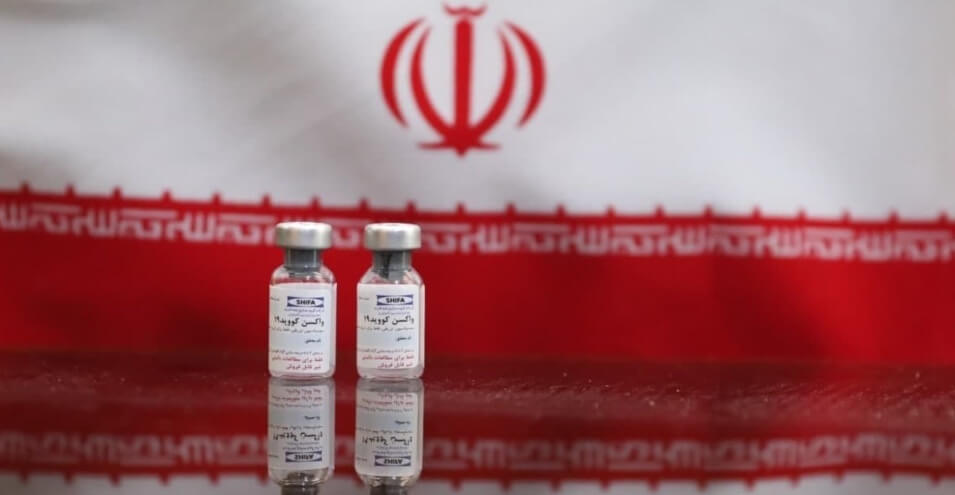
- First - The "Cov Iran Barkat" vaccine, which is manufactured by Shafa Pharmed Company, a subsidiary of the Barkat Pharmaceutical Group affiliated with the Executive Headquarters of the Imam's Decree, which is managed by the Supreme Leader's House. This vaccine is undergoing the third clinical phase and "killed virus" technology has been used to prepare it.
- Second - The "Pastovaccine" vaccine, which is a product of collaboration between the Pasteur Institute of Iran and the Finley Institute of Cuba. This vaccine is also undergoing the third clinical phase and the technology used in it is in the form of a conjugated recombinant protein. This vaccine has undergone phases one and two in Cuba and is presented there under the name Sobrana 02 (meaning independence).
- Third - A vaccine that will be produced by the Razi Institute and has completed phase one and is in the data analysis stage. The technology used in this vaccine is also in the form of recombinant protein.
- Fourth - Milad Daru Noor's vaccine, which is in phase one of clinical studies in collaboration with the Ministry of Defense. The technology of this vaccine is also "killed virus" and is scheduled to be released under the name "Fakhravak".
- Fifth - The vaccine manufactured by Cinagen in collaboration with Australia, which is in clinical phases two and three. This vaccine is a recombinant protein type and its phase one was conducted in Australia.
- Sixth- The "Nora" vaccine, which will be produced by the Noargen Company in collaboration with Baqiyatollah University affiliated with the Revolutionary Guard Corps, is also a recombinant protein vaccine and is in phase one of clinical studies.Three other vaccines are also in the preclinical study phase in Iran, including:
- A - The vaccine from Darmangostar Renap Company in collaboration with Ariogen, which is in the monkey challenge testing phase. This vaccine will be of the mRNA type.
- B- Home Safe Biotechnology Company, which has been introducing its vaccine into the monkey challenge since the beginning of June. This vaccine will be a vectorial vaccine.
- C- A vaccine that will be produced by Osweh companies in collaboration with Paya Fan Yakhte Alborz and Kian Gene Azma. This vaccine, which is produced from a killed virus, is in the final stage of monkey challenge testing and is in the process of reviewing the drug file at the Food and Drug Administration to enter the clinical trials stage.
Source: Radio Farda