Repression in universities, suspension of students, and spread of nationwide protests in the country's academic centers
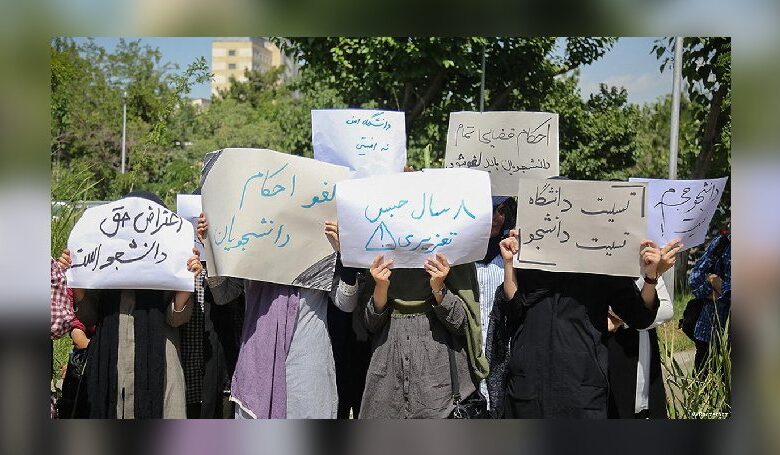
The crackdown on universities, coupled with the suspension of students and the rise of nationwide protests in Iran's largest higher education centers, indicates students' disgust with the government of the day and their continued protests despite severe repression.
As universities across Iran began to reopen, many of Iran's major universities have once again witnessed the formation of protest rallies, extending from Tehran to Mashhad and Isfahan, and accompanied by summonses, suspensions, arrests, and educational deprivations. In the most recent case, three students from the University of Tehran were temporarily banned from studying and entering the university, a move that observers see as a sign of increasing disciplinary pressure on the student movement.
According to published reports, three students at the University of Tehran have been temporarily banned from studying at the university by order of the university’s president for what they described as “insulting the national flag and symbols” during protest rallies. According to the report, based on Article 117 of the disciplinary regulations, these students will be banned from entering the university until a disciplinary committee meeting is held. The identities of the students have not been officially announced, and further details about the investigation have not been released.
Critics say that using general, interpretable titles paves the way for quick, legal action without transparency, an approach that has been used repeatedly against student activists in recent years.
Also, in recent days, protest rallies have been held at a number of higher education centers, including Sharif University of Technology, Amir Kabir University of Technology, Allameh Tabatabaei University, Al-Zahra University, Ferdowsi University of Mashhad, and several other universities. Students in these rallies have protested against the security environment, the summoning of union activists, cultural restrictions, and disciplinary actions.
Reports on social media indicate that some gatherings have ended with the presence of security forces and a number of students have been arrested or summoned to provide explanations. Human rights sources have reported hundreds of suspensions, dormitory bans, and even expulsions for protesting students in recent years.
During the widespread protests in 1401, human rights organizations announced that hundreds of students were arrested at various universities in the country. There were also reports of a number of students being killed in street protests that year, some of whose names were announced by families and independent media. However, the exact figures remain unclear due to the lack of official transparency.
In addition to the recent arrests, university disciplinary committees have issued numerous sentences, including suspension for one or more semesters, academic exile to other universities, and permanent expulsion. Some students have also been barred from continuing their studies at higher levels.
Universities in Iran have always played a prominent role in social and political developments. From the events of 18th of Tir 1999 to the protests of 2009, 2010, 2011, and now in the recent protests in Iran, students have been at the forefront of the protests. This historical background has caused student movements to always face special sensitivity from security institutions.
In recent days, there have been reports of increased security surveillance, the installation of more cameras, the summoning of union activists, and pressure to sign pledges. At some universities, students have reported restrictions on holding cultural meetings and critical programs.
The suspension of three students at the University of Tehran, although seemingly a limited disciplinary case, makes sense in the broader context of pressure on the academic environment. Many students believe that the disciplinary actions have not only failed to silence the protests, but have also deepened the gap between university administration and the student body.
The question now is whether the policy of suspensions, expulsions, and security clashes can curb the wave of student demands, or will universities once again become a decisive focus in the country's social transformations? The answer to this question depends on how officials deal with students' demands and the degree to which critics are tolerated in academic environments.