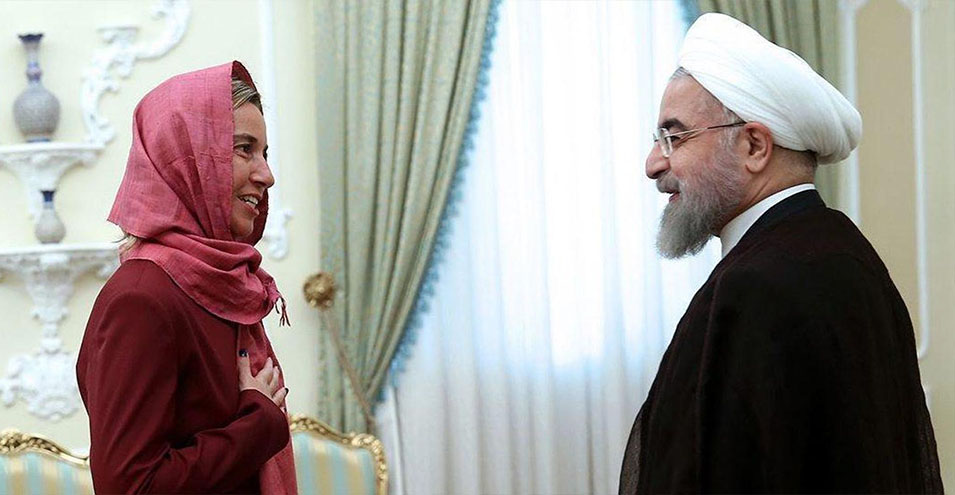
Saeed Razavi Faghih, a journalist and political activist who was released from Evin Prison on April 9, published a letter addressed to Federica Mogherini, the European Union’s foreign policy chief, during her visit to Iran last week, writing: “Do not sacrifice human rights for your commercial interests.” Razavi Faghih also stated in the letter: “The Iranian government has shown for at least the past two decades that it has not posed a threat to any nation except the Iranian nation. The presence of a large number of prisoners in the country’s prisons, representing different trades, beliefs, and political and social groups, is indicative of the gap and discord that has emerged between the government and the people, and is deepening day by day.”
In his letter, he mentioned many political prisoners, writing, among other things: “I do not ask you to demand compensation for the unjustly shed blood or even insist on lifting the house arrest of the oppressed and beloved leaders of the Green Movement or at least challenge the ban on the photographing of the most famous president in Iranian history. I do not even ask you to point out to your respected Iranian counterpart that, contrary to his claims, we also have imprisoned journalists in Iran, and the current example is not a free man like Isa Saharkhiz or Ehsan Mazandarani or Saman Safarzaei.” Razavi Faghih stated the reason for writing this letter as “simply to remind us of the violations of human rights and even the violation of the constitution and the laws of the Islamic Republic of Iran,” and wrote: “The government is making serious and focused efforts to strengthen the force of repression and counter-insurgency, organize special mercenary forces in plain clothes, establish parallel intelligence and security agencies, and transform the judicial system into a bureaucratic tool of the political police to fabricate legal and judicial justifications for repression.”
In this letter, he suggested to Mogherini: "Stay in Tehran for an extra day and visit one of the many prisons in our country's capital, especially the black detention center or the regular women's prison in Varamin and the women's ward of Evin Prison, where a group of Iran's most deserving women and girls are imprisoned; and get up close and personal with what is going on under the skin of the Islamic Republic, which is seemingly returning to the international system."
Saeed Razavi Faghih, a journalist and former member of the Central Council of the Office for Strengthening Unity, worked for a number of reformist newspapers, including Sobh Emrooz, Bahar, Yas Nou, Vaqayyah Eftahfiyyeh, and Nowruz. He was arrested on March 5, 2013 in Karaj for what the Fars News Agency described as a “structurally disruptive” speech to a group of reformists in the city of Hamedan, and sentenced to one year in prison on charges of gathering and collusion with the intent to disrupt national security.
This prisoner was supposed to be released from Rajai Shahr Prison in Karaj on March 29, 2014, after completing his one-year sentence, but Branch 15 of the Revolutionary Court, headed by Judge Salavati, sentenced him to another three and a half years in prison on charges of insulting the leadership, insulting the Assembly of Experts, and propagandizing against the regime.
Mr. Razavi Faghih was transferred to Imam Khomeini Hospital in February 2014 due to an acute heart condition and underwent heart surgery. After he was returned to prison before he could be fully treated and despite the doctors' objections, 96 civil society activists wrote a letter to Iranian judicial authorities demanding his release.
The full text of Saeed Razavi Faghih's letter to Federica Mogherini is as follows:
In the name of God
Open letter addressed to the President of the European Union's Foreign Policy Commission, Federica Mogherini; through the Delegation of the EU Presidency (Kingdom of the Netherlands) in Tehran
Dear Ms. Federica Mogherini, President of the European Union's Foreign Affairs Commission;
With greetings and respect, I welcome you to my country in the coming days, based on ancient Iranian traditions of hospitality and good Islamic manners and ethics, and I wish you a pleasant stay in Iran and good memories of this land and its noble people.
However, I know that the tightness of your political and economic programs and missions will not allow you the opportunity to experience meeting the noble people of Iran, and your stay will generally be spent in continuous and intensive diplomatic negotiations with government officials.
However, as someone who has been a political prisoner in Rajai Shahr and Evin prisons for more than two years and has only been released from prison ten days ago, and who has witnessed what I am about to say with my own eyes, I would like to take this opportunity to share a few points on the eve of this trip. However, given the many years of activities of Iranian political and civil activists and the follow-up of international human rights institutions, you may know more about the details of what I am about to say than I do.
Madam Mogherini
As I write these lines to you, more than twenty days have passed since the hunger strike of my dear and steadfast friend and fellow prisoner, Hossein Ronaghi Maleki, while a few days ago the parents of this young and freedom-loving civil activist also went on a hunger strike in support of their son and his ideals. This brave young man, who is twenty-three years old, has been spending some of the best years of his life in prison for more than seven years, and this is in addition to the illegal process of interrogations accompanied by torture, unusual searches of his home, and constant pressure on his family.
Hossein Ronaghi is just one example. Before him, many prisoners have gone on hunger strikes and will continue to do so in protest of unjust sentences issued by arbitrary and non-independent courts or in protest of the cruel and inhumane conditions of interrogation, detention, and prison.
Isa Saharkhiz, who recently went on a long hunger strike twice and suffered serious physical injuries, Ehsan Mazandarani, Siamak Namazi, Mahmoud Beheshti, Rasoul Badaghi, and many others, and most poignantly, Heda Saber, whose strike led to a heroic and painful death.
This is very worrying for me, who recognizes the seriousness of the individuals mentioned, their level of commitment to social responsibilities, and their persistence in the path of civil resistance, peaceful struggle, and hunger strike or hunger strike as the only solution to defending prisoners' rights. I think with sadness and concern about the dangerous and irreparable consequences that could occur at any time.
Hossein Ronaghi Maleki's crime, like many other political and conscientious prisoners, is simply fighting news censorship and trying to free the flow of information or express opinions in cyberspace. Of course, in a country where the authorities at the top level rely on security and authority based on intimidation and fear or silence and ignorance of the people, these actions are considered and promoted as security crimes, while the drafting and approval of the Political Crimes Law has been deliberately kept silent after 38 years, so that Article 168 of the Constitution of the Islamic Republic of Iran will not be implemented on the basis of thousands of prisoners who have either been released after years or are still patiently serving their sentences in Iranian prisons.
It is therefore wrong that those in charge of this matter, through this scandalous trick and trickery, falsely claim that there are no prisoners of conscience in Iran, including ideological and political prisoners, or imprisoned lawyers and journalists, and that no one is tried and punished solely for their beliefs or for expressing their opinions and ideas, just as they claim that no one is tortured or punished for confessing to a crime they did not commit, but rather is simply punished.
Madam,
Alongside the name of Hossein Ronaghi Maleki, whose memories of the recent months of my imprisonment in Evin Prison are tied to, among other things, his calm and reassuring presence, I can list a long list of the names of oppressed youths whose faces, the extent of their convictions, and the unfavorable conditions in prison, even for a moment, place a rock of sadness on my helpless chest.
Zaniar and Loghman Moradi, Hamzeh Savari, Ayqan Shahidi, Navid Khanjani, Peyman Arefi, Vahed Khuloosi, Rasoul Hardani, Farhang and Shahrampour Mansouri, Saeed Masuri, Saeed Pourhaidar, Saeed Shirzad, Misagh Yazdani, Shahin Zoghitabar and Jafar Eghmady and others in the disastrous Rajai Shahr prison, whose daily events resemble some medieval legends, as well as Masoud Ghasem Khani, Mohammad Saeed Hosseinzadeh, Masoud Abutalebi, Mohammad Hossein Aziz, Fariborz Gerami, Farid Akrami, Mahmoud Beheshti, Omid Kokabi, Mohammad Sediq Kabudvand and Rasoul Badaghi and others in the seven-room prison of Evin, which I recently had the honor of visiting in Evin, a prison that bears the heavy scars of dark and shameful memories of several decades since 1970 on its forehead like eternal infidels. Alongside the above names, there are wise and unscrupulous men who have mortgaged their youth to improve the situation of the next generation. A generation that unfortunately still does not see a clear vision for itself, and whose uncertain fate is tied to the stupidity or power-hungry and wealth-accumulation of a small minority that has unworthily seized illegitimate sources of wealth and power.
Dr. Hossein Rafiei, Mr. Abdi, and Mostafa Tajzadeh, as representatives of Iranian professors, teachers, and free journalists, are still in prison, but those who have faced the people's resounding "no" time and time again are devouring a large share of the power cake with an insatiable appetite and saying, "Hurry up, I'll do more."
Along with all the freedom-seeking activists, I would like to mention the symbols and outspoken outspoken figures of the still vibrant and dynamic green social and political movement, namely Ms. Rahnavard and Mr. Mousavi and Mr. Karroubi, who have been arbitrarily and illegally under house arrest for more than five years, without trial, in difficult conditions, and, along with their loyal supporters, are paying the price for their truth-telling, legalism, and peaceful freedom-seeking to those who are thirsty for wealth and those who are obsessed with unlimited power.
Let's forget about the blood unjustly spilled on the streets of Tehran and the innocent bodies sleeping in the cold, black soil of Behesht Zahra or Khavaran, which is another sad and detailed story.
Dear Commissioner for Foreign Affairs of the European Union,
What I mentioned was merely to remind you of the violation of human rights and even the violation of the constitution and laws of the Islamic Republic of Iran, and that was all. But what I want to say, contrary to your and others' expectations, is not that you will descend from the sky to Tehran as the great savior of the long-standing, wise, and noble nation of Iran and miraculously restore the lost rights of the freedom-loving youth of Iran from an expansionist and authoritarian government and return them to their rightful owners as charity or a gift.
You and I both know very well that the European Union and its institutions, including the Commission under your management, do not represent the public opinion of the European people and do not reflect the progressive values that have emerged from the intellectual, social, and political developments of the past several centuries of Europe as universal and human values. Rather, they represent the interests of European governments, most of which are primarily concerned with protecting the interests of big capitalists who seek greater profits at any cost and under any conditions.
Therefore, I do not ask you, in the name of the values of the new world that European nations have created, many of which have a human and universal aspect and are considered a precious treasure for all peoples of other lands, to rise up in negotiations with Iranian authorities to fight for the lost rights of intellectuals, journalists, students, professors, freedom-loving youth, women seeking equality, religious and national minorities, civil activists and lawyers, instead of representing the interests and demands of the member states of your respective union. Although, according to the dictates of reason, you have a duty to do so as an informed human being with free will.
I do not ask you, as a free woman who enjoys equal rights with men, to defend and demand the release of freedom-loving and egalitarian Iranian women who are proudly serving long-term sentences in the "Women's Ward of Evin Prison" for their innocence; women whose obvious truth fully testifies to their innocence, and whose melodious and intelligent words have remained silent behind the walls of Evin Prison solely for the sake of freedom, justice, and defense of the rights of Iranian women. Although you are expected to do so as a free woman.
I do not ask you to demand compensation for the unjustly shed blood or even insist on lifting the house arrest of the oppressed and beloved leaders of the Green Movement or at least challenge the ban on the most famous president in Iranian history. I do not even ask you to point out to your respected Iranian counterpart that, contrary to his claims, we also have imprisoned journalists in Iran, and the current example of that is not a free man like Isa Saharkhiz or Ehsan Mazandarani or Saman Safarzai. I do not want to remind him that an honorable politician is one who changes the bitter reality and a subtle politician is one who, if he cannot change the bitter reality, at least explains or justifies it, rather than denying it outright. Although as a politician raised in the culture and values of the modern world, you are, in principle, obliged to do so. But I urge you to be especially diligent and insistent when negotiating with senior Iranian officials at various levels and sectors, not to use the blood of the youth of my homeland, the list of young and old prisoners in the small prisons of this large prison, and the report of their suffering and misfortunes as a means of reconciliation to increase the volume of commercial contracts and large profitable transactions. I urge you to be especially careful that if you do not want to defend the rights of the suffering women of my homeland, especially the activists in the women's rights ward, and demand their immediate release, and if you do not try to convince the Islamic Republic to unconditionally adhere to the principles of human rights, the Constitution, and its ordinary laws regarding the rights of people and political, ideological, and trade union prisoners, at least do not use such arbitrariness and oppression as a tool to tame and calm the Iranian authorities in economic and political bargaining.
Madam,
The Iranian government has shown over the past two decades that it has not posed a threat to any nation other than the Iranian nation. The large number of prisoners in the country’s prisons, representing various trades, beliefs, and political and social groups, is a reflection of the gap that has emerged between the government and the people, and it is deepening day by day. This is why the government is making serious and focused efforts to strengthen the force of repression and counter-insurgency, organize special mercenary forces in plain clothes, establish parallel intelligence and security agencies, and transform the judicial system into a bureaucratic tool of the political police to fabricate legal and judicial justifications for repression. In fact, the Iranian government is only a threat to the people under its control within Iran’s borders, and that’s it. Therefore, I ask you not to use bargaining over the quantity and quality of missile tests and nuclear facilities and their dangers to regional security and global peace as a tool to increase the volume of profitable investments in Iran, and worse, do not use the concepts of human rights, democracy, and peace as a means of commercial gain and gaining economic privileges. And if you do not want to make serious and non-profit demands on behalf of the educated people of European nations in the field of democracy, human rights, and legal freedoms in Iran, at least do not make the suffering of our proud, proud, and unassuming friends a free compromise for profitable contracts for the member states of the European Union and detrimental to the Iranian nation. Otherwise, be sure that this unforgivable sin will not be erased from the historical memory of the Iranian nation, and the day when the Iranian people rule over their material and spiritual capitals inside and outside their borders, they will give a worthy response to these dual behaviors.
In conclusion, I apologize for the length of my speech. I wish you and your delegation a pleasant stay in Iran and good memories of this trip. However, I suggest that you stay one more day in Tehran and visit one of the many prisons in our country's capital, especially the black detention center or the regular women's prison in Varamin and the "Women's Ward of Evin Prison," where a group of the most deserving women and girls in Iran are imprisoned. And get up close and personal with what is going on under the skin of the Islamic Republic, which is seemingly returning to the international system.
With respect again
Saeed Razavi Faqih
2016/01/28
04/16/2016
*Copy: His Excellency Dr. Hassan Rouhani, President of the Islamic Republic of Iran, for information.
Source: International Campaign for Human Rights in Iran