The manager of an automobile parts manufacturing company was accused of "smuggling 8.7 trillion tomans"
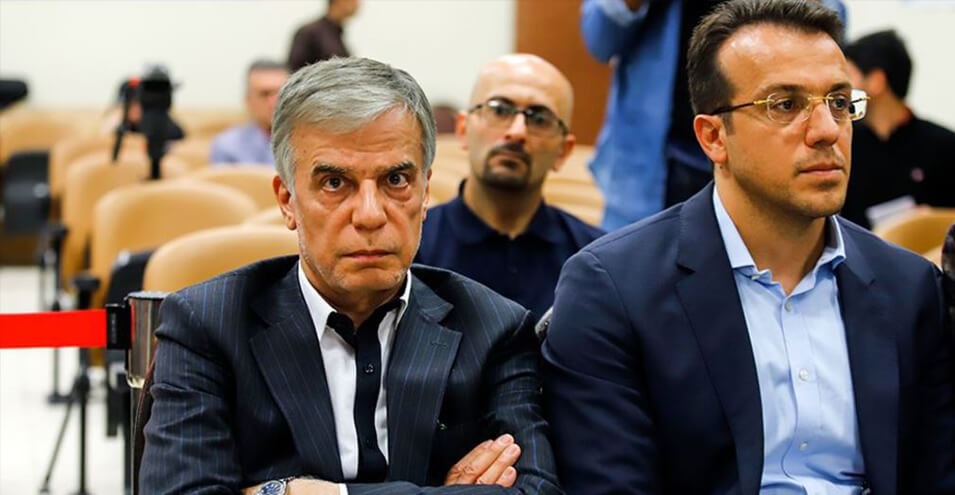
The Tehran prosecutor's office says Abbas Iravani, director of the "Azzam Auto Parts Group," has committed "corruption on earth" by "disrupting the country's economic system," "forming a car parts smuggling gang," and paying bribes to customs officials.
According to Article 286 of the Islamic Penal Code, the punishment for "corruption on earth" can be the death penalty.
The first hearing on Mr. Irvani's charges was held on Wednesday, October 1. Six other defendants are also present at the court hearing, two of whom were managers of Mr. Irvani's companies and four others were customs employees.
According to the prosecutor's representative, these six people, under the control of Mr. Iravani, have formed a large car parts smuggling network.
The prosecutor's representative said that Abbas Irvani, with the help of his network, committed $764 million in "organized and professional smuggling of auto parts." At the exchange rate of 11,400 tomans to the dollar, the amount of the charges against Mr. Irvani is more than 8,700 billion tomans.
In today's court session, the prosecutor's representative introduced Abbas Iravani as "one of the most influential economic activists" and said that "his bank arrears exceed three trillion tomans."
He also accused Abbas Irvani of embezzling four trillion tomans from the treasury and paying more than 400 million tomans in bribes over the past 10 years.
According to the prosecutor's representative, Mr. Irvani paid a bribe to Mahmoud Khavari, the former CEO of Bank Melli, in one case. Mr. Khavari, who was accused in a corruption case worth 3 trillion tomans, has since fled to Canada.
The "Azzam Auto Parts" group, established in 1997, is one of the most important manufacturers of auto parts in Iran. There are 12 major manufacturing companies under this group, which are mainly located in the provinces of Tehran, East Azerbaijan, Gilan, Alborz, and Isfahan, and produce a significant portion of auto parts for Iran Khodro and Saipa.
The prosecutor's representative said in the court session that the profits of these companies in the field of parts production were 400 billion tomans annually.
Non-economic activities of Yerevan
In addition to the company's extensive range of activities, Abbas Iravani's personality and activities have also received intense media attention in recent years.
The publication of pictures of Abbas Iravani at the inauguration of economic projects and programs and private meetings alongside many Iranian political figures, such as Akbar Hashemi Rafsanjani, Mohammad Shariatmadari, Hossein Dehghan, Ali Jannati, Sadegh Kharrazi, Mahmoud Vaezi, Mahmoud Alavi, Mohammad Bagher Ghalibaf, and Mohammad Reza Nematzadeh, indicated his close and continuous interactions with government managers.
Abbas Iravani was also the director of two "Hazrat Fatima" organizations, the "Asr Noor Charity Organization" and the "Matusalin Be Imam Reza" organization, and was very active in religious and charity events. Ali Jannati, former Minister of Education, and Zahra Sadat Moshir, wife of Mohammad Bagher Ghalibaf, were among the figures who were members of Abbas Iravani's charitable and religious organizations.
He has also been active in the field of manuscripts and works of art. Mr. Irvani has written on his personal website that he has restored and printed “very valuable handwritten Qurans” in Germany, and that Ayatollah Khamenei, the leader of the Islamic Republic, has also seen these Qurans.
The media also published a picture of him and Sadeq Kharrazi, who works in the field of manuscripts and antiquities, showing two copies of the Quran to Akbar Hashemi Rafsanjani.
Mr. Iravani also wrote that, on the advice of Qassem Soleimani, commander of the IRGC's Quds Force, he has made plans to rebuild religious centers in Iraq and is sending livelihood and food aid to 18,000 orphaned children in Iraq.
In recent years, he intended to exploit a large amusement park project called "A Thousand and One Cities," which was supposed to be the largest amusement park in the Middle East and, according to him, "a Disneyland adapted to Iranian-Islamic culture."
This complex began in 2006 with the participation of the Tehran Municipality, but was left unfinished due to problems the Islamic Republic Army had with land ownership.
Source: Radio Farda