The mystery of identifying dozens of coronavirus patients among travelers from Iran
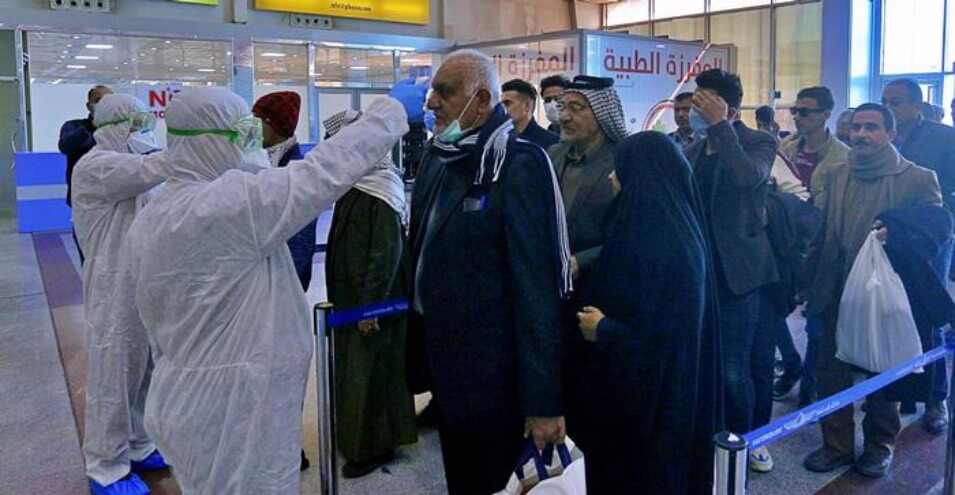
So far, at least seven countries have identified cases of coronavirus in people who had previously been to Iran. The ratio of these people to the number of officially identified cases in Iran itself is unlike any other country in the world.
Officials in several countries, including Bahrain, Kuwait, the United Arab Emirates, Iraq, Oman, Lebanon, Afghanistan, and Canada, have so far reported the identification of one or more people infected with the new coronavirus, known as COVID-19, who had previously been in Iran.
According to statements by the responsible authorities of these countries, the total number of these people reaches more than 30, and most of them have been in the city of Qom, the so far known epicenter of the coronavirus outbreak in Iran, for some time.
Most of the infected people were identified as having been in Iran until a few days ago, when the Islamic Republic's authorities announced the number of coronavirus cases in the country at 43 and the number of deaths at 12.
On Wednesday, February 26, as a second Iranian traveler was identified as infected with the coronavirus in Canada, the number of confirmed cases of the coronavirus in Iran increased to 139 people and the death toll to 19, according to the latest statistics from the Ministry of Health.
The number of confirmed cases in Iran has skyrocketed in the past three days, more than tripling. However, the ratio of this number to the number of imported cases of coronavirus outside Iran is not comparable to other countries.
Johns Hopkins University, one of the oldest and most prestigious research universities in the United States, has launched a special website to monitor and publish information about the spread of the coronavirus around the world. Since this site and other similar websites extract their statistics from official sources, their data is more or less the same.
According to statistics from the Hopkins University website, as of noon on March 27, 81,191 cases of coronavirus have been identified worldwide, of which slightly more than 78,000 are in China.
If China were like Iran
If we consider the ratio of identified cases of infection originating from Iran abroad to cases of corona infection inside Iran to be 20%, in the Chinese sample, about 15,600 people infected with corona must have been identified in various countries so far, and the infection of the Covid-19 virus to them occurred on Chinese soil.
This is while the total number of people infected with the coronavirus identified outside of China was less than 2,000 as of Wednesday, according to statistics from Hopkins University, of which about 1,260 cases are in South Korea.
This glaring discrepancy could have various causes, the most important of which is the long-standing and well-known tradition of secrecy and disinformation by senior officials of the Islamic Republic in all political, military, and other government positions and affiliations.
In response to increasing criticism of the lack of transparent information about the coronavirus outbreak, President Hassan Rouhani claimed at a March 27 cabinet meeting: "We will neither increase nor decrease the statistics. We will neither exaggerate nor downplay them. I have also emphasized to the Ministry of Health that any statistics should be told to the people truthfully."
Rouhani's claim, citizens' distrust
Given the existing evidence and the history of false statements by Rouhani and other officials regarding issues such as the bloody suppression of the November protests and the downing of a Ukrainian passenger plane by the Revolutionary Guards' air defense missiles, public trust in the Islamic Republic's officials has been severely damaged, and many citizens on social media consider such claims false.
On February 17, months after the suppression of the November protests, Hassan Rouhani claimed in a press conference about the number of people killed in these repressions: "This figure is in the possession of the country's forensic medicine, which can announce it."
Abbas Masjedi Arani, head of the Forensic Medicine Organization, revealed the falsehood of this claim in an interview with ILNA news agency that day, saying that this statistic is in the possession of the National Security Council, a subsidiary of the Ministry of Interior, and that this council has designated the government as responsible for announcing it. In other words, Rouhani had this statistic in his possession that day and has not yet published it.
Iran, a unique example of the ratio of victims to infected
Another point that casts doubt on the government's statistics on the spread of the coronavirus in Iran is the ratio of the number of infected people to the number of victims of the virus, which is completely at odds with estimates from the World Health Organization and samples from all other countries in the world.
The World Health Organization estimates the death rate from the novel coronavirus to the number of people infected with it at between two and three percent. This estimate applies to all countries in the world where cases have been identified, with slight variations, and the death rate is even lower in most countries, except Iran.
Until a few days ago, this ratio was close to 20 percent in Iran, and according to statistics published on Wednesday, it is still slightly more than seven percent.
The number of coronavirus cases in South Korea is about nine times that of Iran, but the number of deaths in the country as of Wednesday was seven fewer than in Iran.
To justify the contradiction between their alleged statistics and the spread of the coronavirus in other countries around the world, Islamic Republic officials present "arguments" that are clearly false.
Head of Prevention Management, infected with Corona
Iraj Harirchi, Deputy Minister of Health and Secretary of the Special Headquarters for Managing the Prevention of Coronavirus Infection, expressed regret on March 25 that “most countries in the world” are refusing to publish their country’s real information about the spread of the coronavirus, and for this reason, the Islamic Republic has “become more visible” as the only country publishing “real statistics.”
The senior health ministry official, who was supposed to be managing the prevention of coronavirus infection, confirmed a day later that he had contracted the coronavirus. Harirchi had told ISNA that most countries announce the death rate based on the number of confirmed and suspected cases, and accordingly, the proportion of deaths is lowered.
Such a claim is false according to the available evidence in most countries, and suspected cases are not counted as infected in principle. The official South Korean news agency recently reported, when the number of coronavirus cases in the country was around 550, that health officials had tested 22,633 suspected cases and arrived at this number of confirmed cases.
Accordingly, if we consider the pattern of infection and death from the new coronavirus worldwide to include the Islamic Republic, for which no scientific or logical reason has been presented to the contrary, the actual number of coronavirus cases in Iran could be several times higher than the announced figures.
If unofficial reports and news about concealment of the number of victims or registration of death certificates due to apparently similar diseases such as pneumonia and respiratory diseases are true, the dimensions of the spread of the coronavirus in Iran will be much more worrying.
It has not yet been definitively determined or announced how the new coronavirus entered Iran and spread. What is certain is the role of inefficiency and the lack of equipment needed to detect and combat the spread of the virus, which officials are also misrepresenting.
Contradictions about the existence of diagnostic kits
According to IRNA, Kianoush Jahanpour, head of the Public Relations and Information Center of the Ministry of Health and Medical Education, a month ago (February 27), when there was a discussion about the necessity of screening incoming travelers from China, claimed that coronavirus diagnostic kits were available in Iran and that more would be imported "in the coming days for strategic storage."
While the claim that there are enough diagnostic kits had been repeated in recent days by the Minister of Health and a number of other senior officials of the Islamic Republic, the Chinese ambassador to Tehran announced in a Twitter message this morning the donation of five thousand diagnostic kits for the new coronavirus "to the Iranian side."
The number of decision-making centers, the influence and power of religious and military institutions, and the government's lack of decisiveness and ability to implement effective preventive measures could be among the factors that fuel the widespread spread of the coronavirus.
One of the solutions that has been widely discussed is to quarantine the city of Qom and at least close the city's religious centers and shrines, where large crowds come into contact with each other every day.
Hossein Taeb, head of the Revolutionary Guards’ intelligence agency, is apparently among those who have opposed the quarantine of Qom. Mohammad Saeedi, the custodian of the “Hazrat Masoumeh Shrine,” responded to concerns about the shrine’s continued closure in a video message on March 27, saying, among other things, “We consider this holy shrine a place of healing. A place of healing means that people can come and be healed of mental and physical illnesses.”
Qom's "Dar al-Shifa" is the epicenter of the deadly virus outbreak
This "healing center" has so far failed to prevent dozens of Qom citizens and several prominent figures from contracting the coronavirus and dying.
On March 25, it was announced that Mohammad Reza Ghadir, the president of Qom University of Medical Sciences and responsible for dealing with coronavirus patients in the city, had himself contracted the coronavirus. The previous day, Mojtaba Fazeli, the office manager and executive and financial officer of Musa Shabair Zanjani, a Shiite religious leader in Qom, died of the coronavirus.
Previously, the mayor of Tehran's 13th district had also tested positive for the coronavirus, and yesterday, Mahmoud Sadeghi, a member of the Islamic Consultative Assembly, announced in a Twitter message that he had contracted the coronavirus.
Many airlines have completely stopped or severely restricted their flights to Iran. Land and sea borders between neighboring countries and Iran have also been closed and heavily controlled.
However, hundreds of kilometers of uncontrolled or inadequately controlled borders in all four directions of Iran have made neighboring countries extremely concerned about the spread of the coronavirus in the country and the revelation of its true dimensions.
Given the doubling of coronavirus cases in the past two days, the possibility that this trend will continue in the coming days cannot be ruled out.
Source: DW