Pouya Molaei-Rad is an attempt by government forces to silence those seeking justice.
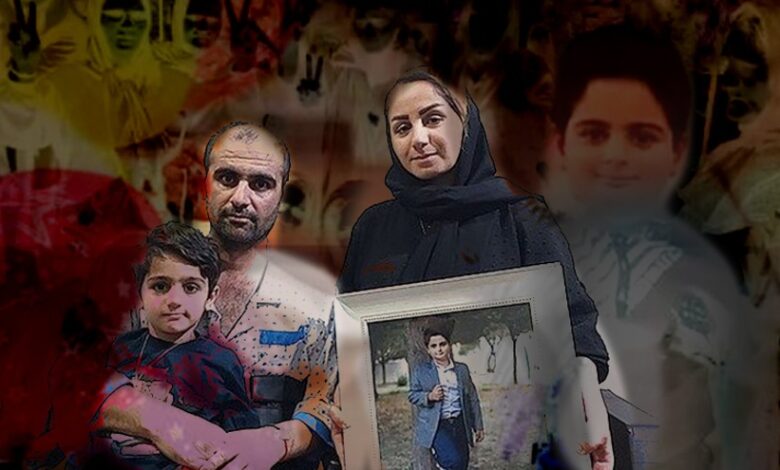
The murder of Pouya Molaei-Rad, Kian Pirfalak's mother's cousin, by law enforcement forces in the city of Izeh during a birthday celebration held at Kian's grave, is a clear example of the government's efforts to silence the voices of the families of victims of popular protests.
Hadi Ghaemi, director of the Human Rights Campaign in Iran, said, referring to the murder of Pouya Molaei-Rad by law enforcement forces: “The authorities of the Islamic Republic have given the security forces free rein to shoot and kill critics and opponents of its policies.” According to Hadi Ghaemi, “The Islamic Republic’s killing machine of rage continues to be set in motion even as mourning ceremonies are held for the victims, and families cannot mourn their lost loved ones.”
Hadi Ghaemi added, "World leaders must raise the cost of the Islamic Republic's increasingly cruel and illegal violence against the people for the leaders of the Iranian government."
First, they killed 9-year-old Kian, and a few months later, it was the turn of 21-year-old Pouya.
On June 11, 1402, the family of Kian Pirfalak, a 9-year-old child who was killed by military forces in the city of Izeh, celebrated Kian’s 10th birthday at his grave in the village of Parchestan in the city of Izeh. After the birthday celebration, security forces went to the cemetery and the atmosphere became more secure, and Pouya Molaei-Rad, the cousin of Zeinab Molaei-Rad, Kian’s mother, was shot and killed by police officers. According to the government’s account, Pouya, 21, drove a car toward the forces, causing an accident and killing a police officer. State media claimed that the police were initially “deliberately” attacked with a car and that they responded by shooting the attacker.
The state-sponsored murder of 21-year-old Pooya Molaei-Rad is a continuation of the severe pressures and threats against the families of the advocates in Iran. Families that have become more united than ever in recent months, and their unity has deeply worried the government. On Friday, June 19, a group of advocates from Sanandaj, Divandarreh, and Dehgolan went to visit the families of those killed in the 1401 protests in Saqqez and Bukan. On their way back, the Ministry of Intelligence forces arrested more than 30 of them. After several hours of arrest, most of them were left on the road between Saqqez and Divandarreh, where they wandered on the roads until morning. The Islamic Republic’s record of exerting pressures and threats against the advocates’ families is very dark, and concerns have grown about the intensification of these threats and security and judicial pressures.
The murder of Kian and the government's scenario for implementing the death sentence of the blind Mujahid
On November 17, 1402, during public protests in Izeh, armed forces opened fire on a car carrying 9-year-old Kian Pirfalak and his father, killing Kian and seriously injuring his father. It was then that Zeinab Molaeirad, Kian’s mother, took up the banner of her son’s legal rights and filed a legal complaint against her son’s attacker. However, without accountability and transparency regarding this government murder, the judicial and security authorities not only did not follow up on Zeinab Molaeirad’s complaint, but also claimed to have arrested Kian’s attackers. Mujahid Korkur, one of the Izeh protesters, was sentenced to death on charges of shooting Kian and his father in a completely illegal and non-transparent process. Despite the government’s insistence that Mujahid Korkur was guilty, Kian Pirfalak’s family clearly stated that Mujahid Korkur was not their son’s killer and that they had no complaints against him. On March 1, Kian Pirfalak's uncle wrote on his Twitter page: "It seems that there was a strong and biased will to push the case and attribute the murder of Kian to Mujahid Korkor from the very beginning."
He also wrote: "Attributing the charge of Kian's murder to Mujahid Korkur, despite the existence of another case in Branch 1 of the Revolutionary Court on charges of war, brings to mind the intention to make maximum use of the accused Mujahid Korkur."
According to existing laws, the family of Kian Pirfalak, as the family of the victim, can demand retribution, but when the family itself has officially announced that they have no complaints against the blind mujahid, the government cannot proceed with the case proceedings according to its own narrative and scenario. One of the reasons for the intensification of pressures and threats on the family of Kian Pirfalak, and especially Zeinab Molaeirad, is this behavior of seeking justice, which is against forgetting and also for the truth to be made clear to the government. After the killing of 21-year-old Pouya Molaeirad, the state media opened their mouths to threaten Zeinab Molaeirad; the Tasnim news agency, affiliated with the Revolutionary Guards, and the Saberin News Telegram channel in a note called Kian Pirfalak’s mother “one of the main instigators and troublemakers” and accused her of “supporting terrorists.” The Noornews website, close to the Supreme National Security Council, also introduced Mahmonir Molaei-Rad alongside the "main counter-revolutionary currents" behind the killing of the Faraj officer in Izeh, and wrote: "Islamic compassion does not work for such people and they must be dealt with decisively."
Source: Human Rights