A member of the Ahvaz city council accused officials from the Ministry of Oil and Khuzestan Province of "colonialism"
Nasser Mahdavi, head of the Ahvaz City Council's Transportation and Traffic Commission, on Wednesday, January 28, strongly criticized officials from the Ministry of Oil and Khuzestan Province for what he called "plundering Khuzestan's capital," and also accused them of "colonialism."
At the beginning of his remarks at the city council meeting, this Ahvaz city council member referred to the accident involving a minibus carrying 16 oil company workers on the Ahvaz-Khorramshahr route, in which 10 people were killed.
Nasser Mahdavi said: "The question that will be asked a lot and will not be answered is why, after all these years when oil and drilling companies have benefited from this communication road, are they not willing to fulfill their social responsibilities in the slightest? Who is really responsible for this plundering of Khuzestan's capital?"
He added: "The story of Khuzestan and the white collars of the Ministry of Oil is the story of a husband who neither pays for expenses nor is present at home. In addition, every now and then, the poor woman is also beaten."
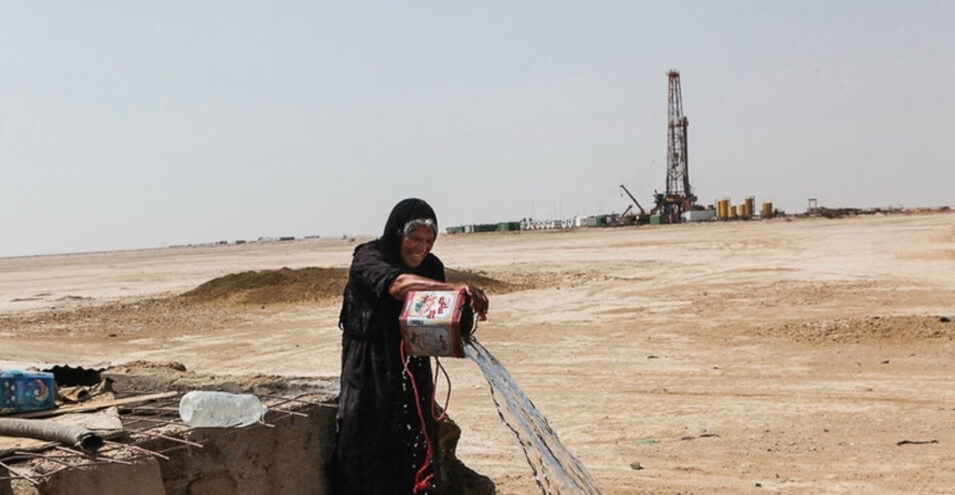
This Ahvaz City Council member added: "You may laugh at this example, but in reality, when they suck the juice from your land, they don't give you your share and don't pay you for polluting the environment, and in addition, they throw flares at your and my health and dry up the water of the Hur-al-Azim wetland to make extraction cheaper; what else can we say?"
Nasser Mahdavi clarified: "Does colonialism have horns and tails? Isn't colonialism the same as living next to oil pipes while also being poor and sick? Of course, this colonialism is modern and colorful, and perhaps it is not so obvious, but if you look closely, you will see that they have dug wells wherever they have reached. In the Kourosh area of Ahvaz, they have dug wells up to 140 meters from people's homes. This means violating their own environmental standards."
He continued, "Didn't they say and write that they dried up the Hur by order of the high command and to welcome the Chinese? Apparently, they don't realize that the lives, economy, and livelihoods of the people around Hur were looted, and dust covered other cities in the province, and cancer, disease, and forced migration became the people's lot."
Nasser Mahdawi clarified: "In the closed-door meetings of friends where the decision to dry the Hor al-Azim wetland was made, wasn't there anyone who said that a wetland has an economic value of about 10 times that of forests and 200 times that of farmland?"
It was previously reported that in order to reduce the costs of developing the West Karun fields and handing them over to Chinese companies, the Ministry of Oil obtained permission from the Supreme National Security Council to drain the Hur al-Azim wetland in 2010.
In this context, a representative from Shadegan in the Islamic Consultative Assembly had referred to the situation of the Hor al-Azim Wetland as "one of the most horrific environmental disasters in history."
Nasser Mahdavi continued his remarks at the Ahvaz City Council, stating: "What is even funnier is that sometimes they celebrate the news of the discovery of a large oil field, while this news is like mourning for the people of Khuzestan. These cases will bring nothing but pollution and disease to the oppressed people."
A member of the Ahvaz City Council, pointing out that "turning Khuzestan into black soil is the common denominator of all oil ministers" in reformist and moderate governments to conservative ones, said: "The white-collar workers in the center who benefit from astronomical facilities and salaries in the Ministry of Oil are on one side of the issue, and on the other side are the officials of yesterday and today who have occupied the positions of power in Khuzestan province."
He added: "These people were not demanding this right and are only talking about healing and providing statistics on non-payment of pollution fees and failure to fulfill social responsibilities."
The people of Khuzestan have been protesting the inattention of officials to the environmental situation in the province in recent years. This summer, farmers in the province, who have been protesting water shortages and the transfer of water from the province to other cities for years, staged demonstrations following continuous water and electricity outages as the weather warmed.
These protests quickly spread to various cities in Khuzestan. In these demonstrations, citizens, in addition to protesting the lack of water, also chanted slogans against Ali Khamenei, the Supreme Leader of the Islamic Republic, and against the Islamic Republic system.
Source: Radio Farda