Corona in Iran; The saddest day in the history of "Behesht Zahra" and a proposal to extend the nationwide closure
Statistics from the Iranian Ministry of Health show that from April 21 to May 1, 388 more people lost their lives due to the coronavirus.
Also, 24,886 new patients have been identified in the country.
Many doubt the accuracy of the official statistics, and even the Research Center of the Islamic Consultative Assembly announced that the actual number of infections and deaths is several times the official figures. The Iranian Medical System Organization, based on field surveys, has also predicted that the actual number of victims is at least three times the announced figures.
Failure to implement restrictions, slow progress in vaccination, and the spread of a more contagious strain of the coronavirus in the country are among the reasons for the fourth wave of coronavirus in Iran.
Sima Sadat Lari, spokesperson for the Ministry of Health, pointed out that the only mutant virus observed is the strain that was first found in Britain and said that the responsibility for preventing the entry of new strains of the coronavirus into the country lies with "the responsible agencies and institutions."
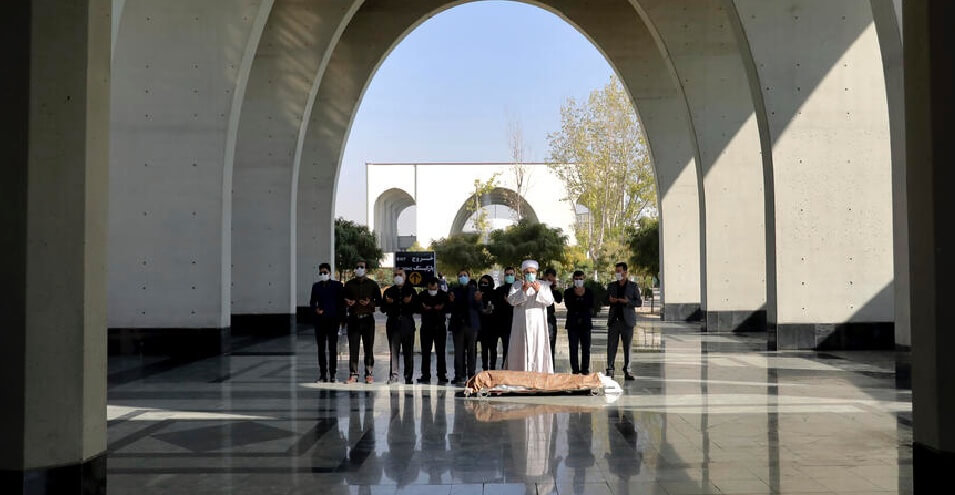
The saddest day in the fifty-year history of Behesht Zahra
Saeed Khal, CEO of the Behesht Zahra Organization, said 147 people who died of COVID-19 were buried there. He said that in addition to this daily figure, 200 ordinary deceased are also buried in this cemetery.
The CEO of Behesht Zahra Organization called Farvardin 31, 1402, "one of the most difficult and saddest days in Behesht Zahra's 50-year history."
Health officials have repeatedly warned that hospitals and morgues will be at capacity in the coming weeks.
Hossein Kermanpour, the director general of public relations for the Medical System Organization, says that since hospital morgues are not designed for the duration of the epidemic, if the current conditions continue, they will most likely not be able to handle the number of deaths.
Nationwide shutdown: from words to action
Minoo Mohrez, a member of the scientific committee of the National Headquarters to Combat Corona, said that if the government and the Ministry of Health intend to control the disease, they must impose a nationwide lockdown for a week, otherwise the disease will not be contained.
Ms. Mahrez said, "Almost nowhere is closed and everyone uses public transportation."
According to Alireza Zali, commander of the coronavirus management operations headquarters, on some days more than 600,000 or 700,000 people use the metro. He had previously said: “What we are seeing in the city is not a lockdown, we are playing with words.”
Referring to the continued upward trend in the number of infected and dying from the coronavirus, Mr. Zali said: "We have no choice but to desert cities, including Tehran."
Currently, 301 cities in the country are in red (very high risk) status and 95 cities are in orange (high risk) status.
Source: Voice of America