The Forgotten Priest Who Predicted the Existence of Black Holes 250 Years Ago
Nearly two centuries before scientists discovered the existence of black holes, a British priest named John Mitchell published a startling prediction about cosmic objects. Belief in the existence of black holes is a mind-boggling one. For decades, leading physicists of the 20th century did not believe that these gigantic cosmic objects could be real, ignoring what mathematicians predicted.
Even Albert Einstein didn't believe in their existence, although his theory of general relativity made black holes possible. However, long before Einstein was born, someone showed remarkable awareness of black holes, predicting their existence using only Newtonian laws.
John Mitchell was born in 1724 in the village of Icking, England, into a family that followed the Christian tradition of preferring reason over extreme doctrines. He went to Cambridge University, where he studied and taught for more than 20 years in a variety of subjects, including Hebrew, Greek, mathematics, theology, and geology.
He was both a theorist and an experimenter. John Mitchell was the first person to explain the cause of earthquakes by proposing the hypothesis that "earthquakes and the waves of energy they produce are due to the movement of rock layers located many kilometers below the earth." For this reason, he is considered one of the fathers of seismology.
John Mitchell Public Domain
John Mitchell also showed a way to estimate the epicenter of the catastrophic Lisbon earthquake of 1755 and explored the idea that undersea earthquakes could cause tsunamis.
He used scientific methods to calculate the density of the Earth in a surprising way. The number he obtained is only one percent different from what is known today as the density of the Earth. In addition to his work in the church, Mitchell corresponded with other natural philosophers and intellectuals of the time, including Benjamin Franklin, one of the world's most prominent scientists and one of the Founding Fathers of the United States.
From a 21st-century perspective, the idea of a Christian minister at the heart of scientific life may seem surprising; but like many 17th-century intellectuals, he did not distinguish between religion and science. For John Mitchell, the natural laws of science were still the laws of God.
Alongside his local duties, Mitchell gradually turned his attention to cosmology, and in particular to the nature of gravity. He built his own 3-metre reflecting telescope and in 1767 became the first to apply new statistical methods to the study of visible stars, showing that clusters such as the "Principia" in the constellation of Taurus could not be explained by random distribution.
A future perspective on the existence of black holes
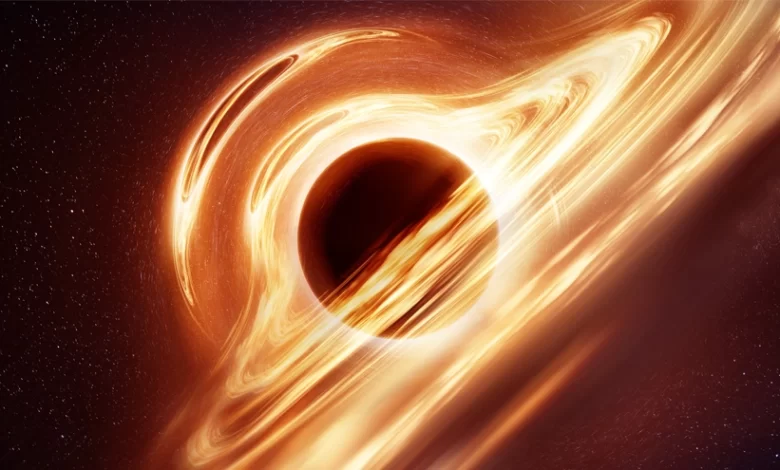
Mitchell published a paper containing a hypothesis that, while less scientifically enduring, was perhaps his most brilliant contribution to understanding the universe. In it, he explained, using Newtonian principles, how to determine the density of stars by observing how their gravity affects other nearby objects.
The 18th-century scientist argued that although light tends to escape from the surface of a star, if the hypothetical star is large enough, its gravity would be sufficient to deflect it. It is possible, he said, that the gravity of the most massive cosmic objects could overcome their light rays. He went further, pointing to a fact that is widely accepted by scientists in the 21st century: that although the light from such a star cannot reach us and we may not be able to see it, we may be able to detect it by the gravity of the invisible star and the irregularities it creates in the orbits of other nearby celestial bodies.
He writes in his paper that these speculations were “somewhat beside my present purpose,” but they provided perhaps the closest approximation to the idea of possible black holes in Newtonian physics.
His hypothesis was put forward at a time when Newton's theory of light was the dominant belief of his time. The idea of invisible stars was a relatively common idea among scientists at the time. However, some time later, new experiments convinced scientists that light was made up of waves, not particles. As a result, the hypothesis that light could be deformed or trapped by gravity fell out of fashion.
Mitchell's astronomical work fell into obscurity and was only rediscovered in the second half of the 20th century. "It was John Mitchell's scientific enthusiasm and his imaginative power that led to this discovery," says historian Russell McCormack. "As Albert Einstein said in 1929, imagination encompasses the universe."
It should be noted that the above-mentioned article was taken from the Parsapsh website and was included in cooperation between this site and the fcnn website.