Memorial to the victims of Iranian kings in Georgia
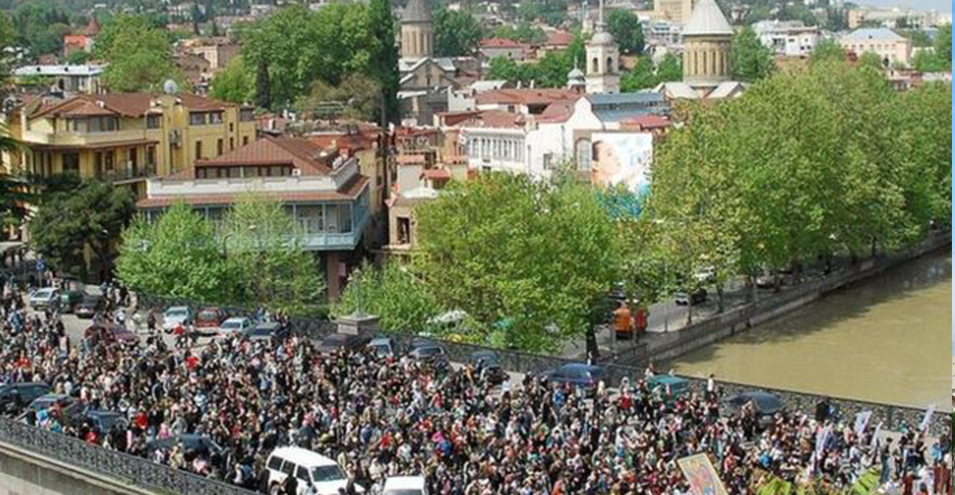
Every year, Georgia holds ceremonies and commemorations that are somehow related to Iran. Georgians try to keep alive the memory of those who were “martyred” in the campaigns and repressions of the Iranian kings. They are particularly sensitive about the massacres of Shah Abbas I and Agha Mohammad Khan Qajar, considering them dark spots in the country’s turbulent history.
One hundred thousand martyrs of Tbilisi
Every year on November 13, many people gather on a bridge over the Kura River in Tbilisi, the capital of Georgia, to commemorate the “Hundred Thousand Martyrs of Tbilisi” who were killed by Sultan Jalal-ud-Din, the last king of the Turkic-Iranian dynasty of the Khwarazmshahs.
In 1226, Sultan Jalaluddin besieged the city of Tbilisi, which had been in Georgian hands for more than a century, but finally a group of "Iranians living in Tbilisi" opened the city gates to the invaders at night.
At that time, Georgia was ruled by Queen Rasudan, who managed to escape the invaders. After the capture of Tbilisi, the Christian inhabitants were ordered to convert to Islam.
By order of Sultan Jalaluddin, symbols of Jesus Christ and the Virgin Mary were placed on a bridge over the Kura River so that Christians would be forced to step on them. Anyone who refused to step on these symbols and convert to Islam was beheaded.
It is said that one hundred thousand people, almost the entire population of Tbilisi, refused to renounce their religion, and the Kura River turned red with their blood. Georgian historians have described the atrocities of the massacre of women, children, old and young, and the looting of the city as “indescribable,” and refer to this event as “Georgia’s darkest day.”
Every year on November 13, priests and people carry signs and plaques of the event through the streets. They finally gather on the Metekhi Bridge, where the massacre is said to have taken place, to light candles in memory of the victims and throw flowers into the Kura River. Ceremonies are also held in churches.
Martyr's grave
Every year on September 26, people gather at the Church of Queen Ketuvan (Katayon) and other churches in Tbilisi to light candles in her memory.
Ketvan was the mother of Prince Tahmurth. From 1605 onwards, when Tahmurth was a minor, his mother ruled the Kakheti Kingdom as regent with the permission of Shah Abbas Safavi. However, in 1614, Shah Abbas sought to suppress the rebellion and unrest in Georgia and consolidate his rule there.
Ketvan surrenders to Shah Abbas to prevent his attack, but the Shah of Iran invades the Georgian region. The Iranian army commits a massive massacre, and according to historians, thousands of Georgian soldiers and people are killed and thousands more are displaced to central Iran.
The massacre of the Kakheti people is still a painful tragedy from the perspective of the Georgian people and historians, and is even mentioned in Georgian schools. But even sadder was the fate that befell the queen in Iran.
Queen Ketvan spent 10 years in Shiraz until Shah Abbas, seeking revenge on Tahmurt, who had not surrendered, asked Ketvan to convert to Islam and marry him. However, she met with fierce opposition and was tortured with hot iron until she was killed. The Georgian Orthodox Church declared her a saint and gave her the title “Ketvan the Tortured.” She is also known as Ketvan the Martyr.
Portuguese priests who oversaw the torture secretly exhumed her remains. It was said that parts of the remains were buried in a church in India. Recent DNA tests have shown that the remains belonged to a Georgian woman, Queen Ketuvan.
In 2015, a copy of a painting depicting the torture of Queen Ketuvan was unveiled at the Mokhrani Palace in eastern Georgia. The original, carved on a tile, is in a church in Lisbon, Portugal.
300 Aragoli soldiers
Georgians gather at the 300 Aragoli Monument and churches in Tbilisi on September 24th every year to remember the victims and soldiers killed in the attack of Agha Mohammad Khan Qajar.
In the late 18th century, after Agha Mohammad Khan completely conquered Iran, the Georgian ruler Erakli (Heraclius II), backed by his co-religion with the Russians, severed all official relations with Iran and declared himself under the protection of Tsarist Russia.
Therefore, in 1795, Agha Muhammad Khan announced in a letter to Arakli that he would launch an expedition against Georgia if the governor did not sever his relations with the Russians and fully obey Iran.
Arakli refused Agha Muhammad Khan's request and prepared himself for an attack. Agha Muhammad Khan marched into Georgia and, despite Georgian resistance, won the battle, and Arakli fled to Tbilisi.
Agha Muhammad Khan marched to Tbilisi to find him. Arakli fled from Tbilisi to western Georgia with his family and relatives. Agha Muhammad Khan conquered Tbilisi and ordered the killing and plundering of the people. His army drowned many of the clergy in the Kura River and destroyed the city. About fifteen thousand of the city's boys and girls were captured and taken to Iran.
According to historians, the Persian invasion dealt Georgia such a blow that it never recovered. Arakli died in 1798 and the rule of Georgia passed to his son, George XII. With George's death in 1800, the Georgian monarchy ended and the Russian Empire, which had occupied Georgia, annexed the country.
In 1959, the Aragoli Monument was erected at the site where the remains of the graves of the 300 soldiers who made the last stand to repel the army of Agha Mohammad Khan were discovered. These soldiers were from Aragoli, near Tbilisi, who died in the Battle of Krestsanisi.
Griboyedov
Alexander Griboyedov, the Grand Russian Ambassador who was killed in an 1829 attack on the Russian embassy in Tehran, is buried in Tbilisi. Although Iranians dislike him for drafting the Treaty of Turkmenchay and annexing part of Iranian territory to Russia, Georgians remember him as a man of letters, playwright, poet, and composer.
Although Griboyedov was not killed by the Persian shahs and no official memorial service is held for him, many who visit his grave and that of his wife, who is buried next to him, bring flowers and light candles in their memory.
In 1828, Griboyedov married Nino, the daughter of the Georgian poet Alexander Chavchavadze, and shortly after, he was sent by the Tsar to Iran as the Grand Ambassador.
When he arrived in Tehran, he discovered that a number of Georgian women were living in the homes of Iranian men. He considered them prisoners under the terms of the Treaty of Turkmanchai and requested their extradition from the Iranian government.
Finally, at Griboyedov's insistence, two Armenian women, who according to the Iranians had converted to Islam and were staying at the home of Allahyar Khan Asef al-Dawla, the then Foreign Minister, were granted asylum by the Russian delegation. On the orders of Rustam Beg, one of Griboyedov's Iranian companions at the Russian embassy, the Armenian women who were considering seeking asylum in Russia were taken to a bathhouse adjacent to the embassy.
Some have considered the bathing of Armenian women to be the culmination of public anger in Tehran. Many people in Tehran were angry at the conclusion of the Treaty of Turkmanchai, and some people, incited by Mojtahid, attacked the Russian embassy on January 30, 1829.
The attackers climbed over the wall of the ambassador's residence and began shooting from there. One of the first bullets killed Griboyedov. Griboyedov's body was taken out of Iran for burial and buried in Tbilisi.
Griboyedov's wife Nino is always praised among Georgians for never refusing to remarry.
Source: BBC