Air Pollution: Iran's Prosecutor's Office Rejects Circular on Fuel Oil Consumption in Power Plants
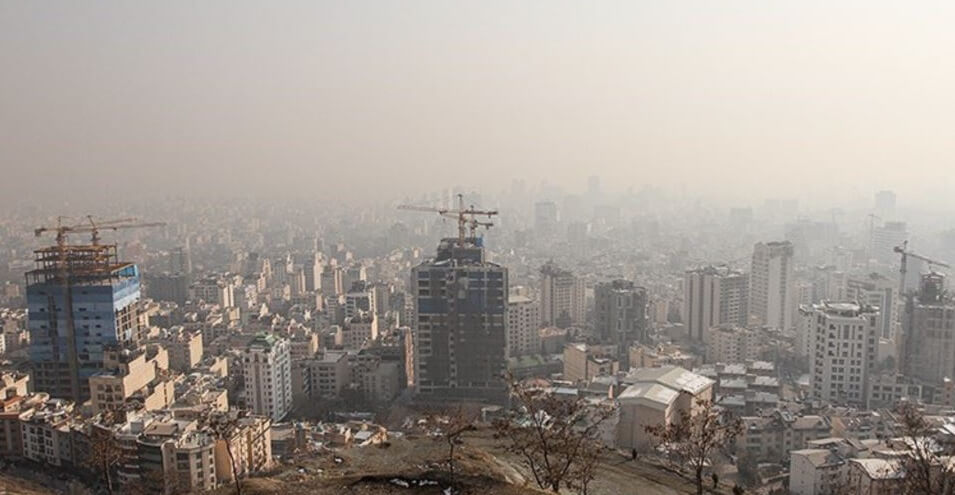
While the head of the Environmental Protection Agency has claimed regarding air pollution in metropolitan areas that "the Deputy Attorney General has issued a directive to the provinces not to prevent the burning of fuel oil (mazut) in power plants and industries," the judiciary has denied such a directive.
Reza Khosnoudi, the Deputy Attorney General of the country, said in response to Mr. Kalantari's remarks: "No circular has been issued in this regard by the Public Rights Department of the Attorney General."
Air pollution in Iran's major cities has received widespread media coverage in recent days, and officials in the Rouhani government say that due to the "shortage of gas" and "the storage of diesel fuel without customers," there is no choice but to consume it domestically.
In this context, Iranian Oil Minister Bijan Namdar Zanganeh, referring to the gas shortage in the country, announced on Sunday, January 4th: "We do not want fuel oil to be consumed, but we have no choice but to deliver fuel oil to power plants."
Issa Kalantari, head of the Environmental Protection Agency, also announced on Sunday that the sulfur content of Iranian diesel fuel is 30,000 ppm (equivalent to 3 percent), which is highly polluting, but it is burned in the country's power plants.
He added: The Deputy Attorney General has issued a circular to the Environmental Protection Agency asking not to obstruct the burning of diesel fuel in power plants and industries: "This means that the person who should implement the Clean Air Law has concluded from a security perspective that this diesel fuel should be burned."
Mohsen Hashemi, the head of Tehran City Council, also announced on Sunday that due to the use of diesel fuel in power plants, the concentration of sulfur dioxide in Tehran's air has doubled over the past week.
According to official statistics from the Ministries of Oil and Energy, in 2018, about five billion liters of fuel oil (mazut) were consumed in the country, of which 3.5 billion liters were in the power plant sector.
In the same year, Iran also exported more than 15 billion liters of diesel fuel. Diesel fuel, the most polluting fossil fuel, is mostly used as fuel for ships or power plants located in remote areas.
But since the beginning of 2020, the International Maritime Organization has banned ships from using fuels with a sulfur content of more than half a percent. The sulfur content of Iranian-produced diesel fuel is between 3 and 3.5 percent, and the use of this fuel on ships has been banned for more than a year.
Iranian officials do not mention this issue, saying only that sanctions have prevented the sale of diesel fuel on international markets.
This is while Iran's exports of other oil products, including gasoline, to global markets have not only not decreased, but have also increased significantly. US sanctions only target the sale of Iranian crude oil and do not apply to petroleum products.
Two-thirds of Iran's exported gasoline goes to neighboring countries such as the UAE, Iraq, Afghanistan, Pakistan, and Armenia, and the remaining shipments are mainly destined for African markets, Syria, or Venezuela.
For example, Iran's customs statistics for the first seven months of this year show that $1.4 billion worth of gasoline was exported. Iran's total gasoline exports in the 12 months of last year were less than half a billion dollars.
Also, due to the outdated technology of Iran's refineries, a quarter of the oil delivered to the refineries is converted into diesel fuel; an issue that Kalantari also pointed out, saying that 400 or 500 thousand barrels of diesel fuel are produced daily.
He said that this produced diesel fuel must either be exported or consumed, because if the warehouses are full, the refinery must be closed or it must be dumped in the desert or somewhere else because they cannot close the refinery because people want gasoline.
Source: Radio Farda