US-backed militias likely to clash with Iran in Syria
In recent weeks, small but significant developments have taken place on the Syrian operational scene, causing observers of the Syrian crisis to reconsider their future calculations. The following analysis sheds light on the nature and direction of these developments.
In April, a Syrian rebel group backed by the United States and trained by American special forces repelled an ISIS attack in an hour-long battle. The battle took place in the strategic Al-Tanf region near the border between Syria, Jordan and Iraq, and the group received air support from coalition forces during the operation. In addition, in recent weeks, ISIS has also suffered significant blows from the Western-backed opposition elsewhere, including in the offensive by the Kurds to liberate Raqqa, ISIS’s self-proclaimed capital. ISIS is also retreating elsewhere, including in Iraq.
Apparently, the existence of the armed anti-Syrian opposition prevents the Assad regime from occupying the territories that have been liberated from ISIS in the past week or two. Some of these areas, after liberation, will be controlled by the Kurds and groups that are supported and armed by the United States, the Gulf Arab states, Jordan, and Turkey. Geographically, these mainly Sunni groups are active on a north-south axis.
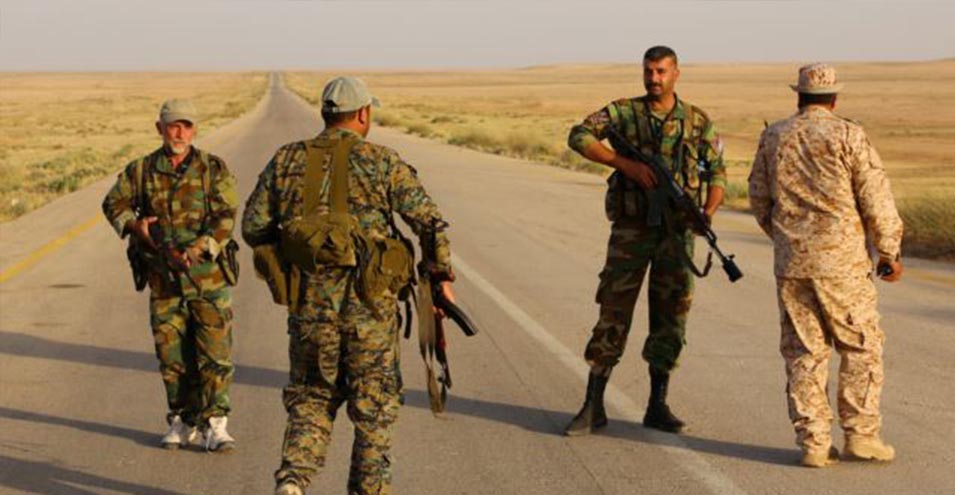
In contrast to these developments, the Assad government and its allies are forming a coalition force that is more present on the East-West axis and consists of Lebanese Shiites, Iran, and Syrian government forces.
Despite the relative silence within the parts of Syria controlled by Assad’s forces, this conflicting east-west and north-south grouping has inherently created tension. In other words, it cannot be said that there is a complete demarcation between forces allied with the Syrian regime and those opposed to the Syrian regime. If such demarcations existed, Syria would have been completely divided by now. In other words, there are points that are under the control of the north-south axis, but elements from the east-west axis are also active there as nuclei of resistance and crisis-making, and conversely, within the parts controlled by the east-west axis, elements from the north-south axis are active.
The main issue is the possible political solution and the extent to which the political demands of the conflicting groups in Syria have been taken into account. Let us not forget that some armed groups still want Bashar al-Assad to be completely removed from power and open up the political space for free participation. Foreign support is directly related to the political orientation of the armed group. For example, Iran and the United States, or Saudi Arabia and Turkey, are each willing to support groups aligned with them in order to achieve their desired solution. Iran does not believe in a political solution based on free elections, because the results of free elections could lead to the overthrow of Bashar al-Assad and would inherently conflict with Iran's interests in Syria and Lebanon.
Iran supports the Popular Mobilization Forces in Iraq, and as these forces approach the Syrian border, it has also dispatched hundreds of military and paramilitary forces to Syria since about three weeks ago. For example, they are stationed in the town of "Saba Bayar", which is located near the strategic Damascus-Baghdad highway and the common border between Iraq, Jordan, and Syria.
Last week, the US military announced that it had increased its “combat capability” in southern Syria, where Western-backed groups fighting the Islamic State (IS) group are under threat from Iranian-backed groups, according to Reuters. US military spokesman Colonel Ryan Dillon, who is based in Baghdad, was referring to the strategic al-Tanf region. This suggests that as the battle for Mosul approaches what could be the final battle to drive IS out of Mosul, Iraq, the fight against IS will naturally continue on Syrian soil. If the military formations remain in their conflictual form, such a battle, even though it shares the same goal of IS, could lead to a confrontation between the two groups backed by Iran and the US, and ultimately to a confrontation between the US and Iran. This confrontation could take place before, after or during the fight against IS, unless the parties reach some kind of political agreement.
Colonel Dillon describes the situation in the operational theater, referring directly to the Iranian-backed forces, as follows: We have strengthened our presence and foothold in the region and are ready to confront any threat that may arise from groups supporting the Bashar al-Assad regime.
Colonel Dillon believes that a small group of Iranian-backed forces remain inside the safe zone after the May 18 agreement, while a larger number of forces have been seen concentrated outside but close to the zone. According to Colonel Dillon, the presence of Iranian-backed forces both inside and outside the safe zone is considered a threat.
The army has distributed around 90,000 leaflets in these areas this week, warning them, according to an unnamed military official. Reuters had previously reported the leaflets being distributed, citing a website. The agency, which obtained a copy of the leaflet, said: “Any movement towards the al-Tanf barracks will be considered hostile and we will defend our forces… You are inside a stabilized area of conflict, leave this area as soon as possible.”
It is clear that the competition for access to this southeastern region between Iranian-backed militias and US-backed anti-Assad fighters, who now have heavy military vehicles, TOW missiles, and combat vehicles, could end in a confrontation between the US and Iran. While in the current situation, the real and immediate threat is ISIS, there is no need for anti-ISIS forces to engage in military confrontation with each other.
In a situation where Kurdish forces affiliated with the People's Protection Units (YPG) with US support will soon begin their attacks to liberate the city of Raqqa, if the Syrian army and Iranian-backed forces insist on controlling Al-Tanf, this will practically cost them a formal and public confrontation with the US. Currently, the distance between the two forces is about 50 to 60 kilometers. Between the Al-Bukamal region (in Syrian territory) and Al-Qaim (in Iraqi territory), which is the border point between Syria and Iraq, and the Jordanian border, there is a completely dry and desert area that is likely to be used more as a passage for refugees and ISIS forces fleeing towards Jordan, and at least in the current situation, it seems unlikely that access to it will have strategic value. However, the insistence of Iran or groups supported by Iran and the Syrian government to confront other opposition groups can only create an unwanted war in the region and increase the probability of ISIS survival.
Source: Radio Farda