12 Kurdish environmental activists continue to be detained without meeting their lawyers and families
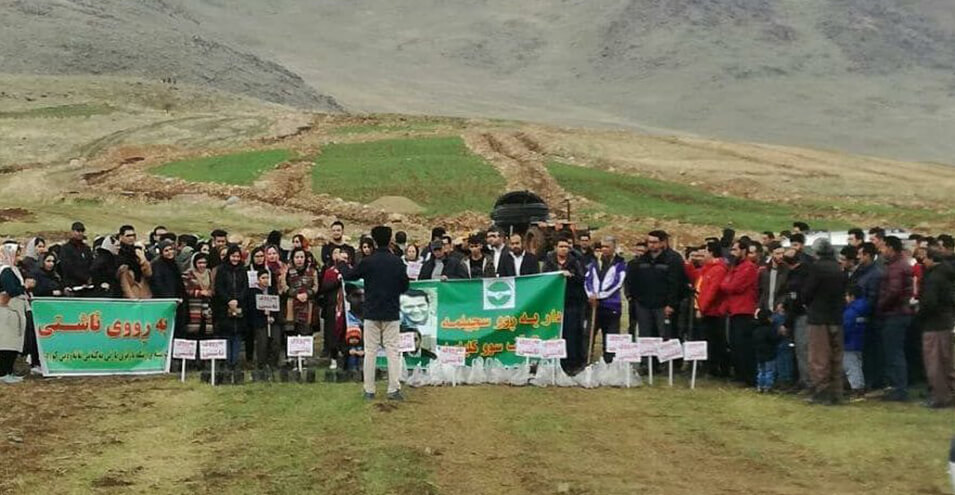
An informed source told the Campaign for Human Rights in Iran that 12 Kurdish environmental activists who were arrested in January and February 2018 are still being held in the security detention centers of the Ministry of Intelligence and the Revolutionary Guards Intelligence Organization in Sanandaj without access to their lawyers and families.
More than twenty environmental activists in Kurdistan province were arrested in February and January 2018. Both the intelligence agencies of the Ministry of Intelligence and the Revolutionary Guard played a role in the arrest of these civil society activists, who mostly worked in the field of environment. An environmental activist in Sanandaj, who asked not to be named, told the Campaign on April 13 that a number of those arrested had been released on bail, but 12 remain in limbo without access to lawyers or families.
Farhad Mohammadi, Hadi Kamangar, Issa Faizi, Rashed Montazeri, Hossein Kamangar, Armin Sperlos, Avat Karimi, Idris Mohammadi, Farzad Hosseini, Homayoun Bahmani, Sirvan Ghorbani, and Jalal Rostami are still in detention three months after their arrest. The informed source told the Campaign that these individuals have had no contact with their families or lawyers except for brief phone calls, and that judicial authorities are not responding to their families’ follow-up: “We have not met them and have not heard from them. They make brief phone calls to their families every few weeks but do not provide any information about their whereabouts. The families have gone to the Ministry of Intelligence several times but they have not provided any information, and they have said that if necessary, we will inform you ourselves.”
The source told the campaign that a number of the initial detainees, including Fazel Gheitasi, Reza Asadi, Zaniar Zamiran, and Amanj Ghorbani, have been released on bail but have refused to speak to the media or provide information due to security warnings and threats. According to the source, most of the detainees have environmental activities in common, but these individuals have been separately charged with other charges: “Apart from the twelve who are still detained, the rest were released on bails of 500 or 700 million, because their mobile phones and computers were confiscated and they were threatened with silence, so they cannot speak, but I was able to speak to one of them and I learned that they are all somehow related to the environment and each has separate charges such as propaganda against the system, acting against national security, or ties to political parties.”
According to the campaign source, a number of people have been arrested by the Revolutionary Guards Intelligence Organization and some have been arrested by the Ministry of Intelligence.
According to the Kurdistan Human Rights Network, a number of the detained citizens have been interrogated by both the Ministry of Intelligence and the Revolutionary Guards. The organization, which focuses mainly on human rights violations in Kurdistan, wrote on April 10, citing an informed source: “These two (Idris Mohammadi and Avat Karimi) were transferred to the IRGC’s intelligence detention center, known as Shahram Far, some time after their arrest and interrogation at the Sanandaj Intelligence Department’s detention center, and we have not heard from them for more than a month.”
The crackdown on environmental campaigns and NGOs intensified in early February 2017 with the mass arrests of environmental activists in Tehran by the IRGC Intelligence Organization, and continued despite the suspicious death of Kavous Seyed Emami, a university professor and prominent environmental activist, and the Ministry of Intelligence’s announcement that the detainees were not spies. Despite the Ministry of Intelligence’s opposition to the arrests of environmental activists in Tehran, after a while the ministry proceeded to arrest environmental activists in the cities.
A number of those arrested are members of the Kurdistan branch of the National Unity Party, which was established with the permission of the Ministry of Interior. Farhad Mohammadi, a lawyer and secretary of the National Unity Party, Hadi Kamangar, the party's secretary in Kamyaran city, and Isa Faizi, a member of the Kamyaran district's environmental committee, are among the well-known members of this party who have been imprisoned for their environmental activities.
Websites and news agencies affiliated with the security forces in Iran accuse environmental activists of espionage under the guise of environmentalism. However, they have not yet provided evidence for such claims, but a number of environmental activists in provinces such as Tehran, Kurdistan, and Shahrekord have spent months in prison without a fair trial. However, hardline media outlets continue to spread unsubstantiated allegations against those arrested.
The campaign source said that a number of lawyers have volunteered to defend the defendants, but the Sanandaj Prosecutor's Office has not yet allowed them to enter the case and accept representation. The environmental activists of Kurdistan have been deprived of legal advice for more than three months, even though the right to a lawyer and legal advice is one of the most obvious rights of the defendant, which has been repeatedly emphasized in domestic and international laws.
According to Article 14 of the International Covenant on Civil and Political Rights, to which Iran has also signed, the accused, in addition to having a lawyer, must have sufficient time and facilities to defend himself and communicate with the lawyer of his choice. The Constitution of the Islamic Republic also stipulates in Article 35 that in “all” courts, the parties to the lawsuit have the right to choose a lawyer for themselves, and if they are unable to choose a lawyer, they “must” be provided with the means to appoint one.
According to Articles 48 and 190 of the Code of Criminal Procedure of 1392, defendants not only have the right to choose a lawyer, but if the defendant is not informed, the court must explicitly inform the defendant of the right to choose a lawyer, and the judge will be subject to disciplinary punishment for denying this right. According to Note 1 of Article 190 of the Code of Criminal Procedure, “Denying the right to have a lawyer and failing to inform the defendant of this right shall result in disciplinary punishment of the eighth and third degree, respectively.”
Source: Human Rights Campaign