On the occasion of the World Day against the Death Penalty; One Year Report on Executions in Iran
Through the efforts of the Statistics Institute of Human Rights Activists in Iran, as usual, on October 10, the International Day Against the Death Penalty, a report on the past year in this area is prepared and published with the aim of drawing public attention to the situation of thousands of people currently awaiting execution.
The report states that between October 10, 2016 and early October 2017, at least 508 people were hanged in different parts of Iran, a figure that has not only not decreased compared to the same period last year, but has also increased by at least 1%. The issuance and execution of death sentences against citizens in Iran occur while many defendants are deprived of access to a fair trial. It should also be noted that due to the lack of permission for independent human rights groups to operate in Iran, the report cannot be considered free from shortcomings.
The main source of this report is reports prepared and compiled by the Human Rights Activists in Iran (HRANA) news organization or other independent and credible sources. Another part of these reports is news texts or a collection of statements that judicial authorities officially announced in conversations with state media about the issuance and execution of death sentences for citizens.
From October 10, 2016 to early October 2017, 381 reports were registered by the Statistics and Publications Institute and the Human Rights Activists' Association in Iran regarding executions, including the sentencing of at least 223 people to death and the execution of at least 508 people, of whom 32 were executed in public. Of the victims whose identities have been verified, 6 of the executed were female, and 6 of the executed were under 18 years old at the time of the crime.
The execution of defendants under the age of 18 occurs despite the fact that in some cases, in addition to the lack of credible evidence and documents against the defendant, the court has sentenced the defendant to death regardless of his physical condition and age.
During the aforementioned period, seven child criminals were also sentenced to death, with the convicts claiming that in most cases they were forced to confess against themselves under severe psychological pressure and torture.
The number of executions during the period under review has not decreased compared to the same period last year, and has even increased by about 1%. This increase in executions comes at a time when the number of death sentences issued has decreased by 62%. The number of public executions has decreased by 5% compared to the same period last year, and the number of executions of women has also decreased by 33%.
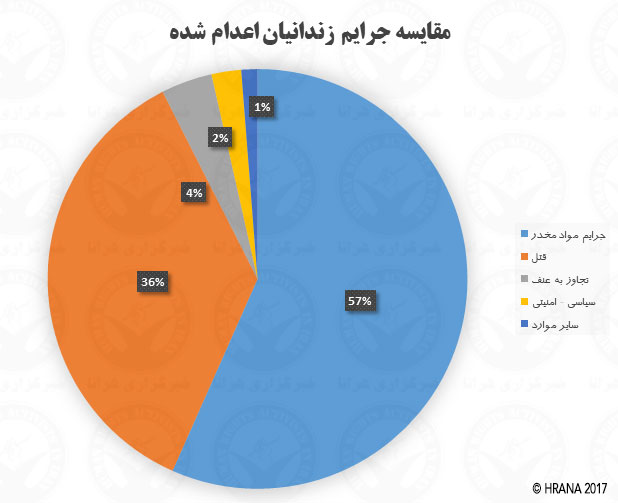
According to this report, 57% of those executed in Iran were executed for drug-related crimes, 36% for murder, 4% for rape, 2% for political or security charges, and 1% for other cases.
The increasing number of executions for drug crimes comes as the Iranian parliament has approved an amendment that further restricts the legal conditions for issuing the death penalty for drug-related crimes, in a way that could result in the commutation of death sentences for several thousand prisoners, but it will require the approval of the Guardian Council to become legal.
As mentioned, despite all efforts and pressure, there is no comprehensive and perfect statistics on the number of executions carried out, to the extent that a member of parliament recently announced that the judiciary does not inform us of the number of executions for drug crimes.
The chart below shows the proportion of executed prisoners for crimes, showing that the number of people executed for drug crimes is more than twice that of other crimes.
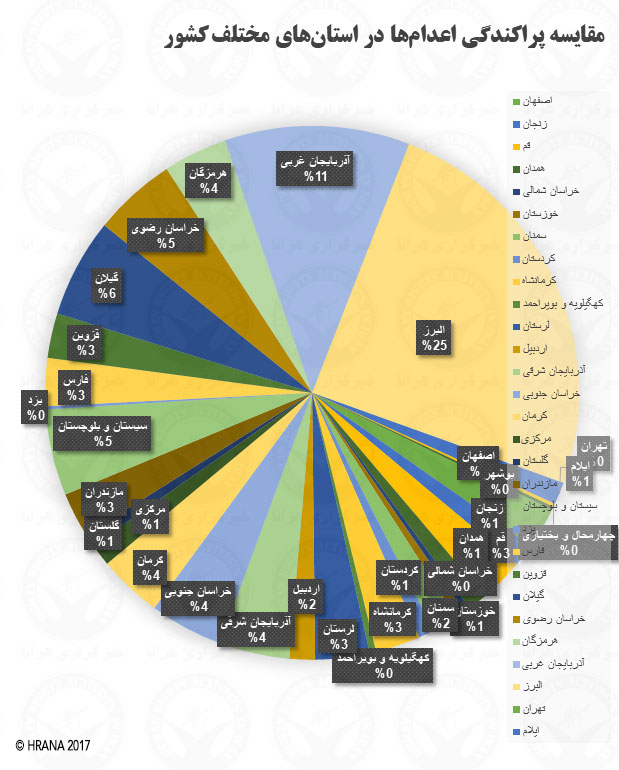
Alborz Province, with three of the country's most populous and important prisons, which are mainly concerned with holding those accused of violent crimes, leads the way in the number of executions, with at least 127 executions during the period mentioned, many of which were carried out in groups.
Also, the most executions carried out in prisons were carried out in Alborz province and in Rajai Shahr Prison in Karaj. During the mentioned period, 73 people were executed in Rajai Shahr Prison in Karaj. Most of these executions were carried out in groups.
The pie chart below examines the execution of the death penalty in different provinces of the country, with Alborz Province in the lead with 25%, and West Azerbaijan Province and Gilan Province in second and third place with 11% and 6%, respectively.
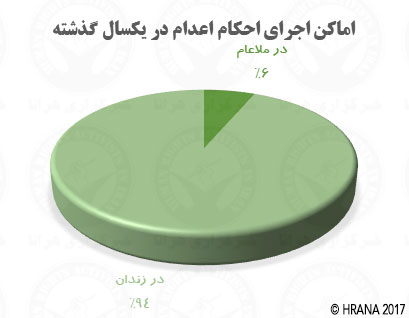
According to the statistics provided, 6% of executions were carried out in public and in full view.
The provinces with the most public executions are: Hormozgan Province, which ranks first with 7 public executions, and Khorasan Razavi Province, which ranks second with 5 public executions.
Also, the most executions carried out in one day were on January 15, 2016, when 18 people were executed in one day.
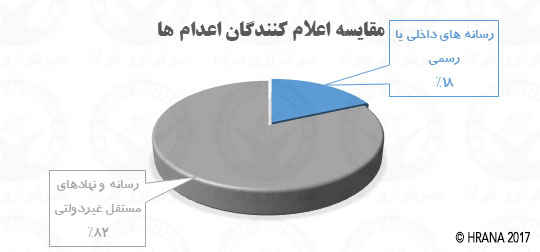
This chart, which is directly related to the secret execution of prisoners, examines executions reported by independent and human rights sources, and according to this chart, 82% of those executed were executed secretly or without announcement in the mass media.
Source: HRANA