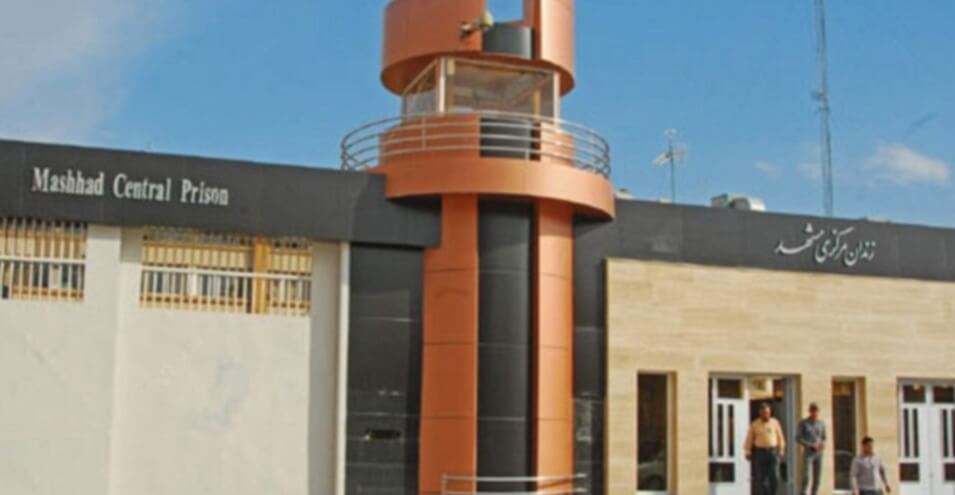
“The risk of execution threatens Milad Azimi, a teenage prisoner”

Milad Azimi, a teenager accused of “premeditated murder” in a mass brawl, is facing execution. The Iranian Human Rights Organization says his relatives are trying to gain the victim’s family’s consent. Two weeks ago, news of another teenager’s execution spread.
The Iranian Human Rights Organization reported on December 4 that Milad Azimi, a teenage prisoner who was charged with “premeditated murder” at the age of 17 in connection with a mass brawl in high school, is now at risk of execution.
According to the report, Milad Azimi, who was born in Kermanshah, was arrested by police following a mass brawl at the Rudaki Township High School on December 8, 2013. He is charged with “premeditated murder.”
Milad Azimi was under 18 years of age at the time of the crime. After his arrest, he was transferred to the Kermanshah Correctional Center for about a year and then to the city's Diesel Abad Prison because he had reached the legal age. The prisoner is currently in the "Consultation One - Youth Ward" ward.
Two years after Milad Azimi's arrest, the Islamic Revolutionary Court of Kermanshah Province sentenced him to "retaliation" in 2015 on charges of killing a man with a knife in a mass brawl.
In November 2015, Amnesty International issued a statement warning of the possibility of the death penalty being carried out against this imprisoned teenager. Amnesty International reported on the “unfair process” of Milad Azimi’s trial and his “confessions made under torture.”
According to the prisoner's family, "due to the hustle and bustle of the fight and the crowd, he is not sure if he committed the murder himself."
The relatives of the imprisoned teenager are trying to prevent the execution of the prisoner by collecting money and paying the ransom. One of Milad Azimi's relatives told the Iranian Human Rights Organization: "They wanted to execute Milad on November 12 of this year, but with the intervention of the elders, we got a one-month reprieve, and this is the last deadline they gave us. If we cannot provide 550 million tomans by December 13, they will execute Milad."
Fariba Bakhshi, Milad Azimi's mother, told the Iranian Human Rights Organization: "After my son was sentenced to self-sacrifice, we had no choice but to go. We went everywhere. I begged anyone we thought could help us a little. By selling my belongings and helping some good people, we raised 150 million tomans. The Imam Ali Association did not leave us alone in this endeavor and raised 200 million tomans to help Milad's release, which together amounts to 350 million, but we are still 200 million short of the amount requested by the victim's family. Now they have threatened to execute the sentence if the blood money is not paid in full by December 4 of this year."
The prisoner's family has also sent their request for help to artists and the media.
Execution of a teenager in Rajai Shahr prison
Human rights organizations have reported the execution of a teenager named Omid Rostami. He was reportedly among 10 prisoners executed two weeks ago in Rajai Shahr Prison in Karaj. Omid Rostami was arrested at the age of 16 and sentenced to death following a murder in Islamshahr in July 2012.
He had been taken to the gallows four times before, but the execution had been postponed. Omid Rostami had a record of robbery twice. The prisoner's family was unable to satisfy the victim's family due to the high amount of blood money.
Despite being a signatory to the Convention on the Rights of the Child, Iran carries out the death penalty on criminals under the age of 18. Article 37 of the International Convention on the Rights of the Child prohibits the imposition and execution of the death penalty, deprivation of life, and unpardonable life imprisonment on children – all persons under the age of 18.
The Iranian judiciary does not recognize the legal age of 18 as the end of childhood and adolescence. Article 91 of the new Islamic Penal Code, enacted in 2013, allows judges to refrain from issuing death sentences to children who do not understand “the nature of the crime or its sanctity.”
According to Amnesty International and the Iranian Human Rights Organization, since the enactment of Article 91 in Iran until 2017, at least 25 people have been executed for crimes they committed as children.
According to Amnesty International, Iran executed at least five prisoners who committed crimes when they were under the age of eighteen last year alone.
Source: DW