Court refuses to allow prisoner of conscience to meet and say goodbye to his mother
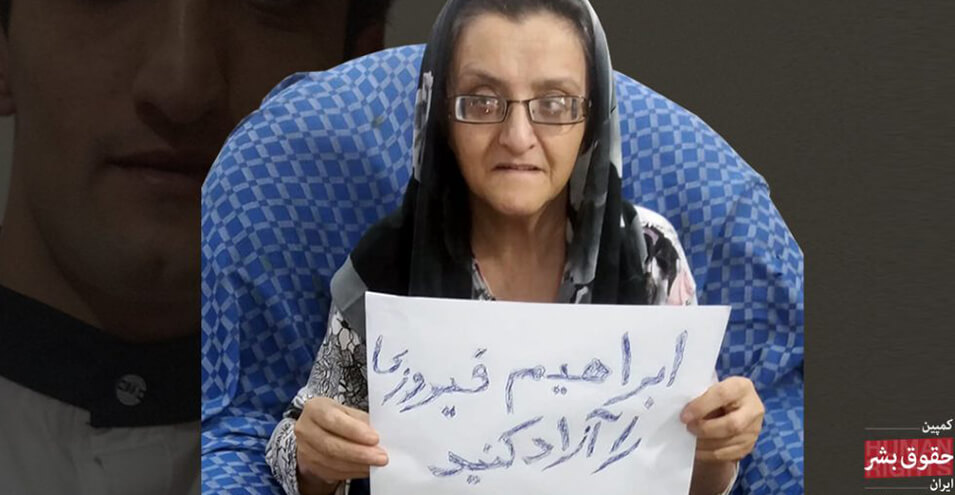
Ebrahim Firuzi's brother told the Campaign that their mother died while her only wish for the past year was for Irahim's freedom and that until the last moments of her life she had been looking for her son and hoping for his release from prison. Mohammad Firuzi told the Campaign that his mother was unable to attend the prison due to cancer and poor eyesight, and that judicial authorities had ignored her repeated requests for leave.
Ebrahim's mother, Kobra Kamrani, passed away at home on December 1, 2018, after a year-long battle with breast cancer, without ever meeting her son for the last time. Ebrahim Firouzi has been arrested and imprisoned many times for converting to Christianity, most recently on March 8, 2012, for religious propaganda and distributing books about Christianity, and was released on bail after two months. The trial of this Christian convert was held in April 2015 at Branch 28 of the Revolutionary Court of the Islamic Republic of Iran, presided over by Judge Moghiseh. According to the verdict, Ebrahim Firouzi was sentenced to five years in prison on charges of forming an illegal group and acting against security. When the verdict became final on September 15, 2013, he was transferred to Evin Prison and after a while he was exiled to Rajai Shahr Prison.
Mr. Firoozi, a 32-year-old woodworker and resident of Robat Karim, has been arrested and tried three times on charges of converting to Christianity and holding religious meetings. This Christian convert was arrested in January 2009 and transferred to Rajai Shahr Prison in Karaj after being summoned twice by security agencies for his Christian missionary activities. According to an informed source, he was told during interrogations that if he declared that he was a Muslim, he would be released and otherwise he would be tried. In this case, Ibrahim Firoozi was charged with “propaganda against the system” and “insulting the sacred” for converting to Christianity and carrying out missionary activities. He was acquitted of the charge of insulting the sacred, but was sentenced to 5 months of imprisonment and 5 months of suspended imprisonment by the Karaj Revolutionary Court on the charge of propagandizing against the system. This sentence was confirmed by the Court of Appeal and he was released from Rajai Shahr Prison in Karaj on June 8, 2011.
Mr. Firouzi was arrested for the second time on March 8, 2012, for “attempting to launch a Christian theology education website” and sent to Evin Prison, and was released on bail after two months. The Robat Karim Revolutionary Court, presided over by Judge Babaei, sentenced him to 1 year of penal servitude and 2 years of exile to Sarbaz County in Sistan and Baluchestan Province on charges of “propaganda against the regime” through holding religious classes. Although the text of the verdict stated that Mr. Firouzi had stated that he did not oppose the Islamic government, this sentence was also upheld by the appeals court.
The Christian convert was arrested for the third time on September 15, 2013, and transferred to Rajai Shahr Prison. According to the informed source, he was held in Rajai Shahr Prison for four days without being charged and then transferred to Ward 240 of Evin Prison. According to the source, his interrogations in Evin Prison were accompanied by “insults and inquisitions” to extract a forced confession. The interrogators also addressed issues for which Mr. Firouzi had previously been interrogated and tried.
In April 2015, Branch 28 of the Revolutionary Court, presided over by Judge Moghiseh, sentenced Ebrahim Firouzi to five years in prison on charges of “forming a group with the intention of disrupting national security,” as per Article 498 of the Penal Code. According to Mr. Firouzi’s relatives, he denied forming a group or intending to disrupt national security throughout the proceedings, and some of the evidence in the verdict included activities for which Mr. Firouzi had previously been tried and convicted.
Source: Human Rights Campaign