Prohibitions and restrictions on women in Iran after 41 years; the Islamic Republic government has set women back
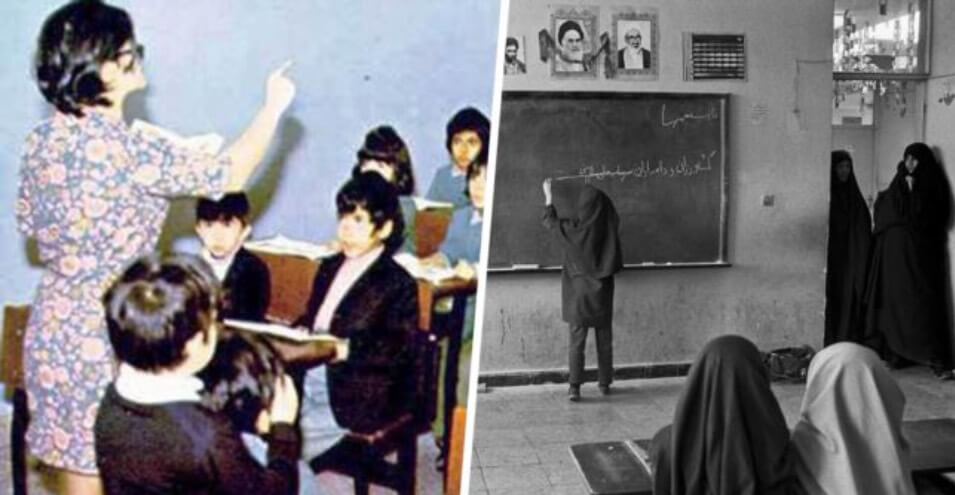
Women's society in Iran has changed so much during the 41 years of the Islamic Republic's rule that not only the statistics but also the outward appearance of this society indicates years of regression in women's basic rights.
Looking at the black and white images of the 1979 Revolution, we see women from different walks of life who, regardless of whether they were wearing or not, were present in the ranks of the protesters in an effort to improve the situation of those days. However, after the 1979 Revolution, sparks of ideological and physical unification among women began with the passage of the first law, the "compulsory hijab," against the freedom of this segment of society in 1983, and the field for women became so narrow that in recent years, even going to the gym has become one of their "violated rights."
But during the life of the Islamic Republic, whenever there has been talk of pursuing women's rights by Islamic Republic officials, it has mostly been a rhetorical device for an election slogan that has lasted only a few days after a government came to power.
Ministries empty of women
Appointing women to ministries is one of the slogans that has been repeatedly heard from presidential candidates. In Iran, which before the revolution had Farrokhrou Parsa as Minister of Education from 1978 to 1985 and Mahnaz Afkhami as Minister of State for Women's Affairs from 1986 to 1988, only one woman, Marzieh Vahid Dastjerdi, has been elected to a ministerial position in the second administration of Mahmoud Ahmadinejad in the past 41 years.
Dastjerdi, who was Iran's Minister of Health, had harsh comments against women while representing the parliament, leading some civil society activists to criticize him for his anti-women views.
Among the officials of the Islamic Republic who have repeatedly promised to introduce women to ministerial positions is Hassan Rouhani, although he did not introduce a single female candidate for a cabinet in either of the eleventh or twelfth governments.
Women's unemployment rate in Iran
While, according to Iranian officials, Iranian girls have taken up to 60 percent of the entrance exams in recent years, the Leader of the Islamic Republic does not believe in the strong presence of women in high management positions.
Among other things, in 2013, Ali Khamenei described the presence of women in jobs and executive positions as a "problem" and said: "For us to be proud of the high presence of women in executive positions is a wrong view and, in fact, passivity in the face of Western discourse."
The approach of the Leader of the Islamic Republic to the presence of women in society is a decoding of what shows why, according to members of parliament, 63 percent of educated women in Iran are unemployed!
Masoumeh Aghapour Alishahi, deputy head of the women's faction in parliament, while announcing this statistic, said that 53 percent of female students pursue specialized fields in university, but the gap between the growth of education and the employment rate of women is very large.
Women's dancing and singing banned for over 40 years
Gender inequality in various sectors has taken away freedom from women's society in Iran since the 1957 revolution. Issues such as the ban on women's voices in Iranian music, restrictions on female musicians going on stage, the criminalization of women's dancing, and many other things that did not exist before the revolution are now major problems for Iranian women and examples of their violated rights.
There are no accurate statistics on how many women's voices have been forcibly silenced in Iranian music during the 41 years of the Islamic Republic's rule, and how many underground female singers continue to perform despite all restrictions; but these forbidden voices sometimes break out of the framework of social networks and gain global resonance.
Haleh Seifizadeh is one of the female Iranian singers who faced a ban on herself and her group simply for singing. Shirazi singer Negar Moazzam, who sang on a tour, was eventually convicted and forced to leave Iran.
The ban on women dancing has also had its place in recent years. Many times, girls who posted their dances on social media faced legal punishments. Iranian actress Farzaneh Kabuli was also accused of dancing on stage.
The United States has repeatedly condemned the regime's discriminatory and security-related treatment and repression of various segments of society in Iran, including women.
Gyms closed to women
The backward boundaries that the Islamic Republic has imposed on women over the years have even crossed the doors of stadiums. An unwritten ban in the law that neither allows male spectators to attend women's competitions nor allows women to exercise their right to sit in the stands of stadiums like Azadi.
The ban on women's presence in stadiums began shortly after the hijab became mandatory for women in Iran, and women have been trying to get into the stadiums for all these years. In the meantime, Mahmoud Ahmadinejad, the then president of Iran, in 2006, sent a letter to the head of the Physical Education Organization requesting that facilities be provided for women's presence in stadiums; but in the end, it did not go anywhere due to the opposition of the clerics of Qom.
Women's struggle to reclaim their share of stadiums has come at a heavy cost. The self-immolation of Sahar Khodayari, known as the Blue Girl, in protest of this ban, the widespread coverage of the Blue Girl's death in the media, and the subsequent increase in international pressure, led to the stadium doors being officially opened to female spectators only once, in October 2019. But after that, the water did not move and this restriction continues.
A ban on cycling, motorcycling, some martial arts, and restrictions on participation in some international sports, including swimming and gymnastics, should also be added for women.
The most prominent right denied to women: the right to choose how to dress
But the most significant right that has been taken away from women for over forty years is the right to choose their appearance and clothing. According to the compulsory hijab law, which was passed in 2013, girls are forced to wear the hijab from the age of seven, when they are supposed to call school their "second home," and after that, this unwanted covering accompanies them wherever they are considered "public"; an unwanted companion that women have no say in choosing.
In addition to the mandatory hijab, the Islamic Republic has also created definitions that women who do not adhere to the hijab are accused of “improper hijab.” Guidance patrols and their violent encounters, the seizure of cars that, according to officials, have passengers wearing “improper hijab,” and dealing with modeling photographers who promote “improper hijab” are among the actions of this government in its 41-year history. However, the “Girls of Revolution Street” began their public protests against the mandatory hijab in January 2017, holding white scarves.
In recent years, the Islamic Republic's authorities have had severe security crackdowns on the girls on Enghelab Street. Examples include heavy sentences for Mojgan Keshavarz, Monireh Arabshahi, and Yasman Ariani.
Recently, female athletes have also publicly protested the mandatory hijab and restrictions in Iran. Kimia Alizadeh, the only Iranian female Olympic medalist in history, described herself as “one of the millions of oppressed women in Iran” after emigrating.
Mitra Hejazipour, another Iranian national chess player, also recently appeared at the world championships without a hijab and was expelled from the national team for this reason. Shohreh Bayat, an international chess arbiter, also appeared at the championships without a hijab in November of this year.
The US State Department and human rights organizations have repeatedly protested the harsh treatment of protesters against the mandatory hijab in Iran in recent years. Morgan Ortagus, a spokesperson for the US State Department, also said that "no one should be forced to wear or not wear religious clothing."
However, the granting of citizenship by a mother to her child, which was approved with restrictions and upon approval by security and intelligence agencies, the uncertainty of the bill to ensure women's security against violence after 7 years, the need for women to obtain their husband's consent to leave the country, the lack of custody of children, gender inequalities in the areas of work and education, and many other issues are among the rights that the Islamic Republic government has ignored; rights that many women may not even be aware of after the revolution.
Source: Voice of America