Nasrin Sotoudeh will not defend herself in the Evin Prison Prosecution Office.

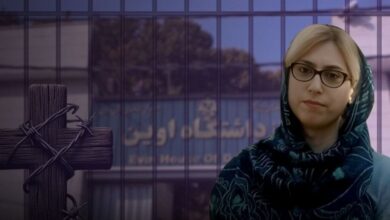
Nasrin Sotoudeh, a lawyer and human rights activist currently in Evin Prison, has announced that she will not appear and defend herself before the Evin-based prosecution. She outlined her reasons in a letter published by her husband.
In a letter published by Nasrin Sotoudeh through her husband, Reza Khandan, she explained why she is unwilling to appear despite the prosecutor's summons.
In the letter, which was published on Tuesday (August 21), Nasrin Sotoudeh discussed the history of her arrest and wrote that she was arrested two months ago on an arrest warrant issued in absentia by Branch 28 of the Revolutionary Court. She was then sent to the prosecutor's office located in Evin Prison, where she was informed of the new charges. Nasrin Sotoudeh pointed out that this action was illegal.
Nasrin Sotoudeh was arrested at her home on June 13, 2018, and transferred to Evin Prison. At the time of her arrest, she was told that she was “arrested on the basis of a 5-year penal servitude sentence [tried in absentia].” However, after appearing at the Evin Prosecutor’s Office, it became clear to her that her advocacy in the “Daughters of the Revolution” case and other human rights activities, such as her membership in the Association for the Abolition of the Death Penalty, were the reasons for her arrest.
The human rights defender says that he has refused to present any defense since the accusation was first made and that he had reasons for avoiding it.
According to this lawyer, one of his reasons was that the District 33 Prosecutor's Office, where he is supposed to be present, has been located in Evin Prison since the summer of 2009 to handle political charges, while lawyers and advocates have always objected to the location of the prosecutor's office in the prison.
Sotoudeh emphasizes the need for the independence of the judiciary and considers "establishing the prosecution in a part of the prison and applying strict security measures to travel to the said prosecution, which has no meaning other than the control of the security institutions over the said prosecution," as well as determining a designated list of lawyers who are allowed to defend political and security defendants, as violating the principle of the independence of the judiciary.
Another reason Nasrin Sotoudeh gave for avoiding the aforementioned court, according to her, is that the court is acting contrary to Article 35 of the Constitution, which states: “In all courts, the parties to the dispute have the right to choose a lawyer for themselves, and if they are unable to choose a lawyer, they must be provided with the means to appoint one.” According to Nasrin Sotoudeh, the Evin District Court does not allow defendants to choose their own lawyers.
Nasrin Sotoudeh says that, aware of her right to choose a lawyer, she has announced the names of three of her colleagues to represent her since she appeared at the aforementioned courthouse, but the relevant investigator has not accepted the representation of the three.
Sotoudeh writes in her thesis: "In light of the above points, and since I do not intend to make myself responsible for a conviction that has already been issued by accepting representation from lawyers approved by the judiciary's data protection department, I will therefore refrain from any appearance or defense before the prosecution and the relevant investigation."
Nasrin Sotoudeh has always been under pressure for her role in representing political prisoners. In September 2008, while representing a number of political prisoners, she was arrested and sentenced to 6 years in prison and 10 years of disqualification from practicing law. The lawyer was then released in September 2013 after serving three years in prison.
Ms. Sotoudeh was arrested again at her home on June 13 and sent to prison. Ms. Sotoudeh’s lawyer, Payam Darfashan, explained to DW Persian about the case being prepared against her client, saying that her client has been accused of “hiding espionage,” which is a subcategory of espionage crimes. He added that the recent case preparation was carried out with the intervention and order of the Ministry of Intelligence, and that the story began with a letter that the Ministry’s Judicial Deputy sent to the head of the Evin Prosecutor’s Office.
In a statement released on August 18, Human Rights Watch said that the arrest and pressure on Nasrin Sotoudeh was due to her human rights activities. The organization strongly criticized the new case against Nasrin Sotoudeh and the criminalization of human rights activities. The Middle East director of the human rights organization said that the Ministry of Intelligence, along with the IRGC’s intelligence organization, is responsible for the repression of human rights defenders in Iran.
In Iran, not only human rights activists, but also their families and supporters are under pressure. On the same day that Human Rights Watch released its statement, security agents also searched the homes of Nasrin Sotoudeh and her sister Reza Khandan, her husband.
Source: DW