Valentine's Day, Thirst for Love and Lack of Happiness in Iran
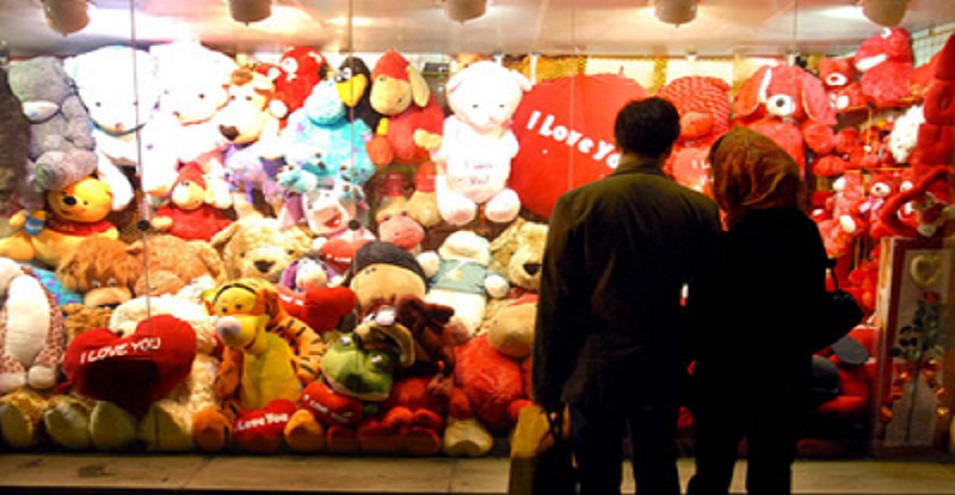
Last year, I got an iPhone and a bunch of chocolates from my boyfriend for Valentine's Day. This year, I don't know what he wants to get me, but I bought him a shirt, a big teddy bear, and a bunch of other stuff.
February 14th, Valentine's Day, although it has no historical background in Iran, has been taken very seriously in recent years, and government and governmental reactions to it have become more severe: Iranian police have banned the giving of flowers and dolls on Valentine's Day.
Despite these threats and warnings, Iranian youth celebrate Valentine's Day more magnificently each year than the previous year.
The reason why Valentine's Day makes young Iranians so excited to do their own thing regardless of threats probably has sociological and psychological roots.
Neda Afrogh, a sociologist, told Radio Zamaneh about the special attention Iranian youth pay to Valentine's Day and the fact that this occasion becomes more significant every year: "Since there is no balance between sadness and happiness in Iranian society, it is obvious that such conditions will arise. For example, if there are 70 days a year for mourning, we may have 20 days for joy and happiness. A society that focuses on mourning and sadness, its youth automatically find other ways as alternatives. The ways that their nature requires, which is to be happy, under any pretext."
Valentine and Muslims
Mona is a mother of two. She has planned to take her daughters to her mother’s house for Valentine’s Day and “surprise” her husband with a romantic dinner and a red homemade cake. Mona wears the hijab and does not stop praying or fasting. “When I see the excitement of Valentine’s Day on the street, I think to myself, ‘Why shouldn’t my husband and I be a part of it?’ What could be better than being happy and making my husband happy?” she says.
According to the latest UN reports and statistics, Iran ranks 110th among 158 countries in which the happiness indicators of citizens have been examined. The indicators of this statistic are defined based on variables such as annual income, having a life partner, and having the possibility of free choice in life. Based on this, the happiest country in the world in 2015 was Switzerland, followed by Iceland, Denmark, Norway, and Canada, with a small gap.
Neda Afrogh says in this regard: “When the country’s policies and policies do not allow for happiness, people create happiness themselves. For example, while celebrating birthdays was not very common in the past hundred years, today both the rich and the poor celebrate birthdays. Even celebrating divorces has become popular these days. This means that people want to be happy even in the most terrible and saddest moments of their lives.”
Sociological data show that societies that lack sufficient reasons or occasions to be happy borrow reasons to be happy from other cultures. This borrowing is initially covert and covers a small segment of society, but gradually becomes widespread, reaching a point where, after years, people in that society rarely remember what their celebration and joy originated from.
Valentine's Day, Business, and the Taboo of Love in Iran
A shopkeeper on Mirza Street in Shirazi told Radio Zamaneh: "I have decorated my shop for Valentine's Day gifts. The dolls start at 50,000 tomans and go up to one million. Our highest sales of the year are on Valentine's Day. What's wrong if a young girl and boy want to give each other gifts on Valentine's Day? It doesn't matter whether the origin of this day is Iranian or foreign. What's important is that even married couples celebrate this day. What better excuse than this?"
But consider the faces of Iranian parents after hearing their child say, "I'm in love," and compare it to the faces of, say, European parents. If we were to put aside the excitement and excitement of adolescence and consider this situation as that of a young person graduating from university, we can imagine how different the way these two families deal with each other is. What is the reason for this difference?
Saeed Sharafikia, the father of two female students in Iran, says: "It is clear that hearing this sentence makes my face wrinkle. In a society where my daughters do not have any social support, the first thing that comes to mind when I hear this sentence is what kind of family does that boy come from? Is he an addict? Does he have a job? If my daughter wants to marry him and then falls out of love, how will society view him? Does he have the financial, social, and spiritual strength to live independently for himself? Will society support him or will it mostly hinder him? Because of all this, I prefer that my daughter not fall in love and instead wisely choose a reasonable spouse so that both she and we can have peace. This is the grave of Father Valentine!"
Asghar Jahanshahi, a father of two daughters and two sons who is a culture and book lover, expresses his opinion about the love of these young people as follows: "I am not confused. First, I will try to explain the difference between love and liking from Shariati's perspective to my daughter and son. In my opinion, the love of these Iranian young people is exactly like the love he brought in his book. Love has a spark, and because it is in the dark and the lover and the beloved do not see each other, it is after the explosion of this lightning that they can see each other's faces in the light of its light. And it is here that after the spark of love, the lover and the beloved look into each other's faces, they feel that they do not know each other. Alienation and unfamiliarity in love are no small pain."
Iranian, Islamic Valentine
Samaneh is a journalist and has decided to celebrate the ancient Iranian day of Sepandar Mazgan, four days after Valentine's Day, instead of Valentine's Day. "I want to buy my wife a pair of love birds. A symbol of me and her. I believe that Valentine's Day does not belong to one day of the year. Every day is Love Day. But this day is just an excuse to be happy together. I prefer to base my excuse for being happy on an authentic Iranian occasion rather than a foreign one," she says.
In recent years, Sepandar Mazgan Day has also gained popularity, and it can be seen on social media that many Iranians prefer to celebrate Iranian Love Day instead of Valentine's Day.
Spandar-e-Maz is a nickname for the earth. The earth is a symbol of love because it loves everyone with humility, modesty, and forgiveness. It sees the ugly and the beautiful with the same eye. For this reason, in ancient culture, Spandar-e-Maz was considered a symbol of love.
In ancient Iran, in addition to the month, the days also had names, and once in each month, the name of the day and the month became the same. Ancient Iranians would organize a celebration on the day whose name coincided with the name of the month. Sepandar Mazgan is a celebration of the earth and a celebration of love, both of which made sense together. On this day, women would give gifts to their husbands with love. Men would also give gifts to women and girls by placing them on royal thrones.
Among them, there are religious people who consider the wedding day of the first Shiite Imam and his wife Fatima to be the day of love and do not believe in foreign Valentine's Day or national Sepandar Mazgan. They believe that "if there is to be a day of love, that day is the day of the union of Ali and Hazrat Fatima, because they consider the origin of this love to be divine."
An educated religious youth who is also a member of the Basij base says: "Many young people don't even know what Valentine's Day means? They even pronounce it incorrectly, but because the glamour of this day fills their eyes, they don't want to fall behind others. They don't know that the whole story is to make money go into the pockets of the vendors so that Western culture can spread."
In the early years of Valentine's Day's popularity among young people, the Iranian government kept the issue quiet. However, last year, due to the abundance of Valentine's-related products, even in Iranian supermarkets, some law enforcement agencies declared the supply and sale of these products a violation.
Valentine's Day in the UAE and Türkiye
Gulben is a dentistry student in the UAE. He says about the importance of Valentine's Day in the UAE among foreigners: "It is rare that true love between a girl and a boy in college is to the point where they give each other gifts on Valentine's Day. If a girl and a boy plan to get married and their love is serious, they give each other gifts. The gift also depends on their nationality. For example, if the girl and boy are Arabs, the gift must be expensive, but if they are European, Filipino or Indian, a box of chocolates and a small teddy bear will suffice."

Regarding the decoration of stores and shopping malls in the emirate, Golbon says: "I have never seen major shopping malls in the Emirates decorated for Valentine's Day. Some brands and shops decorate to their own taste, but Valentine's Day is not officially advertised throughout the city."
Gulben, who grew up in the Emirates since childhood, says about her relationship with love and Valentine's Day that she doesn't see love only in the opposite sex and buys gifts for her man every year: "I haven't found anyone yet who is worthy of serious love."
This is while the owner of a supermarket in Tehran's Air Force area told Radio Zamaneh: "There are many boys who buy multiple teddy bears or chocolates. When I ask them how many girlfriends they have, they answer, "Innumerable."
Zeinab, who is 16 years old and lives in Turkey, says: "Even though I hear a lot of advertisements about Valentine's Day on the radio every day on the way to school, I have never taken this day seriously because I have never had a serious boyfriend. I have never seen Turkish friends my age give or receive Valentine's gifts. I have never received one myself, so I don't know what kind of gifts are exchanged."
Mustafa Gungur, a quality engineer at a large factory in Turkey, says: "I have been married for two years. My wife and I have decided to celebrate Valentine's Day as a couple every year. We didn't have such a day in our culture, and now that it has become almost international, we welcome it."
This is while the Turks have created an equivalent for Valentine's Day in Turkish, and some radio and television channels are also promoting it.