Ayatollah Khomeini's secret message to the Kennedy administration
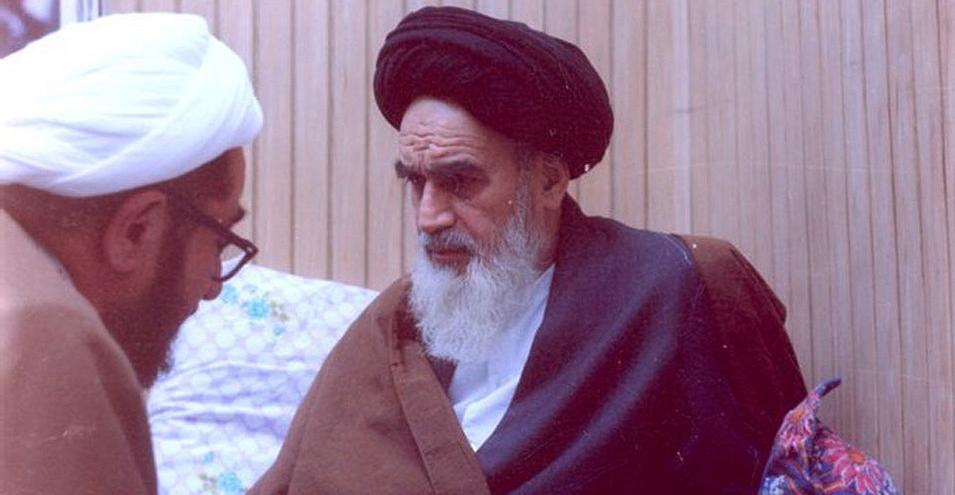
A CIA document states that half a century ago, a Qom scholar who was under house arrest in northern Tehran contacted the US government, away from the watchful eyes of SAVAK.
Ayatollah Darband was not one of the great Iranian authorities of that time, but he was the most vehement of all of them in his attack on the Shah's "White Revolution"; a controversial socio-economic reform program that gave Iranian women the right to vote and divided the lands of many feudal lords among their subjects.
The Shah's opponents called his reforms a demagoguery ploy. The Ayatollah, however, shouted that Islam was in danger.
He declared Nowruz 1962 a national day of mourning because “Jaber’s regime intends to ratify and implement equal rights for men and women.”
A year later, in a strongly-worded sermon that led to his arrest, he questioned the Shah's religion and faith and called him an agent of Israel, but did not say a word against his main supporter, America.
But the cleric mentioned in the CIA's secret document "Islam in Iran," who was none other than Ayatollah Khomeini, after several months of imprisonment in Qasr and Hasr prison in Qaytariyeh, Tehran, in mid-November 1963 quietly sent a message to the John F. Kennedy administration so that his verbal attacks would not be misinterpreted because he supported American interests in Iran.
Message summary
The report from the US Embassy in Tehran, which contains the full text of Ayatollah Khomeini's message, is still kept classified in the US National Archives, but a summary of the message is included in the document "Islam in Iran."
This document is actually an 81-page CIA investigative report – dated March 1980 – and it also includes the records of Ayatollah Khoei, Ayatollah Shariatmadari, and Ayatollah Khomeini.
The CIA declassified the report in 2005, but censored several sensitive sections, including the paragraph regarding Ayatollah Khomeini's message.
In December 2008, the Jimmy Carter Presidential Library released another digital version of the document, in which this paragraph appears uncensored, but until now it has remained hidden from most historians and researchers.
BBC Persian is publishing it publicly for the first time.
“Khomeini explained that he did not oppose American interests in Iran. On the contrary, he believed that the American presence in Iran was necessary to provide a balance against Soviet and possibly British influence.”
According to this document, the message was delivered to the US Embassy in Tehran about 10 days before Soviet leader Leonid Brezhnev's visit to Iran by an apparently apolitical cleric named Haj Mirza Khalil Kamaraei.
“He also explained his belief in close cooperation between Islam and other world religions, especially Christianity,” the document states.
The author's research shows that the message reached Washington on November 6, 1963 - exactly four days after the government shot two Tehran barge leaders, Tayyeb Haj Rezaei and Esmaeil Haj Rezaei, for their involvement in the protests of June 15, 1963 in Tehran's Heshmatiyeh barracks.
It is unclear whether the Democratic president read Ayatollah Khomeini's message; Kennedy would be assassinated in Dallas, Texas, about two weeks later.
- “I am not one of those mullahs”
Ayatollah Khomeini was released in Farvardin 1964. The Etelaat newspaper wrote that he had compromised with the government. Ayatollah Khomeini was not a man of compromise, but he showed leniency according to the requirements of the time.
A few days after returning to Qom, he denied the news from the "dirty" newspaper and told the people about the story of the expedient retreat:
"A person I don't want to name came and said, 'Sir, politics is about lying, deceit, fraud, trickery, in short, it's a betrayal of the father, and you leave that to us.'"
It seems that the official in question was Brigadier General Hassan Pakravan, the head of SAVAK, who opposed the execution of Ayatollah Khomeini and visited him several times while he was under house arrest. Major General Pakravan was the second head of SAVAK and was among the first group of high-ranking officials of the royal regime to be executed in Farvardin 1358.
Ayatollah Khomeini added: “Since it was not the right time, I did not want to argue with him. I said that we have not been involved in this policy that you are talking about from the beginning.”
Now, when the time was right, Ayatollah Khomeini clarified: “By God, Islam is all politics. They have presented Islam in a bad light.”
"I'm not one of those clerics who sits here and says the rosary. I'm not a pope who... doesn't have to do other things."
Despite this, Ayatollah Khomeini was isolated in those days. Many of the better-known religious leaders of the time, such as Ayatollah Shariatmadari, were not seeking renewed conflict with the government.
The Shah's reforms had also found support; serfs wanted land and half the country's population wanted the right to vote. Attacking the Knowledge Corps and the Health Corps was not an effective way to attract Mossadegh's educated supporters or the Tudehs in the cities.
Perhaps this is why Ayatollah Khomeini is deliberately targeting America with his attacks, the same Americans who, in collusion with Britain, the army, Ayatollah Behbahani, and Shaaban Jafari, overthrew the government of Mohammad Mossadegh, but who were most angered by the Iranian people.
"Sir, all our troubles are from America," Ayatollah Khomeini said in his famous speech on November 24, 1964.
The speech was held at his home and was full of passion and emotion: "To Allah and to Him we return."
“… I’m sleep deprived, I’m upset. My heart is in pain.”
The National Assembly and Senate had just approved Iran's request to receive a $200 million military loan from the United States and grant immunity from prosecution to American military advisors. Opponents called it a shameful concession and a revival of capitulation.
Ayatollah Khomeini is late in learning about the incident, but reacts quickly: “They sold us. They sold our independence.”
The audience was crying and the speaker's tone was getting harsher: "America is worse than England, England is worse than America, the Soviet Union is worse than both, all are worse than each other."
"The President of the United States should know, should understand the meaning of being the most hated person in the world in the eyes of our nation."
The speech led to the arrest and exile of Ayatollah Khomeini, first to Turkey and then to the city of Najaf in Iraq. It was in Najaf that he proposed the theory of the Guardianship of the Jurisprudent. According to what he explicitly states in his book, Guardianship of the Jurisprudent and the Great Jihad: “Just jurists should be the leaders and rulers, implement the rulings, and establish the social order.”
It seems that Ayatollah Khomeini in Najaf did not expect his dream of becoming ruler to come true so soon, because in his book "The Guardianship of the Jurisprudent and the Greater Jihad," he explicitly stated that "this is a goal that requires time."
He writes: “The Caliph said to an old man who was planting walnut seedlings: ‘Old man! Are you planting walnuts that will bear fruit in 50 years and after your death?’ He replied: ‘Others planted them, we ate them. We plant them, others eat them.’”
The founder of the Islamic Republic, however, unlike that old man, not only planted, but also harvested and ate the crop in less than 15 years, in his own words.
Ayatollah Khomeini was expelled from Iraq in the fall of 1978 and settled in the suburbs of Paris. More than a decade of his media isolation in France finally ended, and he soon gained international fame as the popular leader of a large coalition of opponents of the Shah.
The “Imam” of Iranian Islamists, nationalists, and Marxists had now achieved mythical popularity; millions of Iranians gazed up at the sky one night, hoping to see his face on the crescent moon.
On the eve of his return to Iran, Ayatollah Khomeini did not speak about his theory of Velayat-e-Faqih. To those who were somewhat suspicious of his intentions and asked whether we would go from under the boots of tyranny to under the sandals of tyranny in the revolution, he would say: “If you see the Islamic government, you will see that dictatorship does not exist at all in Islam.”
The Iranian revolutionary leader is not leaving America without his promises either. According to a new set of Carter administration documents that have been declassified after 35 years, Ayatollah Khomeini and his aides were deeply afraid of a repeat of the August 18 coup scenario: that the White House would order the Iranian military to crack down at the last minute and disrupt their plans.
For this reason, in Noufal, Lechateau once again adopted a policy of quiet interaction with the United States; of course, not through Hajj Mirza Khalil Kamarai, but through Ebrahim Yazdi, a member of the Freedom Movement who had lived in Texas for years and understood the American language well.
Ayatollah Khomeini's promises to the Carter administration were detailed and specific. For example, according to a document dated January 19, 1979, he responded to Washington that the Islamic Republic would not close the oil taps to the West; would not export the revolution to the region, and would have friendly relations with the United States.
He personally sent the message: “You will see that we have no particular enmity with the Americans, and you will see that the Islamic Republic, which is based on Islamic philosophy and laws, will be nothing other than a humanitarian (government) and will contribute to the cause of peace and tranquility for all humanity.”
Source: BBC