One-year history of the "JCPOA"
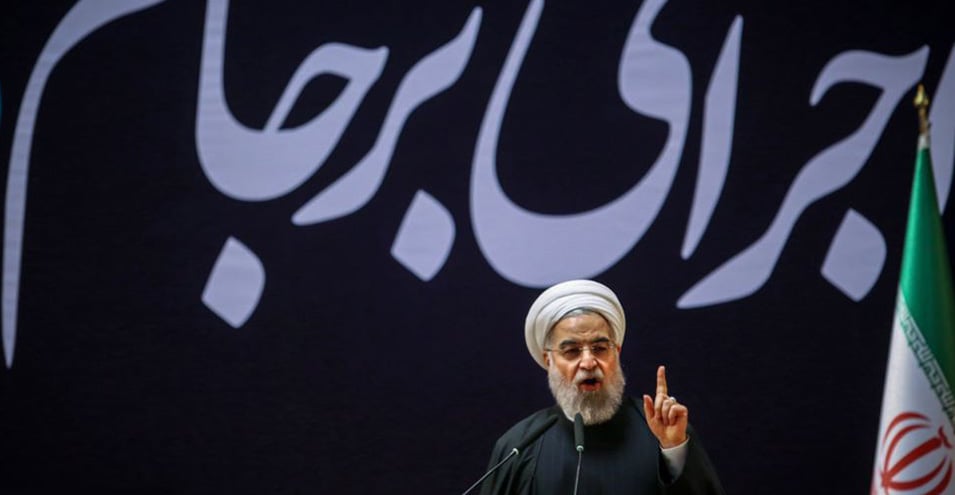
January 17 marks one year since the implementation of the Joint Comprehensive Plan of Action (JCPOA). Iranian public opinion, a significant part of which celebrated the signing of the JCPOA and considered its implementation to be the beginning of an opening in its economic life, has lost its previous enthusiasm and appears tired and disappointed on the one-year anniversary of this event.
Given the often surprising obstacles that have arisen in the way of implementing the JCPOA and the risks that weigh on its future, this despair and fatigue are entirely understandable.
But despite the doubts that prevail over the performance and future of the JCPOA, hasty and emotional judgments about it should be avoided. The achievements and failures of this agreement should be examined in light of the multitude of complexities in Iran, the Middle East, and the world. Iran is going through one of the most complicated and dangerous passages in its contemporary history. The Middle East is burning in the fire of the greatest tensions in its past hundred years. The global system of international relations has also been shaken by political developments, including in Europe and the United States, and without rebuilding its foundations, maintaining international security in order to avoid uncontrollable explosions will be impossible.
The JCPOA, contrary to what its opponents across Iran’s political spectrum say, is not “much ado about nothing.” Nor, contrary to what its ardent supporters expected, can it be the solution to Iran’s countless pains. This agreement is the result of circumstances that emerged under the pressure of crippling economic sanctions against Iran and was born from actions and reactions, both within the Islamic Republic and within the sanctioning powers, in the twists and turns of countless bargaining between the two sides of this transaction. Its achievements are undeniable. Its limitations are clearer than the sun. Its future is also shrouded in a halo of ambiguity.
If there were no "JCPOA"...
The nuclear talks between Iran and the P5+1 group, if they did not come to fruition, could have very ominous consequences for the country in terms of geostrategy and could pose very serious threats to its security. Some powerful countries in the region were counting on this scenario to finish off Iran. But even if we leave aside the scenario of a possible war if the nuclear talks failed, and limit ourselves to the economic consequences of the failure of the talks, there is no doubt that the intensification of sanctions could almost certainly have brought about the following results:
1) Iran's oil exports will fall to a level of 200 to 300 thousand barrels of oil per day.
Two) The country's foreign exchange receipts will fall further and, consequently, the dollar will irresistibly rise to a level above ten thousand tomans.
3) The inflation rate will rise above 100 percent.
Four) The severing of the remaining bridges of communication between Iran and the outside world in the financial arena, the skyrocketing cost of all types of transactions with the outside world, the further collapse of the wheel of economic activity, the fall of Iran's growth rate to a negative level of less than ten percent, and the growing mass of the unemployed.
5) The "Venezuelanization" of Iran's economy, with the difference that Venezuela is located in a more or less tension-free geographical area, while Iran is surrounded by the most serious regional turmoil.
In the camp of opponents of the Islamic Republic, there are those who believe that the failure of the nuclear talks and the Islamic Republic's further sinking into a whirlpool of economic and social difficulties could pave the way for Iran's liberation from the theocracy and its progress toward democracy and progress.
This notion not only ignores the painful and enduring wound of economic sanctions on Iran and Iranians, but also forgets that the failure of the nuclear talks, by further radicalizing the internal and external environment of the Islamic Republic, could have led to the further isolation of the country and the strengthening of the position of the most radical factions of the country's ruling apparatus, and paved the way for even more severe repression of civil society in Iran. It is no coincidence that these same factions were impatiently awaiting the failure of the nuclear talks, and are still talking about the futility of the "JCPOA."
Achievements of the "JCPOA"
It is quite natural that those within the country, due to their affiliation with certain factions in the Islamic Republic, would consider the JCPOA to be completely fruitless. Beyond these, those who say that the JCPOA was a sterile agreement and did not bring any positive results for the Iranian economy interpret and interpret the realities of the country and its international relations as they wish. In the year since the implementation of this agreement, the JCPOA has been able to provide better breathing space for the Iranian economy in a number of areas. Here are a few examples:
1) Iran’s oil production and exports have more or less returned to pre-sanctions levels. Iran’s oil and condensate exports in December doubled compared to the sanctions period, reaching around 2.8 million barrels per day. This has given Iran a stronger position in its confrontation with Saudi Arabia to maintain its share of global oil production. In addition, all sanctions on tankers, including insurance, have been more or less lifted.
2) The countdown to Iran’s first oil and gas tender has begun, with 29 major European and Asian companies approved by the Ministry of Oil to participate in the tender. If the tender, which is scheduled to be held in about two months, does not encounter any surprising problems, Iran will be able to secure some of the capital and technology needed to restore and develop its oil and gas resources.
Third) Another consequence of the JCPOA is the signing of two very important contracts for the purchase of one hundred and eighty aircraft from the American consortium Airbus and the American company Boeing. The contract with Boeing can be considered the most important agreement between Iran and the United States in the years after the Islamic Revolution. The value of this contract is stated to be nearly seventeen billion dollars, but what makes it more important is its "symbolic" importance.
Symbols are very important in relations between countries, especially those that have been in tension with each other for years. In the pre-revolutionary era, the National Iranian Airline (Homa) became one of the leading and most prestigious companies in the developing world in the field of civil aviation with Boeing aircraft. This era ended due to the Islamic Revolution and the price-gouging incident at the US embassy, and there has been no direct deal between Iran and Boeing since four decades ago.
The agreement that Iran has signed with Boeing after this long period is not just a commercial agreement. A passenger plane is not an ordinary commodity that ends with a simple process of buying and selling. American Boeings have a long history of service and spare parts, and they provide the basis for long meetings and consultations between Iran and a number of American economic circles. This is where the main importance of the Boeing contract lies.
4) The JCPOA reduced the cost of foreign trade and financial transactions, as well as the possibility of regaining oil revenues for Iran.
5) Overall, the signing of the JCPOA has helped improve Iran's international image as a country with a brilliant history and enormous potential. The significant increase in the number of foreign tourists in Iran is one of the most important manifestations of this transformation. A more important consequence is the new outlook of foreign investors towards Iran. However, transforming this outlook into a practical initiative for investing in Iran requires other conditions that are not yet available due to the limitations of the JCPOA and Iran's internal deadlocks.
Limitations of the "JCPOA"
Those at the top of the pyramid of power in the Islamic Republic, who, due to their lack of understanding of the requirements of international relations and without considering national interests, plunged Iran into the whirlpool of crippling international sanctions, bear a very heavy responsibility towards future generations. The wounds inflicted on Iran's economy by the sanctions of the past few years will not heal overnight simply by signing an agreement called the "JCPOA."
Following the signing of this agreement, expectations about its consequences rose dramatically, and the false impression was formed that with this event, Iran had miraculously set itself on a new path. But Tehran’s business circles soon gave up on their fantasies. About five months ago, the “Market and Money Commission” of the Iranian Chamber of Commerce warned in a report that “until the sanctions are fully lifted, in an optimistic scenario, the Iranian economy will be caught up in their consequences for at least a decade.”
Now, the "JCPOA" does not mean "complete lifting of sanctions." The "JCPOA" only concerns the lifting of sanctions related to Iran's nuclear program (known as secondary sanctions), and its provisions have so far been respected by both the Islamic Republic and the member states of the group known as the "Five Plus One." Instead, what has not received enough attention in domestic and foreign economic circles is the set of so-called "primary" sanctions that were implemented by the United States against Iran in the years following the Islamic Revolution, in relation to issues such as "terrorism" or "human rights."
It is these "initial sanctions" that prevent Iran from using the potential of the "JCPOA", including attracting foreign capital and technology. This is explained by the fact that immediately after the grounds for signing the "JCPOA" were prepared, large European and Asian companies began to flock to invest in Iran, and large economic delegations lined up to enter the country. However, it did not take long for the enthusiasm of foreigners to enter Iran to cool down in the face of the difficulties caused by the "initial sanctions".
The most important problem is the reluctance of major European banks to provide credit lines for investment projects in Iran. Following the imposition of heavy fines by the US judiciary against several European banks (in particular, a fine of nine billion dollars against the French bank BNP), participation in transactions with Iran has become a nightmare for these banks. It goes without saying that without the support of banks, investment in Iran will be very limited. Also, without this cooperation, all operations related to trade and investment, including obtaining insurance and bank guarantees and opening credit, will face difficulties.
On the other hand, conducting dollar transactions with Iran faces many obstacles. In addition, the regulations governing the activities of Iranian banks in various fields, including money laundering, are not in line with international regulations, and this is also a major obstacle to European banks cooperating with investment projects in Iran.
But the most important obstacle to foreign investment in Iran is the highly critical stances of US President-elect Donald Trump regarding the “JCPOA.” One can be optimistic and consider his promise to “tear up the JCPOA” as a mere election slogan that is not necessarily going to become the policy of the next US president. But even if we do not take “tearing up the JCPOA” seriously, we cannot ignore the fact that a number of Mr. Trump’s colleagues have spoken of a fundamental “revision” of the agreement.
Whatever the case, this huge ambiguity weighs heavily on the "JCPOA," and until the White House's policy on this agreement is clarified, Iran cannot become an attractive and safe country for foreign investors.
In addition to all these deterrent factors, one must also consider the difficulties arising from Iran's legal, political, and economic structures. This is another story in itself.
Source: Radio Farda