Human Rights Situation in Iran, Subject of Meeting in German Capital
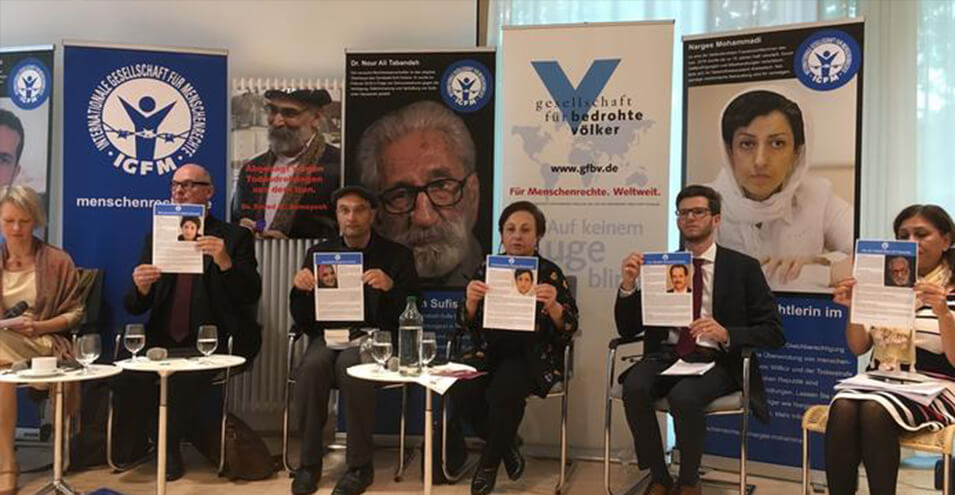
On Thursday, August 30, the “Dignity Center” and the “International Society for the Defense of Human Rights” based in Frankfurt, Germany held a meeting on the human rights situation in Iran. The special guest of this meeting was Shirin Ebadi, Nobel Peace Prize winner.
The opening section of the session was dedicated to brief speeches and answering journalists’ questions. In this section, in addition to Shirin Ebadi, Martin Lüstnin, spokesman for the executive board of the International Society for the Defense of Human Rights, was also present.
According to Helmut Gabel, press spokesman for the Dignity Center and session moderator, Seyyed Mostafa Azmayesh, an activist of the Gonabadi Dervishes living abroad, was supposed to participate in the meeting, but since he has been threatened with death, French police advised him to refrain from attending the Berlin meeting.
Martin Lüstnin in his brief remarks expressed regret that Mr. Azmayesh could not participate in this program and said: “Although the Iranian government has deprived Iranian citizens of the right to freely choose their religion and faith, and has restricted the rights of women, religious and ethnic minorities, many human rights activists continue to defend civil rights, individuals who are admirable.”
He further emphasized that the International Society for the Defense of Human Rights has “not turned a blind eye to human rights violations in Iran and through programs like this Berlin meeting and by contacting German politicians” and encouraging them to pay attention to the human rights situation in Iran, it fulfills its share in promoting respect for citizens’ rights in Iran.
Text Submitted to the Meeting
Further in the press conference, Helmut Gabel read a text that Mostafa Azmayesh had sent for the Berlin meeting. Azmayesh in this text discussed the introduction of the Gonabadi Dervishes, the detention and house arrest of Noor Ali Tabandeh, the leader of the Gonabadi Dervishes, the situation of imprisoned Dervishes and their protests in prison.
He also provided explanations about the reason for the Islamic Republic’s hostility toward the Dervishes and recalled that Saeeid Imami, a Gonabadi Dervish, called them among the worst opponents of the Islamic Republic, and Ayatollah Hashemi Shahroudis during his tenure as head of the judiciary issued orders for serious confrontation with the Dervishes.
Shirin Ebadi’s Speech
The Nobel Peace Prize winner in her brief remarks, while emphasizing that the Islamic Republic has violated human rights for decades, expressed regret over Azmayesh’s absence and said that she herself has been threatened with death many times but believes one should not withdraw from the arena of struggle for human rights due to such threats. She stated: “Participating in this meeting could also pose a threat to my life, but I am not afraid. Although I am not a Dervish, I have come to defend the rights of the Dervishes.”
Ebadi then addressed the situation of the Dervishes and said that they are also Shia but their interpretation of Islam differs from the government’s official interpretation and “for this reason they have incurred the government’s wrath.”
According to Ms. Ebadi, the Islamic Republic has forced Noor Ali Tabandeh into house arrest to designate five people who are in contact with security agencies to handle the affairs of his followers.
Ebadi asked the Islamic Republic to allow Tabandeh to meet with his followers so that it can be determined whether the selection of these people was voluntary or was made under government pressure.
Shirin Ebadi also referred to the abnormal situation of the Gonabadi Dervishes who have been sentenced to long prison terms and said: “Seven of them are in Qarchak prison in Varamin, a prison that does not even have clean drinking water.”
The special guest of the session on the human rights situation in Iran stated that the Islamic Republic learned about this program and “this morning (August 30) security forces visited Noor Ali Tabandeh to take pictures with him and if necessary publish them and make it appear as if he is not under house arrest and under pressure.”
Questions and Answers
A colleague from the French news agency asked Shirin Ebadi for her views on the new American sanctions, recent months’ protests, and the prospects of the pro-democracy movement in Iran.
Ebadi responded that she opposes economic sanctions because they make the Iranian people poorer and also pave the way for more abuse by government affiliates.
She called for political and media sanctions against the Islamic Republic, meaning that Europeans should sanction government leaders and the Revolutionary Guards and prevent them and their capital from entering foreign countries.
In her view, European countries can, in addition to this, by preventing the Islamic Republic’s use of satellites, “stop the government’s propaganda and hate-mongering in the region.”
Ms. Ebadi, in response to another question from a colleague of the French news agency, emphasized: “The pro-democracy movement in Iran has existed for years but has always been suppressed. Now people are tired, they go to the streets and protest, but they do not resort to violence. I am confident that democracy will soon prevail in Iran.”
In this regard, she said: “Within the government there are people who have more sense and know that the continuation of these conditions is not in anyone’s interest.”
Second Part of the Program
In the second part of the session reviewing the human rights situation in Iran, in addition to Shirin Ebadi and Martin Lüstnin, Suhaila Hadipur representative of the Erfan-e Halgheh, Kamal Seyedu from the Society for the Defense of Threatened Peoples, Yasha Noltenius from the Bahai Society of Germany, Pastor Gottfried Martens from the Iranian Protestant Community in the Steglitz-Zehlendorf district of Berlin and two Iranian Christian converts who have taken refuge in Germany participated.
This part of the program, which resembled a roundtable, began with a symbolic action. Each of the participants for one minute held up small posters, each of which bore the image of a political prisoner including Narges Mohammadi, Nasrin Sotoudeh and Abdolfattah Soltani, and called for their release and the release of all political and conscience prisoners.
The participants then discussed specific examples of human rights violations in Iran, including the prohibition of university education for Bahaíis and the prevention of their business activities in various cities, the trial and treatment of Taheri, founder of Erfan-e Halgheh, the Islamic Republic’s violent attempts to prevent the activities of Christian converts and Iran’s interference in the region, particularly Syria.
At the end of the program, an opportunity was provided for questions and answers, and the participants answered questions from the audience regarding human rights violations in Iran.
Program Initiators
The session reviewing the human rights situation in Iran on August 30 in Berlin is just one of the activities of the International Society for the Defense of Human Rights based in Frankfurt and the Dignity Center in Hannover.
The International Society for the Defense of Human Rights was established in 1972 with the aim of defending human rights in socialist countries known as the “Eastern Bloc.” Today, this organization specifically defends individual and social freedoms, especially for religious minorities.
The Dignity Center also persistently strives to raise awareness about human rights violations in the Islamic Republic. According to this center’s bylaws, its main objective is to work toward establishing a democratic government in Iran, one that accepts various and conflicting cultures, religions and viewpoints and is dedicated to the peaceful coexistence of all social classes.
In recent months, the two mentioned institutions held several joint meetings regarding the human rights situation in Iran.
Source: DW