Trump: We Will Make the Strait of Hormuz American Territory; A Claim That Escalates Tensions with the Islamic Republic to a New Level
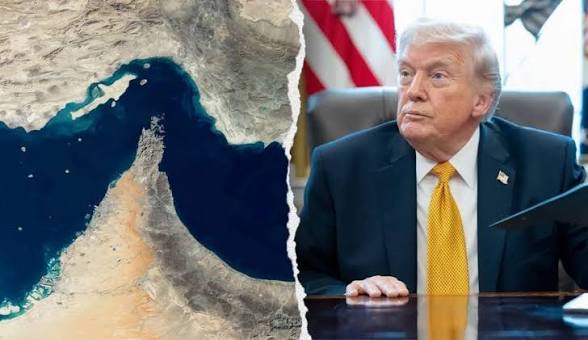
Donald Trump, the U.S. President, has once again raised the idea of declaring the Strait of Hormuz as “U.S. territory” and has claimed that Washington now has “complete control” of this waterway. These statements, amid the stalemate in negotiations with the Islamic Republic, a severe decline in ship traffic, and growing concerns about the future of one of the world’s most important energy routes, have escalated tensions between Tehran and Washington to a new phase.
Donald Trump, on Monday, August 17 (August 26 in the Persian calendar), during a conversation with reporters at the White House, once again defended the idea of declaring the Strait of Hormuz as American territory. He described this idea as “excellent” and said Washington currently effectively controls the waterway.
Trump said in this regard: “We control it now. We control it with a naval blockade and I love the idea of declaring it American territory.” He further emphasized: “We have complete control over the Strait of Hormuz.”
These remarks came one day after the expiration of the 60-day agreement between the United States and the Islamic Republic; an accord that was supposed to pave the way for broader negotiations to end the war and reopen the Strait of Hormuz, but ended without reaching a final agreement.
Trump also said he has no intention of extending the agreement framework with the Islamic Republic and once again called on Tehran to accept Washington’s desired conditions.
In explaining his claim about controlling the Strait of Hormuz, Trump referred to U.S. naval operations against the Islamic Republic.
He said the Islamic Republic can still create problems, including mining the waterway, an action that he said could be extremely dangerous for commercial vessels.
Trump said in this regard: “Nobody wants their billion-dollar ship damaged by hitting a mine.” He also emphasized: “The naval blockade has been completely effective.”
The U.S. President also claimed that millions of barrels of oil are currently passing through the Strait of Hormuz and said if the situation changes, more oil could pass through this waterway.
Trump added: “If you look at the numbers and figures, you’ll see that the Strait of Hormuz is open and oil prices are falling and this decline will continue; unless we decide to do something much more severe than what we’re doing.”
However, this picture differs from some independent data about the state of shipping in the Strait of Hormuz. The Wall Street Journal reported that despite Trump’s claim of “complete control” over the strait, the number of ships passing through this waterway has declined sharply. According to ship tracking data, on one recent day only 14 vessels passed through the strait; whereas before the war this figure was over 130 ships per day.
The newspaper also reported that many ships continue to choose routes that are subject to the capabilities and threats of the Islamic Republic and the presence of the U.S. Navy alone does not mean complete control of traffic in the waterway.
Trump, in another part of his remarks, once again targeted the economic and military conditions of the Islamic Republic. He said in this regard: “The Islamic Republic is in big trouble.” Trump also claimed that the Islamic Republic faces 300 percent inflation and added: “Their country is in chaos, their army is completely defeated, and the Iranian regime is in big trouble.”
The U.S. President has repeatedly attempted in recent days to present economic and military pressure against the Islamic Republic as a sign of Tehran’s weakness; while negotiations to end the war and establish a mechanism for reopening the Strait of Hormuz have remained inconclusive.
Trump’s idea about the Strait of Hormuz was not first raised in recent days. On Friday, August 14, in New York, he had said that after the Islamic Republic’s defeat, he intends to declare the Strait of Hormuz as “U.S. territory” soon.
Trump had said in that speech: “Essentially it is. We have a naval blockade and no vessel can pass without our consent.”
But just a few hours later, a senior White House official told the Wall Street Journal reporter that Trump had not held a meeting with his advisors before raising this issue and was “joking” when expressing it. However, the repetition of this idea at the White House on August 17 indicates that the matter, at least at the level of public statements by the U.S. President, has gone beyond a single remark.
This is while Trump has previously also used the term “Trump Strait.” He had said in one of his speeches that the Islamic Republic should open the “Trump Strait” and then explained that he meant the Strait of Hormuz.
He had said at that point: “First I said ‘Trump Strait,’ I meant the Strait of Hormuz. Sorry, that was a very bad mistake. Fake news will say I said this by accident; nothing about me is accidental.”
The claim of converting the Strait of Hormuz into American territory differs fundamentally from claims of military presence or control from a legal standpoint. The Strait of Hormuz lies between Iran and Oman, and its coastal waters are under the sovereignty and jurisdiction of the coastal states.
According to the United Nations Convention on the Law of the Sea, a coastal state’s sovereignty extends to its territorial waters up to a limit of 12 nautical miles. Furthermore, regarding straits used for international navigation, this convention stipulates that it does not change the legal status of the waters and the sovereignty of coastal states.
Therefore, mere military presence or the imposition of a naval blockade cannot by itself create U.S. ownership or sovereignty over the Strait of Hormuz. This distinction between operational control and territorial sovereignty is one of the most important legal aspects of Trump’s recent statements.
The importance of this dispute is not limited to Iran and the United States. The Strait of Hormuz is one of the most vital energy corridors in the world. According to the latest data from the U.S. Energy Information Administration, in the first half of 2025, an average of approximately 20.9 million barrels of oil passed through this strait daily, equivalent to about 20 percent of global petroleum consumption and close to one-quarter of oil traded via sea. For this reason, any prolonged disruption to ship traffic could have consequences beyond the region; from energy prices and transportation costs to inflation and energy security in various countries.
In recent days, oil markets have also reacted to escalating tensions between Tehran and Washington. The Wall Street Journal reported that on August 17, the price of Brent crude oil rose approximately 2.7 percent and reached $90.87 per barrel; meanwhile, West Texas Intermediate crude also rose 2.5 percent.
In response, officials of the Islamic Republic have rejected the U.S. claim about the Strait of Hormuz. Kazem Gharibabadi, Deputy Foreign Minister of the Islamic Republic, in response to Trump’s remarks, said: “The Strait of Hormuz was Iranian, is Iranian, and will remain Iranian.”
This position shows that Tehran views any Washington attempt to impose control or change the legal status of the waterway as a direct threat to its sovereignty. Meanwhile, the Islamic Republic and Oman have discussed a mechanism for managing commercial traffic through the Strait of Hormuz; a measure that could help restore some commercial shipping, but Washington opposes any arrangement that would consolidate Tehran’s effective control over ship traffic.
Trump’s latest remarks came at a time when the 60-day agreement between the United States and the Islamic Republic has expired and no accord has been reached to end the war and fully reopen the Strait of Hormuz.
On the other hand, Trump’s threat against Oman, should it create obstacles to U.S. policy regarding the Islamic Republic, has even drawn one of Washington’s allies in the region into the scope of the crisis. Trump had warned in an interview with Fox News that if Oman stood in the way of U.S. policy, Washington would take military action against this country.
This threat came at a time when Oman has been one of the most important mediators between Tehran and Washington. As a result, the Strait of Hormuz is no longer just a vital oil transit route, but has become one of the principal points of military, economic, and diplomatic confrontation between the Islamic Republic and the Trump administration.
Trump says the U.S. has “complete control” over the Strait of Hormuz and even speaks of converting it into American territory. But the ground reality is more complex.
The presence of the U.S. Navy has increased Washington’s ability to escort ships, impose blockades, and threaten the shipping routes of the Islamic Republic; but the sharp decline in the number of ships passing through shows that the strait has not yet returned to a normal and safe international route.
On the other hand, international law also makes a clear distinction between the exercise of military power and territorial ownership. Therefore, Trump’s remarks can be seen, more than anything else, as part of Washington’s maximum pressure on the Islamic Republic; a pressure that has now transformed one of the world’s most important waterways into the center of a geopolitical confrontation.
In the meantime, the longer the crisis persists, the cost of it will not fall only on Tehran and Washington; rather, energy markets, global trade, and countries dependent on oil and gas in the region will increasingly be exposed to its consequences.