The Controversial Case of Sogand Seyadi and Crown Prince Reza Pahlavi’s Message Demanding Justice
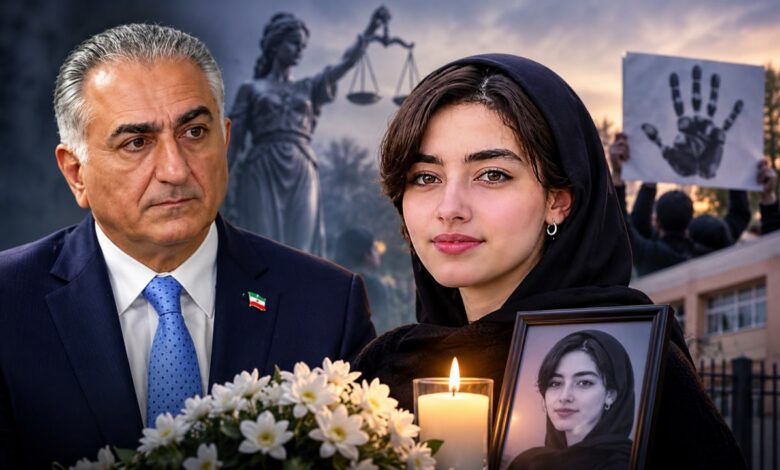
The death of Sogand Seyadi, a 16-year-old girl in Kermanshah, is not merely a legal case concerning the suspicious death of a teenager; this case represents a serious test of school accountability, the child protection system, and laws that still leave loopholes for domestic violence within the legal structure of the Islamic Republic. Crown Prince Reza Pahlavi has also issued a message regarding the demand for justice in Sogand’s case.
Sogand Seyadi, a 16-year-old student, died on Sunday, November 15, 2026 in Kermanshah. Reports published by human rights sources and media outlets indicate that before her death, she had repeatedly expressed her fear of her father and had asked school officials not to involve him in matters concerning her personal life, as she feared he might harm her.
However, published accounts suggest that Sogand’s father was summoned to the school, and after his arrival there, he allegedly beat his daughter in front of a number of students and school staff, and took her away. Hours later, Sogand died. The human rights organization Hengaw and eyewitnesses have reported that she was thrown from the fifth floor of a residential building; a narrative whose full details have not yet been definitively established by judicial authorities.
The prosecutor in Kermanshah announced on November 17 the arrest of Sogand’s father on charges including “assault and battery” and “manslaughter.” The school principal was also arrested on charges of negligence and dereliction of duty. The judicial authority announced that various hypotheses, including murder and suicide, are under investigation.
One of the most alarming aspects of this case is the question about the performance of Razevan High School and the officials who were supposed to ensure the safety of students.
Based on accounts published by Sogand’s friends, she had asked school officials not to inform her father about matters concerning her private life, as she feared his reaction. Some accounts indicate the matter involved a romantic relationship, but varying narratives have been published regarding the precise nature of the matter and what information was provided to her father, with none officially announced as a definitive judicial finding.
Reports from Hengaw and Iran Wire show that Sogand’s father beat her in front of others after arriving at the school and took her away. If these accounts are formally confirmed, the disturbing question would arise: why, after witnessing violence and hearing possible warnings from a teenager about mortal danger, was no effective mechanism implemented to prevent her return to an unsafe environment?
The Education Department of Kermanshah has presented a different narrative. According to this department’s statement, Sogand’s father came to the school on November 14 around 8:30 a.m., insisting on obtaining his daughter’s academic file and transferring her to Gilangan. In this statement, the father cited work and family problems as reasons for his request, and after completing administrative procedures, the file was transferred around 9 a.m., with the father and daughter leaving the school at 9:05 a.m. The Education Department stated that the death incident occurred in the afternoon and outside the school.
However, this explanation does not answer the fundamental question: Were school officials aware of Sogand’s fear of her father? Had she requested that her personal information not be shared with her father? Did the father beat her in the presence of school staff? And if such an incident occurred, why was no immediate action taken to protect this teenager’s life?
The Tasnim News Agency also reported, citing published accounts, that Sogand had visited the principal’s office before the incident and requested that matters concerning her personal situation not be discussed with her father. This news agency emphasized that the accuracy of the details of this account has not yet been announced as a definitive judicial finding.
Meanwhile, following the news of Sogand’s death, security agencies, in cooperation with the school principal, contacted a number of Sogand’s friends and students who may have been involved in publicizing the case using anonymous numbers and inquired about their activities. Iran Wire also reported the prevention of Sogand’s mother from attending the funeral. These matters should also be independently investigated; however, if all events are as reported, instead of accountability regarding the protection of a student, we are facing a kind of pressure on witnesses and those around her.
The director general of forensic medicine in Kermanshah Province announced that upon examination of Sogand’s body, multiple injuries were observed including fractures to the hand and foot, skull fractures, and broken teeth, and the cause of death was determined to be multiple injuries resulting from a fall from height.
However, forensic medicine emphasized that determining the medical cause of death alone does not indicate who caused these injuries or under what circumstances. Determining the cause and manner of the incident is the responsibility of judicial investigations and examination of crime scene evidence. Therefore, despite the gravity of the charges brought against the father, the final outcome of the case and the criminal responsibility of individuals must be determined based on evidence and the court’s ruling.
On the evening of November 19 and the morning of November 20, claims were circulated on social media that one of Sogand’s relatives had shot and killed or wounded her father. In some accounts, the name Milad Seyadi was also mentioned as the person who shot his uncle.
However, Hamidireza Karimi, the prosecutor of Kermanshah, strongly denied this news on Friday, November 20, stating that Kiumars Seyadi, Sogand’s father, has remained in detention since his arrest and reports of his release, shooting, and injury are not accurate. Therefore, until valid and independent evidence is published, the news of Sogand’s father being shot cannot be considered factual.
This denial is important because publishing unverified news not only can divert public opinion from the core of the case, but may also damage the judicial proceedings and the security of Sogand’s family.
Crown Prince Reza Pahlavi, in response to Sogand Seyadi’s death, considered this incident an example of the consequences of the Islamic Republic’s laws and called for an end to discriminatory and anti-human rights laws. Crown Prince Reza Pahlavi published a text regarding Sogand’s death and wrote:
“My fellow countrymen,
The murder of 16-year-old Sogand Seyadi is the latest example of crimes that every day, in every corner of Iran, backed by the rigid and inhumane laws of the Islamic Republic, take the lives of our defenseless women and children. Direct responsibility for these crimes lies with a regime that, 47 years ago, in its very early days in power, abolished the progressive “Family Protection Law” and, with its inhuman laws, paved the way for infanticide and femicide and the immunity of the perpetrators of these crimes.
Today, the Iranian nation mourns Sogand; a teenager who could have lived under the protection of law and realized her dreams. Unfortunately, this innocent girl is not the first victim of these crimes, and as long as this regime and its anti-human laws persist, she will not be the last.
I assure all women and children of Iran that after the overthrow of the Islamic Republic, these anti-human laws will immediately be abolished and replaced by laws based on human rights and equality between men and women. The transitional government is also obliged to be, from the very first day, a protector of the lives and dignity of women and children, not a supporter of murderers. In tomorrow’s free Iran, no husband, father, or guardian, under the guise of “guardianship,” will be above the law, and no woman or child will be deprived of the right to life.
Long live Iran, Reza Pahlavi”
One of the important focal points of criticism of the Islamic Republic’s legal system is Article 301 of the Islamic Penal Code. This article, under specified circumstances, exempts a father and paternal grandfather from qisas (retaliatory punishment) in the event of killing their child; a privilege that does not exist for mothers.
This exemption does not mean the father will definitively go unpunished, but it creates a fundamental difference in the possibility of applying qisas punishment, and under specified legal conditions, other discretionary punishments may be applied. Critics argue that such a ruling is incompatible with the principle of human equality before the law and children’s equal right to judicial protection.
A law that should protect a child from violence should not, because of the blood relationship between the perpetrator and the victim, grant him special privileges. Fatherhood is neither ownership of a child’s life nor permission to inflict violence. No relationship should diminish the value of a child’s right to life.
Sogand Seyadi’s case should not end with the arrest of one person and the publication of a few statements. If her warnings reached the school, it must be clarified why they were not taken seriously. If violence occurred in front of school staff and students, who prevented its continuation? If school officials shared her private information with her father, on what basis and with what assessment of potential danger did they do so?
Furthermore, clear answers must be provided regarding the status of school counselors, the mechanism for reporting domestic violence, and immediate support for students at risk. A school where a teenager sought help out of fear for her life should not become a place where her sensitive information is provided, without risk assessment, to someone she fears.
Responsibility for this case does not lie solely with one individual; a system in which violence against women and children is accompanied by legal discrimination, weak social protection, and an absence of effective preventive mechanisms must be held accountable.
Sogand lost the opportunity to defend herself; however, society must not allow the truth of her case to be buried under pressure, expediency, or conflicting narratives. Justice for Sogand means uncovering all the truth, holding all responsible individuals and institutions accountable, and reforming laws that do not guarantee the safety and dignity of children.